In 1997. Sotheby’s put a dinosaur on the block.
It was the first time.
Most attendees were museum curators, quietly hoping to expand their collections without drawing too much attention. The prize? Sue, a Tyrannosaurus Rex that found its way to the Field Museum in Chicago for $8 million. A steep price then, a steal today.
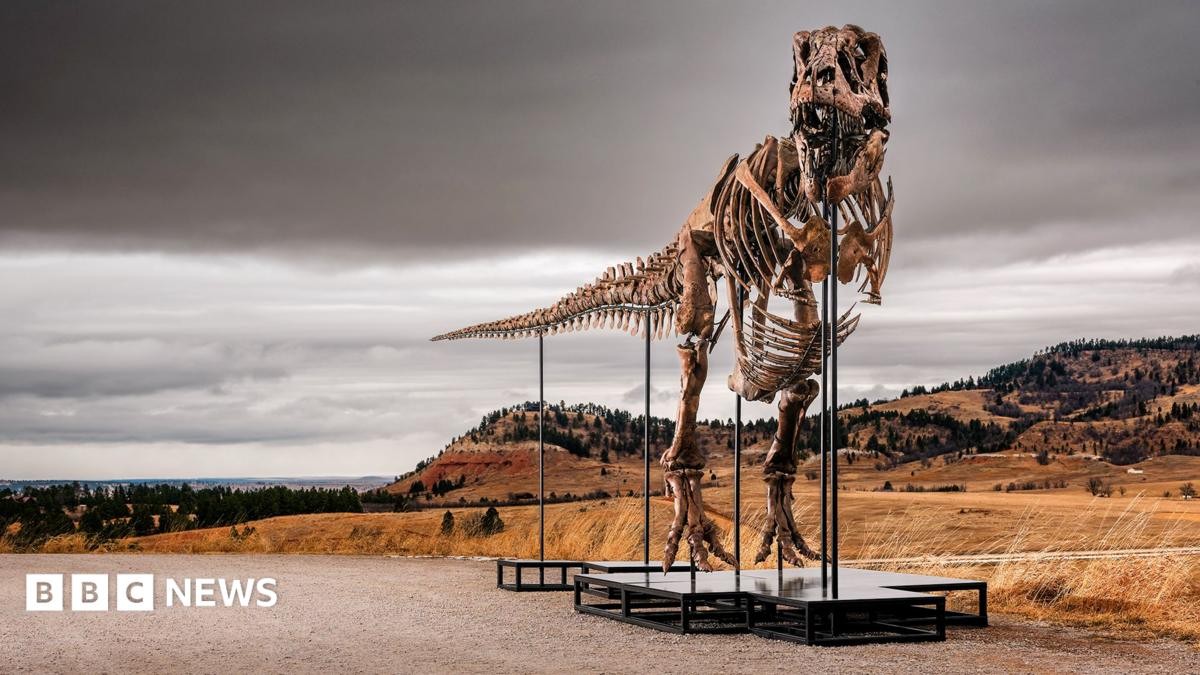
Nearly thirty years later, we have another T. rex. His name is Gus.
And he isn’t looking at eight figures.
He’s staring at thirty million dollars.
Tuesday’s auction features one of the most complete specimens ever unearthed. The valuation is staggering, the competition fierce. But this isn’t just a sale. It is a battle lines being drawn in the dirt and rock.
Who gets to own the past?
The High Price of Excavation
Cassandra Hatton runs natural history at Sotheby’s. She knows what she is selling. She also knows what it takes to get there.
“People die on excavations,” she says.
Simple sentence. Heavy truth.
Fossil hunters don’t just stroll through a garden. They spend months in South Dakota’s Badlands. Camping. Huddled in tents. Backpacks full of food, minds full of fear. Rattlesnakes lurk. Mountain lions watch. The ground freezes. They wait for spring, dig furiously, and then retreat when autumn arrives.
Three years to dig Gus. Three more to document, reconstruct, and prepare.
That’s six years of sweat. Of risk. Of waiting on the weather.
Dr Fiann Smithwick, an expert who has handled fossils for two decades, notes the danger of exposure. “Suddenly when they’re out of the ground,” he says, “they’re out of equilibrium.”
They begin to decay.
The Museum’s Dilemma
If you have the money, you can bid.
The reserve is $19 million. The valuation? $30 million.
The record is currently held by Apex, a Stegosaurus sold to hedge fund king Kenneth Griffin for $44.6 million last year. Griffin loaned it to the American Natural History Museum. It sits in the public eye, funded by private wealth.
A fair deal? Some think so. Others are furious.
Prof Susannah Maidment at the Natural History Museum in London sees a problem. “We’re already priced out of having access,” she admits.
Since 2020 five dinosaurs have shattered price records. The most famous was Stan, a T. rex that sold for nearly $32 million in 2020 against an $8 million estimate.
The science suffers.
Prof Maidment argues that fossils aren’t just pretty bones for rich collectors. They are data.
“We are in what is probably a mass extinction right now,” she warns.
The past provides empirical evidence for the present. We need anatomy. We need truth. Without access to specimens, palaeobiology— the study of past life — stagnates.
There’s no substitute for having the real fossil. If we’re going to do any sort of study the number one thing is we need to understand the anatomy
She means it literally. If you cannot touch it, check it, revisit it over decades, it ceases to be science. It becomes a curiosity. A trophy.
The Science vs. The Private Vault
Top journals won’t touch private specimens.
It is an old rule.
The concern? Access.
If a billionaire owns the bone, scientists need permission. If that billionaire divorces. Or dies. Or sells it. The research ends.
“There’s no substitute for having the real fossil.”
Wait, did I say that already? Prof Maidment said it because she feels the pain.
But here is the twist. Museums are not saints either.
Smithwick points out that institutions lose fossils too. Mary Anning discovered the Squaloraja — the fish with “curling iron eyes” — in 1829. It was donated to a museum in Bristol. Then WWII bombs turned it to dust.
Gone. Forever.
A Second Extinction?
So who saves the dinosaurs?
Hatton argues it’s the hunters. “They’re saving the dinosaurs from the second extinction,” she claims.
Smithwick agrees with the urgency, though maybe not the method. On England’s Jurassic coast, fossils erode by the wave. An impression exists today. It is gone tomorrow.
Lost.
The sea has broken it into 10,000 pieces, and that is it. It is lost forever.
Gus survives.
He has bite marks on his skull. Healed ribs. A story written in bone about a life fought fiercely in a prehistoric landscape.
Sotheby’s hopes a museum will buy him. They have been calling institutions for months. But the price is what it is.
Most of what Smithwick finds never makes an auction block. Small ammonites. Shells sold to kids on the beach. They spark curiosity.
The giants? The T. rex? They spark something else.
Desire.
Will Gus end up behind glass for public learning? Or in a climate-controlled vault somewhere?
We will know in a few hours.
The bidders are ready.