Headline black holes are monsters. Millions of suns. Billions. They anchor galaxies and blast gas into jets that stretch for light-years. Loud. Destructive. Obvious.
This one? Quiet.
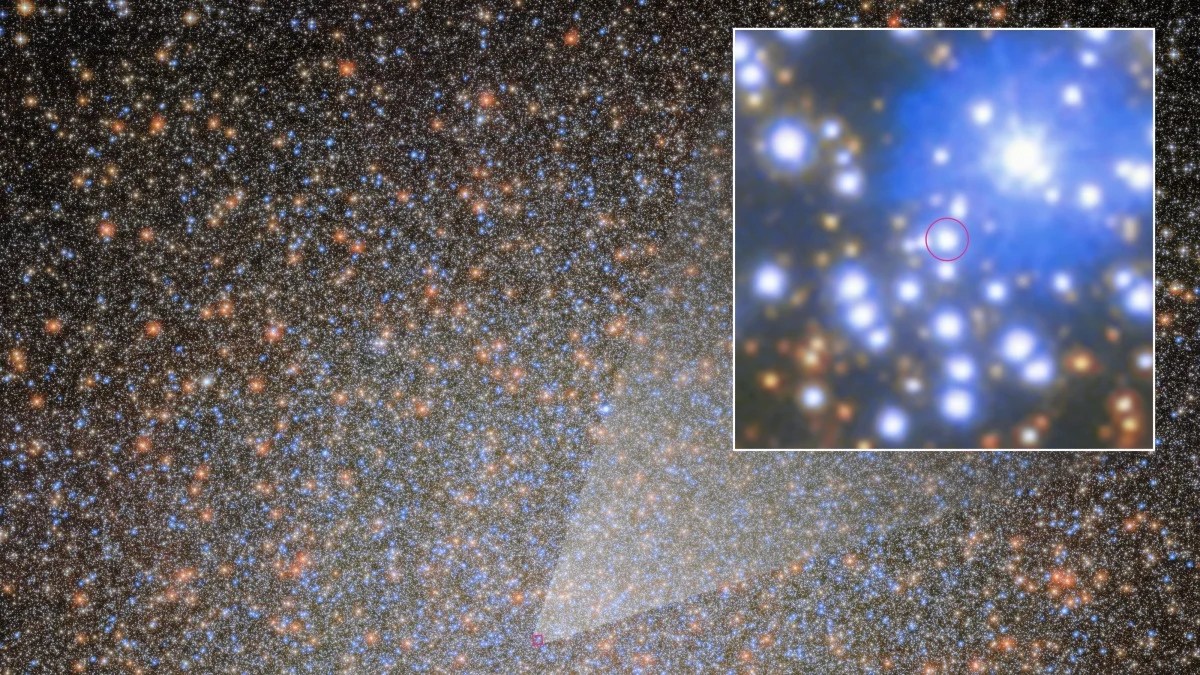
It’s tiny, really. Only 4.4 times the mass of our sun. Hidden deep inside Omega Centauri. That’s a crowded ball of stars about 15,000 light years from Earth. Astronomers call it oMEGACat-BH-2. It doesn’t glow. It doesn’t flash. It just sits there, swallowing space.
We found it using James Webb and Hubble. Not because it screams for attention. But because it pulls on things nearby.
Matthew Whitaker from the University of Utah led the team. He calls the precision “incredible.” Down to a fraction of a pixel. Without both telescopes? No discovery. Period.
“It would not have been possible to see this without Hubble and Webb working together.”
Big black holes like the one at the center of the MilkyWay (Sagittarius A) or M87 are famous now. We’ve photographed them. Well, their shadows anyway. The bright rings of gas surrounding the darkness. That’s what we see.
Stellar black holes aren’t famous. They’re common. The corpse of a giant star. A supernova leaves a wreck behind. Crushed dense matter in a compact space.
But you can’t see the wreck directly.
The team tracked an ordinary star. Half the mass of our sun? No, a bit heavier. About 1.6 solar masses actually. Wait, the data says 0.6 to 0.7. Let’s stick with the smaller estimate. It orbits far from the center. Takes nearly 100 years to make one loop.
Did it wobble?
Just barely. But Hubble and Webb saw the jiggle. Astrometry. The science of tiny shifts. 23 years of data sifted through to find one anomaly. The only thing strong enough to tug that star into a wobble was a black hole.
First time. NASA says this is the first tiny black hole found this way. Previous attempts failed.
Omega Centauri should be full of them. Models suggest 10,000 hiding in that cluster.
But clusters are violent places. Crowded. Gravity throws things out. Like stones from a slingshot. Some black holes stay. Some get ejected into the void. Who knows?
So we have one confirmed. And it surprises everyone.
It’s too light.
Computer models said otherwise. Early stars formed before heavy metals existed. Those stars should be lean. Efficient. When they die, they should leave massive black holes.
Not this one.
This black hole came from a metal-poor ancestor. But it didn’t get big. Why? We don’t know yet. Anil Seth, co-author from Utah, put it simply: We need to figure out how it happened.
Maybe our models of early stellar evolution are wrong. Or maybe this black hole had a messy life we don’t understand yet. Either way, it’s there. Quietly breaking the rules.
There might be 10,00 more like it. Waiting. Silent. Hard to find.