Stars are born messy. Dust, hydrogen gas, gravity pulls it all together. The core heats up, collapses, and suddenly? A nuclear fusion reactor ignites. The part we don’t fully grasp though, is what happens immediately after. Right when that star pops out of its natal cloud.
That’s exactly where these new images of the Whirlpool Galaxy—also known as Messier 51—come in. They’re getting astronomers closer to the truth.
It’s a blend. Data from the James Webb Space Telescope meets the older Hubble. The result shows something distinct. Big groups of stars abandon their birth clouds much faster than the small ones.
This finding is just one slice of a paper dropped into Nature Astronomy on May 6, laying out how galaxies actually shape themselves over time.
Here is the mechanism. Stars start forming. Then they start acting up. Strong stellar winds hit. Harsh ultraviolet light floods the area. Supernovas blow things apart. It’s called stellar feedback. Basically, the newborns clear out the room so fewer of them can exist.
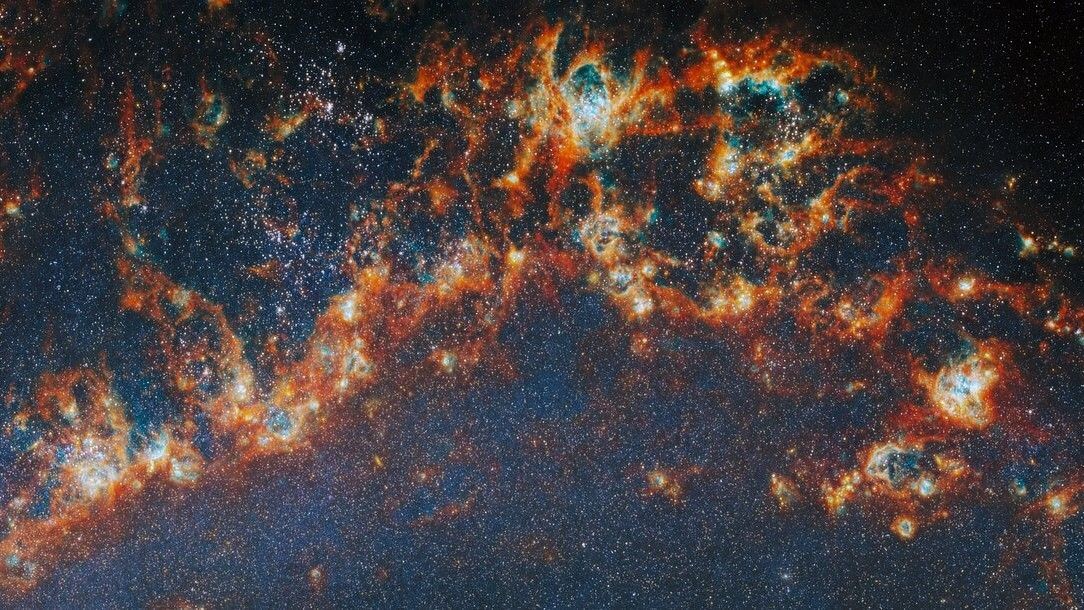
Look at the colors. Red-orange threads stretch across the frame. Blue bubbles glow from within. The white spots? Those are stars showing through the gaps in the gas. JWST sees infrared light, meaning it spotted stars hiding behind dust that regular telescopes missed completely.
When you stack all the data from the study, a pattern emerges.
Large star groups cleared their gas clouds in about five million years. Small ones took seven or eight million. That difference is huge.
Think about the early universe. It got cool after the Big Bang, electrons and protons settled into neutral atoms. Then something tore them apart again during reionization. About five hundred million to one billion years after the beginning. What caused that energy surge?
Was it the massive star clusters themselves?
Daniela Calzetti, co-author at the University of Massachusetts Amherist, doesn’t mince words.
“It had to be the formation of massives star clusters,” she said.
If those biggest clusters can burst through their birth clouds in just five million years, they had ample time. Time enough to release the photons needed to reionize the cosmos. The math checks out. The images confirm the timeline. We finally have a view into those chaotic early moments. The mystery isn’t fully solved but it’s a lot less opaque now.
We’re watching galaxies clear their throats, ready to speak their next line in the history of the universe. What they’ll say next is still up in the stars. 🌌