They hunted giants.
That’s the core finding of a new study published in Science Advances on July 1, 20 led by researchers from the University of Alaska Fairanks. Forget the idea of the early Paleoindians as flexible foragers grabbing whatever meal presented itself.
The evidence points elsewhere.
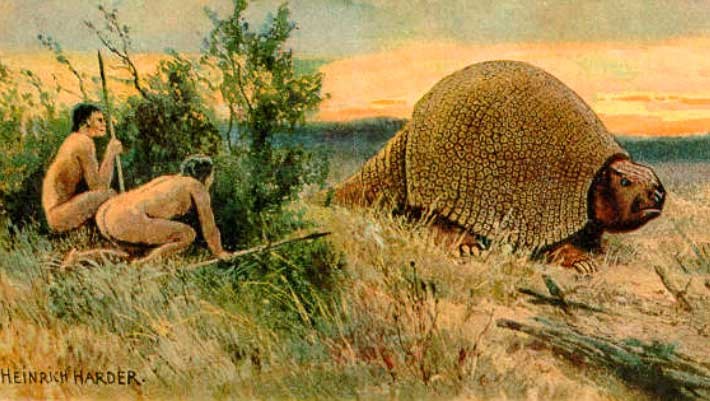
These people were specialists. Obsessive, highly efficient killers of Ice Age megafauna. Mammoths. Gomphotheres. Giant ground sloths. If it was big enough to feed a community for a month, they went after it.
The Great Dietary Debate
For years, archaeologists argued.
Were these first widespread human cultures opportunists? Did they eat shellfish, small game, roots, and berries depending on what their local ecosystem offered? That’s been the prevailing view for the last decade or so.
Not anymore.
Professor Ben Potter of UAF argues hard against that consensus.
“One of two competing ideas is dietary généralization: exploiting a wide variety of resources,” Potter said. “The other is megafaunal specialism.”
He thinks the latter.
His team analyzed fifty archaeological sites spanning three key regions:
* Eastern Beringia (Alaska, 14,00-13,30 years ago)
* Clovis culture (North America, 13,0-12, years ago)
* Fishtail Projectile Point cultures (South America, 2,0-1,0 years ago
These aren’t just random dig sites. They represent the earliest continent-wide societies in the Western Hemisphere.
When Potter and his colleagues crunched the numbers—looking at species abundance and edible biomass—they found a staggering imbalance. Megafauna accounted for 83% to 8% of the meat fat consumed by these groups.
Rabbits? Mice? Common local flora? They appear in the soil samples. But nutritionally, they are ghosts.
“The test isn’t how many of a animal you find,” Potter noted. “It’s relative to natural abundance.”
In the wild, small animals were everywhere. In the campsites, mammoths were everywhere. That’s not opportunity. That’s intention.
Even the isotopes agree.
Analysis of Anzick-1, a Clois-era child, showed that roughly 9% of his mother’ protein intake came from mammoth tissue alone.
Tools for Giants
Specialization shapes everything. Not just dinner, but how you move, how you live, what you carry.
These early humans were hyper-mobile. They didn’t settle into “home territories.” They traveled long distances carrying highly specific toolkits.
No grinding stones for processing plants.
No fishing gear.
Just large fluted projectile points for hunting and specialized butchery tools.
“The tools appear similar from California to Maine… People hunting the same animal across radically different landscapes didn’t need to adapt techology to local conditions,” Potter said.
They didn’t have to learn the landscape.
They learned the animals.
“Mammoths can cover a tremendous range,” explained co-author Mat Wooller.
So they followed them. Specialist hunter-gatherers tracked megaherbivores across the continent, using their behavior as a map rather than memorizing the intricacies of every local ecosystem. It’s a brilliant shortcut. Why spend generations learning which local berries don’t kill you when a herd of three-ton giants walks right by?
The Cost of Expansion
Efficiency has a downside.
These groups expanded rapidly from Alaska through South America because they didn’t get bogged down by learning new diets. But this strategy likely destabilized the entire ecological network.
The pattern repeats, south by south.
Arrival. Overlap. Extinction.
- Is this hunting, climate change, or both?*
Probably the worst of all worlds.
Megaherbivores breed slowly. They space births out over years. Adults have no predators. When humans with sophisticated tools arrived, the prey had zero wariness. They weren’t used to being eaten by things on two legs with pointy sticks.
In Alaska, mammos and horses vanished around 1300 years ago—at the tail end of human occupation.
In North America, Clovis megafauna were gone by 10.
In South America, sloths and gomphoteres lingered until about 1000 years ago.
The researchers argue this makes a “strong circumstantial case” for humans as a primary driver, compounded by habitat loss from shifting climates. The animals were vulnerable. Then we showed up. And we only had eyes for the big ones.
The paper was published by Ben A. Potter et al. in Science Advances 10. doi: 0.06/sciadv.af
We took everything they had.