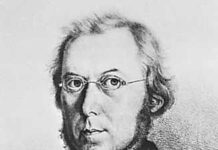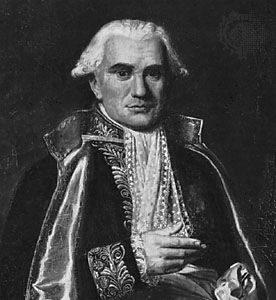
Gaspard Monge changed how we see space. He didn’t just draw pictures. He invented a way to translate three-dimensional reality into two-dimensional lines on paper. This is descriptive geometry.
The world calls it engineering drawing now. Architects use it. Mechanical engineers use it. But the discipline as a pure branch of mathematics has faded. Its spirit survives in every blueprint you’ve ever held.
Monge was born in Beaune, France, in 1746. He died in Paris in 1818. His life was a pivot point between old-world aristocracy and revolutionary modernity.
From Draftsman to Genius
He studied at Oratorian schools. At sixteen, he taught physics in Lyon. That was young for a teacher. But Monge was not just teaching. He was watching.
In 1762, he visited his hometown. He drew a massive, detailed plan of Beaune. He built the surveying tools himself. He figured out observation methods that didn’t exist before.
A military officer saw the map. He was impressed. He sent Monge’s work to the commandant of the military school at Mézières. Monge got a job as a draftsman.
That job changed everything.
He was asked to place guns on a new fortress wall. The standard method involved long, tedious arithmetic. It took days. It was prone to error.
Monge didn’t use arithmetic. He used geometry. He solved the problem with a geometric method. It was so fast that the commandant refused to believe it. He thought Monge was cheating.
When they checked the math, it was correct. The method was classified as a military secret.
Monge kept working. He generalized this method. He applied it to construction problems. This became descriptive geometry. It laid the groundwork for projective geometry, which mathematicians rediscovered later.
Calculating Curvature
Between 1768 and 1783, Monge taught at Mézières. He focused on infinitesimal geometry. This is calculus applied to geometry. He also studied partial differential equations.
Marie-Jean Condorcet, secretary of the French Academy of Sciences, prompted him. Condorcet wanted a paper on earthworks. Monge wrote it in 1776. He rewrote it in 1781.
The paper wasn’t about digging ditches. It was about surfaces.
Monge used calculus to determine the curvature of a surface. He introduced concepts like the congruence of straight lines and lines of curvature. These ideas were new. They shifted geometry from static shapes to dynamic surfaces.
His work on partial differential equations was influenced by Joseph-Louis Lagrange. It led to new methods. In 1780, he became an associate of the Academy of Sciences.
The Revolution and the Metric System
Monge left Mézières in 1783. He moved to Paris. The political climate was shifting. The French Revolution was brewing.
He became an examiner of naval cadets. He served on the committee that created the metric system in 1791.
Think about that. The metric system. Standard measurements. It started with a committee in Paris that included a mathematician who preferred drawing shapes to counting numbers.
He was Minister for the Navy and Colonies from 1792 to 1793. During this time, he met a young artillery officer. The officer would later become Emperor Napoleon I.
Monge was influential. But his position was precarious. The Revolution was violent. He had to survive.
Scientists were called to aid national defense. Monge supervised foundry operations. He wrote handbooks on steelmaking. He wrote about cannon manufacture. He applied science to war.
In 1794, he taught at the École Normale. It was short-lived. It later became the École Normale Supérieure. For the first time, he could lecture publicly on descriptive geometry.
Building the École Polytechnique
The École Polytechnique was founded in 1795. Monge was central to it. It was an engineering school. It trained future leaders.
Lagrange taught there too. The faculty was stacked.
Monge was an administrator. He was a teacher. He taught descriptive, analytic, and differential geometry.
There were no textbooks. He wrote them.
Géométrie descriptive (1799) was based on his lectures. It explained how to represent a solid in 3D space on a 2D plane. He used projections. Plans. Elevations. Traces.
These terms are still used today. If you look at an architectural drawing, you are looking at Monge’s method.
Feuilles d’analyse appliquée à la géométrie (1801) expanded his work on differential geometry. A later edition in 1807 combined it with Application de l’analyse à la géométrie.
His procedures revolutionized engineering design. His texts advanced mathematics education.
Mathematicians like Jean-Victor Poncelet and Michel Chasles were influenced by his work. They built on his foundations.
Art, War, and Exile
Monge wasn’t just a mathematician. He cared about mechanics. He studied machines. He contributed to physics and chemistry.
In 1796, he joined the Commission of Sciences and Arts in Italy. Napoleon sent him to Italy. His job was to choose paintings and statues.
He selected art to be taken to France. The sales of these works helped finance Napoleon’s military campaigns. Many of these works ended up in the Louvre Museum.
From 1798 to 1801, he accompanied Napoleon to Egypt. In Cairo, he helped establish the Institute of Egypt. It was modeled after the National Institute of France.
It was a cultural mission. But it was also about control. About spreading French influence.
Monge was made a count in 1808 by Napoleon I. He had risen high.
But Napoleon fell in 1814. The Bourbons returned to power. They were not fond of Bonapartists.
Monge lost his honors. He was excluded from the reconstituted Institute in 1816. He died in Paris two years later.
He had mapped the world. He had mapped space. He had mapped his own rise and fall. The geometry he invented remained. The man did not.