It’s January 29, 2026. You’re probably walking past a park or a frozen sidewalk and watching hooded owners running after their dogs. It looks like a scene from a comedy sketch. But it highlights a fundamental misunderstanding of dog biology. We live in a world obsessed with metrics and speed. A popular myth is that a well-behaved dog must be exhausted from jogging for miles.
See what happens next. The dog runs for an hour. It drinks water. In the living room, things go round and round. It’s ready to play again.
The problem is simple. You cannot tire out a endurance predator by simply letting it run. The secret to a calm dog lies elsewhere. It’s an activity that seems boring to humans, but is incredibly rewarding to animals.
The nose is a biological decoder
Man is a visual being. We underestimate the organ in the center of the dog’s face. To understand the gap between our species, look at anatomy. Humans have about 5 million olfactory receptors. As for dogs, there are 150-300 million depending on the breed. This is a sensory gap.
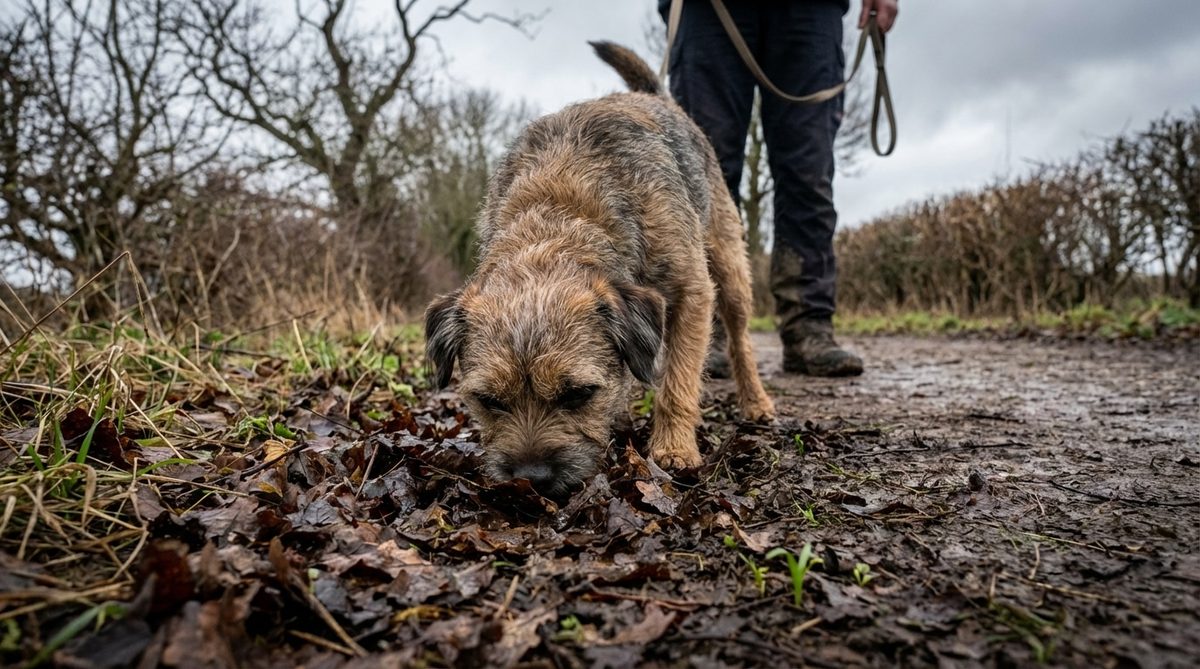
When your dog stops to sniff a blade of grass or a post, it’s not just smelling something. It reads the news. It analyzes people passing by, their gender, health and stress level. By keeping scent molecules in the cold winter air, it even knows how long ago the event happened. This is the chemical reading of the world.
The nasal cavity is connected to a disproportionately large part of the brain: the olfactory bulb. For a dog, smelling means seeing. Stopping your dog from sniffing while walking is like blindfolding a person in the Louvre. It causes great sensory frustration. This deficiency does not calm the animal, but may increase anxiety or irritability.
Mental tracking burns more energy than cardio
Herein lies the core problem. Running is a mechanical physical activity. It strains the muscles and the heart. It produces adrenaline. By exercising, the dog gains endurance. It becomes an athlete who has to run longer and longer to feel the same fatigue.
The intense mental effort required by smell analysis consumes more energy than mere physical activity and calms the nervous system. This is a physiological fact. The brain is a glucose-hungry organ. Unraveling scent trails, sorting through information, and distinguishing meaningful odors require enormous concentration.
Twenty minutes of intense sniffing is more likely to tire a dog than an hour of frantic running. In addition, the type of fatigue is different:
- Running: Can cause tension (cortisol and adrenaline rush) and make the dog nervous.
- Sniffing: Activates the parasympathetic nervous system. It promotes the restoration of peace, lowers the heart rate and provides deep mental satisfaction.
In winter, when the weather shortens walks, prioritizing scent quality over distance is a much more effective strategy for keeping your home peaceful.
A long line is the key to a zen dog
How to apply this? You have to accept the fact that you seem like a “boring” owner during the walk. Forget the military pace and strict heel command. These are only important in certain contexts. To healthily tire the animal, adopt the “decompression walk”.
This means using a long leash (5-10 meter leash) attached to a comfortable harness. Never wear a collar that pulls on the cervical vertebrae. The goal is to let the dog explore at his own pace. If he wants to smell a dead leaf for three minutes, let him. It reads the neighborhood news.
In “hyperactive” or destructive dogs, you often see a radical change when they are allowed to use their nose. Here are the simple adjustments to change gears:
- Stop pulling the leash when the dog stops.
- Vary the environment (forest, quiet urban areas, fields) to provide new “scent libraries”.
- Throw treats in the tall grass to encourage active searching when the dog is not sniffing spontaneously.
By slowing down and letting the animal express its natural tracking behavior, you will have a relaxed companion for the evening. The one who calmly snores next to the radiator with a contented mind.
Dog fatigue is not related to speed or distance. It’s all about intellectual stimulation. Rather than turning your pet into an Olympic marathon runner, the greatest gift is to give him time to read the “scent text messages” left by his peers. So put away your running shoes tomorrow. Take the long line. Let the tip of his nose guide you.