


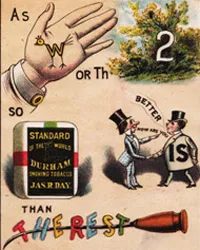
Most Americans do not encounter rebus puzzles in linguistics textbooks. In 1958, they met on the television screen. That’s when NBC launched the game show “Concentration.” The format is simple. It is based on a children’s card game called “Memory”. Players turn over two cards at a time. Match? Keep them. Doesn’t it match? Let’s turn it over and remember its location.
The twist? Solving each pair of puzzles peeled back a layer of a larger puzzle.
The slow release created a visual conundrum for a generation. The answer to the first part of the early advertisement is: “A bird in the hand is worth two in the bush.” It’s simple. Pictograms stood in for words or parts of phrases.
The Latin roots of the visual pun
The term itself is of Latin origin. More precisely, the expression “nonverbis, sed rebus”. Roughly translated, it means “not by words, but by things.” This is the mechanism. You aren’t reading a sentence. You are interpreting the picture.
This principle is not new. It’s ancient. Linguists cite Egyptian hieroglyphs as an early example. The same logic applies to Chinese characters. Ancient China probably started with drawings that looked exactly like the objects they represented.
Over time, homophones changed the game. A character for an eye didn’t just mean “eye.” Because of their similar sounds, they came to represent the word “I”. The drawings faded. The abstract symbols remained.
Modern Applications in Education
教师们并没有将这些难题留在 20 世纪 50 年代。 他们发现它们很有用。 今天的语言治疗师仍然使用画谜图像。 目标? 帮助学生学习英语作为第二语言。
它的工作原理是创建快速关联。 图像位于新词汇旁边。 或者学生画自己的图像来代表一个概念。 大脑将视觉与语言连接起来的速度比将文本与文本连接起来的速度要快。
The Rise of the Modern Rebus
还有另一种类型的画谜游戏。 一种不依赖鸟类或手的图片的方法。 相反,它将单词本身视为对象。
言语变得混乱。 它们会成倍增加。 他们被重定向。 安排创造了意义。
就拿“脚踏实地”这句话来说吧。 A modern rebus might look like this:
E E A A R R T T H H
看到图案了吗? 这不仅仅是一张图片。 这是逻辑上的排版。
这些谜题比较难。 他们需要一种不同的思维方式,而不是用一张太阳的图片来表示“晴朗”。 他们要求你阅读结构,而不仅仅是符号。
由于增加了复杂性,我们需要仔细研究如何解决它们。 我们需要更多的例子来向您展示其中的机制。
接下来,我们分解这些策略。
如何破解棘手的画谜谜题的密码
解决rebus puzzle不仅仅是猜测。 这是关于模式识别的。 它从词汇开始。 你的头脑中需要有一个习语库、流行文化参考资料和陈词滥调。 如果你不知道“up the creek without a paddle”是什么意思,那你就陷入困境了。 孩子们可能会在这里挣扎。 成年人通常具有优势,因为他们吸收了足够多的媒体和文献来识别这些碎片。
但了解这些短语只是成功的一半。 真正的技巧是将文字视为物理对象。 停止将它们作为文本阅读。 开始将它们视为形状。
Positioning and perspective clues
Look at the layout. Is “EARTH” written vertically? Is it double?
E E
A A
R R
T T
H H
Read it straight? You get nonsense. Let’s take a closer look. The word goes down. Appears twice. Combine those clues with the word itself. Be “realistic”.
Manipulation is important. Where is the word placed?
PAWALKRK
It doesn’t seem to make any sense. Break it down. The “walk” is hidden within the park. Putting a word into a word is a classic rebus move. What is the answer? “Let’s go for a walk in the park.”
Spatial relationships are huge. Words above, below or next to each other tell a story.
Arrest
You’re
Say it out loud. “Popular?” No. “Held on you?” No, turn it over. “You are under arrest.” That’s it.
The power of empty space
Empty space is not empty. This is a placeholder.
VA DERS
. ___ RANGE
Two blanks. Two concepts. The first is the “dot”. The second is “space”.
“Blank Area”
“Space Invaders”.
These puzzles are based on visual grammar. Size, orientation, repetition, and inclusion are all semantically important. If the word is small, it becomes “tiny” or “tiny.” If it is on the side, it means “across” or “across”. If you want to repeat it, say “one more time” or “twice”.
脑筋急转弯真的能让你变得更聪明吗?
我们喜欢认为他们确实这么做了。 我们购买数独书籍和填字游戏来“拓展”我们的大脑。 改善认知功能。 预防阿尔茨海默病。
2010 年发表在《自然》杂志上的一项研究却给出了相反的说法。 他们发现解决谜题和一般脑力之间没有联系。 当然,人们越来越擅长解谜了。 但这种技能并没有转移到日常任务中。 你不会因为弄坏了一个填字游戏而更好地记住你的购物清单。
这是一项特定技能。 不是一般的治疗方法。
The origins of the word
Where does \ これはラテン語です。 *非動詞、セド判じ。 *
\
それが核心です。 言葉は単なる乗り物です。 The image, the position, the manipulation—that’s the meaning.
What exactly is a rebus?
A rebus is a pictogram representing a common word or phrase. 但现代版本将文字视为图像。 他们把它们搞乱了。 将它们相乘。 重定向它们。 传达新的意义。
How do you solve them?
- **Know your sentences. ** Idioms, quotes and song titles.
- ** Observe the target. ** How are they arranged?
- Check details. Size, orientation, repetition and placement.
This is not magic. This is an observation.
The word rebus comes from the Latin word ‘non verbis, sed rebus’, which means ‘not in words but in things’.”
Frequently asked questions
What does the picture puzzle mean?
This is a puzzle that uses pictures, letters and their placement to decipher sentences.
**How to play the rebus game? **
Look for visual cues. Words written horizontally. Words in a box. Be it a big word or a small word. Match the visual cues with the words themselves.
What is the origin of the name?
Latin. As mentioned before, non-verb, sed rebus.
Can we really solve this problem with logic?
Yes. If you know the sentences and watch the visual tricks, you will find the answer. This is not a guess. Match visual data with vocabulary.
More information about family games can be found elsewhere. But now look at this word. Not as text. as an object. Look how they sit. Let’s see how they move. The answer is often hidden in plain sight.