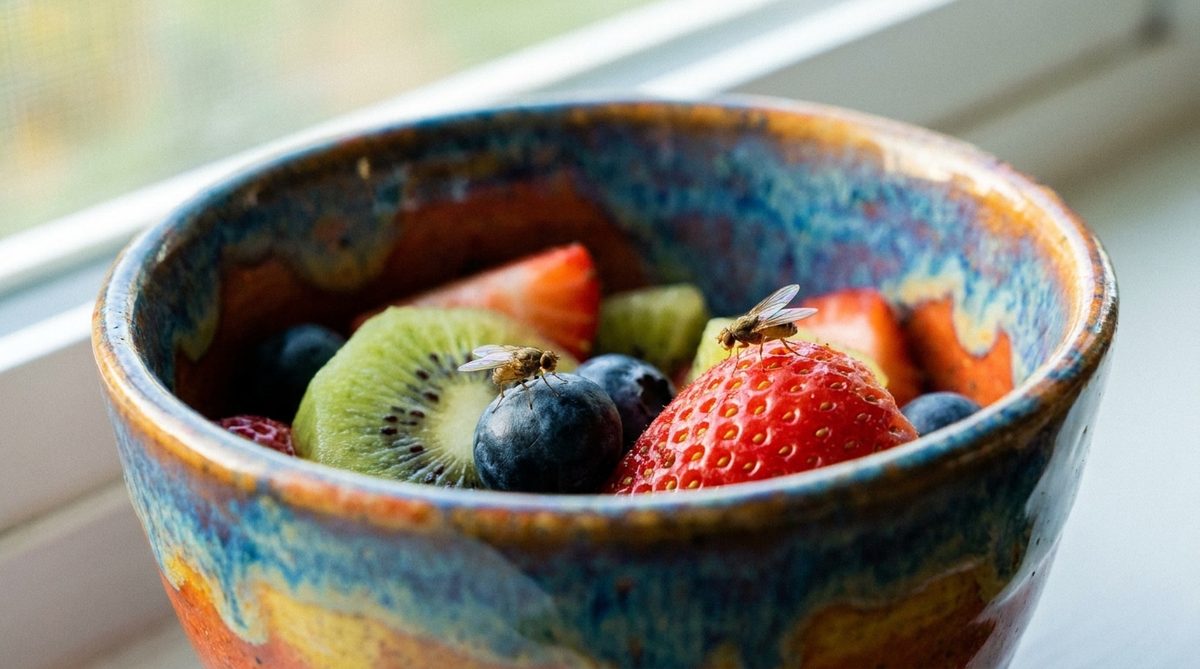
Summer is approaching. The kitchen smells like roasted garlic or bread baking, and then it happens. That familiar, buzzing cloud. Fruit flies have invaded the fruit bowl. Individually they are harmless, but in a pack they are relentless. You try to swat them. You try to scare them away. Nothing works. They multiply faster than you can blink an eye.
You end up staring at the counter in defeat.
Do you really need harsh chemicals to win this war? Probably not. The answer may already be in your pantry. There are natural and eco-friendly ways to clean your kitchen in a matter of hours. Here’s how you can turn your home into a fly-free zone without buying a single bottle of poison.
The Apple Cider Vinegar Trap
To defeat a small enemy, you must understand its weaknesses. Fruit flies are obsessed with fermentation. They love the smell of rotting fruit. They love the taste of yeast.
Apple cider vinegar is the best bait.
It smells spicy and sweet. It perfectly imitates the smell of an overripe product. Pour a small amount into a shallow bowl. The scent acts as an odor marker. Flies rush towards it, thinking they’ve found a feast.
But vinegar alone is not enough. The liquid is too slippery. Flies can land on it and fly away. You have to catch them.
Soap that breaks surface tension
This is where physics does the hard work. You need one more ingredient: dishwashing liquid.
Add two or three drops of environmentally friendly dishwashing liquid to the vinegar. Do not stir it vigorously. You don’t want foam. You want to preserve the surface tension disruption.
This is why this is important. Water and vinegar have a high surface tension. It’s like an invisible trampoline. Light insects can land on it without sinking. Soap destroys this film.
When the fruit fly lands on the soap mixture, the surface tension dissipates. It sinks immediately. It can’t go up. It’s drowning.
Recipe:
- A small baking dish or bowl
- About 50 milliliters of apple cider vinegar
- A few drops of dishwashing liquid
Add this mixture to the center of the spread. Let it wait. The flies are coming. They don’t go.
Plastic film maze
No vinegar? No problem.
Look at that squished banana. Or that half-eaten peach. It’s gone too far to eat. Perfect bait.
Put the rotting fruit in a jar. Cover the top tightly with plastic wrap or wax paper. Take a toothpick or needle. Make small holes in the top.
Flies smell the fruit. They crawl through the holes. They find the prize.
But they can’t find a way out.
It is a one-way labyrinth. The holes are too small to navigate back up. They are trapped. It’s simple. It’s cruel. It works.
Surplus wine or beer
If the flies are still hanging around, check your fridge.
Do you have a glass of red wine left? A few centimeters of beer at the bottom of the bottle? Use it.
Flies love the smell of yeast. They are almost as attracted to alcohol as they are to vinegar. Pour the sediment into a wide container.
Remember the soap rule.
Add a drop of dishwashing liquid to wine or beer. The smell of alcohol is strong. It attracts them. Soap makes sure they stay down.
Why this works
Most people buy sprays. They spray air. They spray the counter. It feels like action. It’s mostly theater.
These insects breed in moist, decomposing organic matter. They reproduce fast. You need to break their cycle. You need to remove the growing medium. And you have to kill the adults so they don’t replace themselves.
The vinegar and soap method attacks adults. The fruit and plastic wrap method traps them. When vinegar is low, the wine or beer method provides an alternative bait.
It’s not magic. It’s just better biology.
The kitchen will smell like vinegar for a while. But the buzzing stops. And this peace? It’s worth the smell.
Starve the swarm before it grows
Getting fruit flies out is satisfying. It is better to keep them out.
Summer brings warmth. Heat causes rot. Red brings tiny, buzzing enemies. They don’t need much to survive. A drop of spilled juice under a spoon. Seeds left behind in the trash bin. The sticky handle of a compost bucket. These are feasts for them.
You must cut off the supply.
Rinse the wicker baskets after you harvest. Seal opened packages tightly. Scrub the sink after every meal. This is not just cleaning. It’s a deterrent. When you deny the colony food, their pantry dries up. They leave.
Smart storage habits for a fly-free kitchen
Combine traps with strict hygiene. The results are immediate. Silence returns to the kitchen. Clarity returns.
Heat waves are the enemy. Place delicate foods in the refrigerator when temperatures rise. This keeps the invaders behind the walls. You want to enjoy the smell of cooking. You do not want the accompanying buzzing.
Start the transition now. Do not wait for an infestation. Protect your space. Keep it simple.