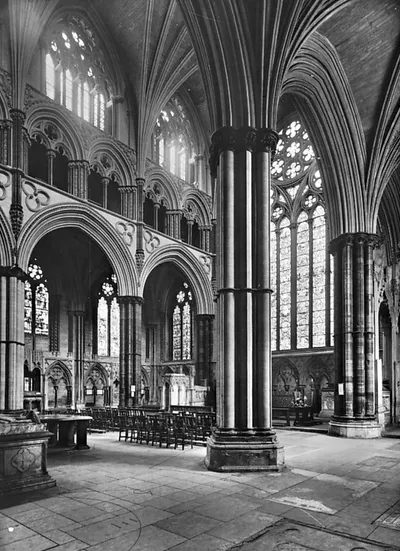
Peek into the medieval cathedral. Really look.
Of course you can see the glass. But you can also see the stone bones that support it. The thin vertical strips of stone or wood that separate the window panes are called mullions. It’s not just a decorative item. These are structural needs due to technical limitations.
Before people got large sheets of glass, windows were just holes in the wall. It cannot be made very large unless the structure collapses under its own weight. Enter the mullion.
Thin vertical divisions (that’s the old word for window panes) between adjacent lights form the backbone of the Gothic aesthetic. This allowed architects to push upwards and outwards to create the soaring, light-filled spaces that defined the era.
Origins in Tracery and Stone
Mullions didn’t just appear. They were born with the invention of window treatments.
Tracery is a stone element supporting a window pane, often arranged in a geometric pattern. Think of the intricate lace-like stonework above the Gothic windows. Mullions are the main vertical elements of the system.
It originated in Northern and Western Europe. This is where Gothic architecture took root. It remained dominant throughout the early Renaissance.
“Mullions appeared with the invention of tracery and are a feature of Gothic and early Renaissance architecture in Northern and Western Europe.”
Why vertical?
There are also horizontal bars. They are called transoms. However, the vertical type is standard. Why?
gravity.
The stones are very heavy. The glass is very fragile. If you try to span a wide gap with a single piece of stone or a large pane of glass, it will break. Or it cracks. Or the takes too long to quarry.
Mullions divide windows into manageable units. Turn large, fragile openings into a grid of smaller, stronger openings. Each mullion carries a load. Transfer the weight of the stone above to the wall below.
Without these, the light and graceful appearance of Gothic churches would not be possible. This is a reinforced bunker with slits.
The Material Shift
Originally these were stones. Hard, cold and tough.
However, even if the material changes, the function remains the same. Later, the mullions became wooden strips. Then there’s metal. Today, you may see aluminum or uPVC frames acting as mullions in modern office blocks.
The term stuck. The functionality is still there. However, aesthetics shifted from a structural necessity to a design choice.
In modern skyscrapers, the vertical columns between the glass panels cannot support a cathedral ceiling. It’s sealing the envelope. Keeping rain out. Keeping heat in. But the idea is still the same.
Separate. support. Define.
That’s the mullion. A simple vertical line. This changed the way windows were built for centuries. And what the light looks like inside the building.

The structural logic of the Gothic bubble
you are looking at the window Let’s look in particular at the stone graters that hold the glass in place. These are Marions. But it’s more than just a bar.
In sash windows, the edges of these beams are chamfered or chamfered. sometimes. There may also be short decorative columns. This is not just an aesthetic problem. This is structural theatre.
In the late Gothic period, the style became more sophisticated. Consider a complex silhouette. Gash. shadow.
Subtle variations between late Gothic and Renaissance
Displays a rectangular group of windows. You can see them in the secular works of the late Gothic period. and the early renaissance. The surface of the attachment is inclined backwards from the surface of the wall. Why?
This is because one shape seamlessly surrounds the entire group. Create a continuous line. Visual kei.
The bodies themselves are shaped. Or a bevel. This profile continues to the top and sides of each lamp. Each glass has its own frame.
When Windows gets complicated
Most windows have two or three lights. Simple.
However, some window treatments can split the whole thing into three or more lights. Then things change.
Bodies can contain different parts. Some sizes have grown. Others come with additional molds. Large carvings surround each partition. It creates a hierarchy.
The whole group is systematic. Divided into two or three light subdivisions. The great Mullion is associated with it. Small ones fill the space.
This is not a random stone carving. It’s a network. Mathematical distribution of weight and light.
Follow the continuous modeling with your eyes. Depends on the bigger chain. You need to understand the structure first and then the glass.
beautiful? Yes.
Is it effective? More than you think.