Science loves an accident.
Penicillin was mold. Post-its were failed adhesives. We didn’t look for them. They just showed up.
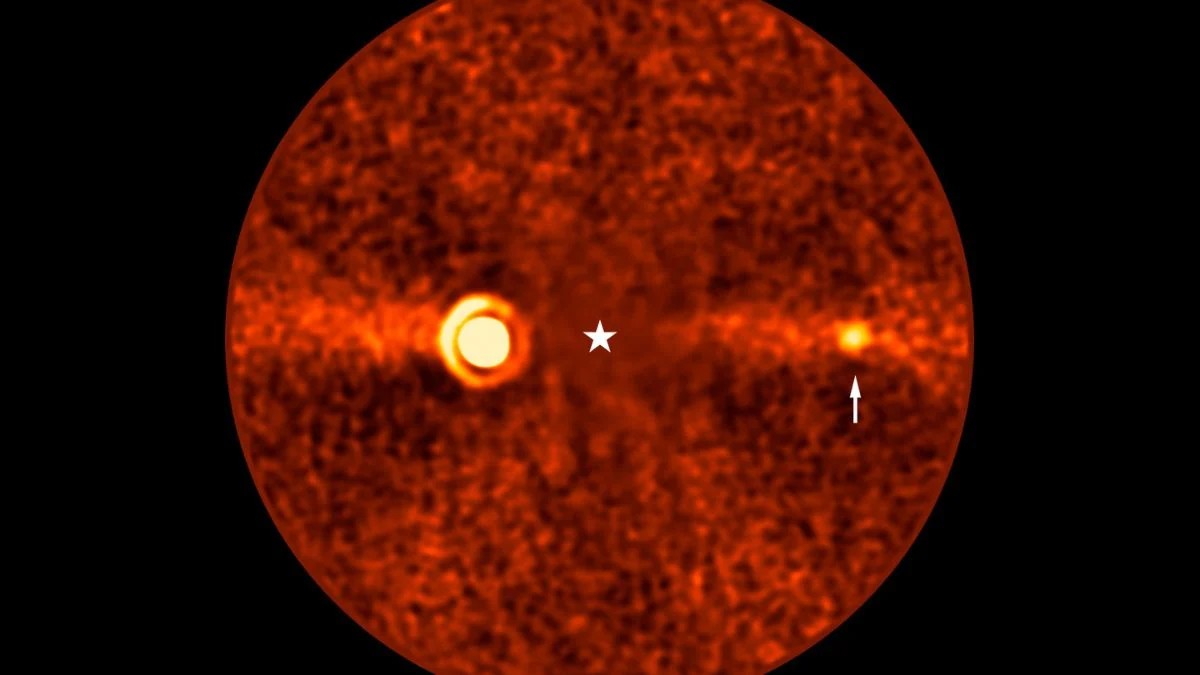
It’s happening in astronomy again. Astronomers just snapped the faintest direct image of an exoplanet from Earth.
They didn’t mean to. They were looking at something else entirely.
The planet, Beta Pictoris d, orbits a nearby star called Beta Pictoris. It was “found” in 2025. Technically. But the data proves it was hiding there for over a decade.
“This was a serendipitous discovery,” Ben Sutlieff from the University of Edinburgh said.
They weren’t hunting for a third child. They wanted to watch the big brother, Beta Pictoris b. See how it aged. How it shifted.
Beta Pictoris isn’t your average neighbor.
It’s in the Pictor constellation. Sixty-four light-years away. A quick hop cosmically.
It’s heavy. Almost twice our Sun’s mass. Fifty percent wider. Nine times brighter.
It’s also a teenager.
Only twenty-three million years old.
For context our Solar System is five billion years old. This star is basically an infant throwing a tantrum.
Comets hit it almost daily.
Debris disks swirl around it. Huge ones. Five times farther out than Pluto is from us. It’s a chaotic nursery. Birth place for two known gas giants before. Both roughly ten times heavier than Jupiter. Both cooking at impossible temperatures.
But now there’s a third.
Astronomers pulled this ghost out of the archives. They combined new shots from the Very Large Telescope in Chile with old data from the James Webb Space Telescope.
Planet d has been playing hide-and-seek since before 2014.
“Found you!” Jayne Birkby from Oxford says.
Unlike its siblings this kid is scrawny.
Mass is only 2.4 times that of Jupiter.
Temperature is a brisk 330 degrees Celsius. Cool relative to hell.
Why was it so hard to see?
Two reasons.
One, it’s far. More than twice as distant from its star as the others. About as far as Neptune sits from the Sun.
Two, glare.
Stars blind us. Their parent shines a billion times brighter than their kids. It’s like trying to photograph a firefly standing next to a stadium spotlight.
Beta Pictoris d is one hundred times fainter than its famous brother b.
“It is the faintest exoplanet ever directly imaged from Earth.” — Markus Bonse
That’s the record. Broken by accident.
It takes patience.
Repeated staring. Swinging orbits. Sometimes the planet is close. Sometimes it’s lost in the dark. You have to come back. Year after year.
This isn’t just about one weird ball of gas.
It’s proof we can do this more.
Direct infrared imaging already shows us dozens of young massive planets. Some hotter than magma. Some truly alien.
“Systems with multiple directly imaged exoplantes are the holy grails,” Sutlieff noted.
Same formation environment. Same recipe. Different results.
We’ll do it better soon. The Extremely Large Telescope is coming. No clever name tricks. Just huge.
It will peel back the layers. Show us lower mass planets currently hiding in plain sight.
Maybe life isn’t out there in these violent nurseries. Probably not. But evolution is. And now we can finally watch it happen without guessing.
The ice cube has been tipped. There is water below.