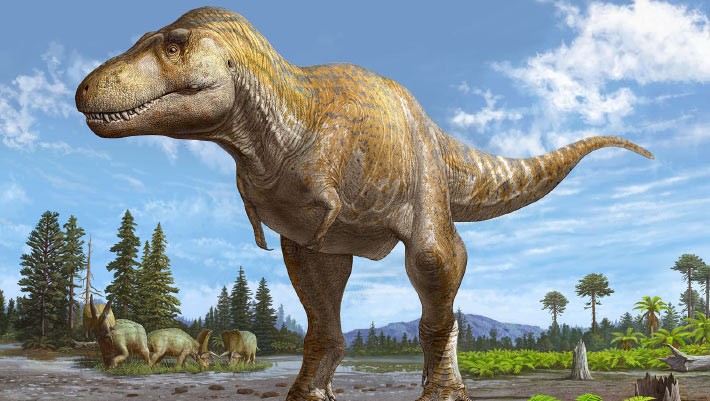
Look at Tyrannosaurus rex. Look at the arms. Ridiculously small. It’s the thing everyone jokes about. But the joke misses the point. The arms aren’t a mistake. They are an adaptation. And not just for T. rex. Other giant predators shrank their limbs too. Why? Because the head got too big to ignore.
Paleontologists from University College London University Cambridge have dug into this. Charlie Roger Scherer leads the charge. A Ph.D. student there. He notes that Carnotaurus had even smaller arms. Truly laughably small. So they asked why. They stopped looking at arm size as a side effect of growing tall and heavy. They started looking at the jaw.
Specifically, the bone-crushing jaw.
Scherer and team analyzed data from 82 species. Not just a handful. A wide net. They found a pattern repeating itself. Five different lineages shortened their forelimbs: Abelisauridae, Carchariodontosauridae, Ceratasauridae, Megalasaurinae and of course, the Tyrannosaurs. Convergent evolution. The same solution. Again and again.
It wasn’t about getting bigger. It was about getting tougher. The skull got massive. Compact. Dense. The jaws became weapons capable of shattering bone. Once the head took over the job of killing the arms had no job left to do. Use it or lose it. Nature is ruthless. If the claws aren’t needed for the kill. They go away.
Increasingly gigantic prey may have resulted in to subdue this prey an evolutionary arms race
The prey got huge. Sauropods. Tank-like herbivores. To crack those shells the predators needed better tools. They didn’t need extra claws. They needed bite force.
Scherer developed a way to measure “skull robustness.” It’s not just length. It’s about how the bones connect. How compact the shape is. A short. Square skull is stronger. T. rex scored the highest on this scale. The absolute top. Second place? Tyrannotitan. A relative from the Early Cretaceous in Argentina. Over thirty million years older than T. rex but almost as massive. And nearly as strong in the bite.
Did the short arms come first? No. That wouldn’t make sense. A predator can’t abandon its attack mechanism before it has a replacement. The strong skull had to exist. Before the arms vanished. The cause comes first. Then the effect. The study shows correlation. It can’t prove cause and effect definitively. But the timeline holds up. Strong head. Then useless arms.
The paper landed in the Proceedings of the Royal Society this week.
We often imagine dinosaurs running like lizards. Snapping with teeth. Grasping with claws. It turns out the later ones became walking cannons. The front end was a heavy. Blunt instrument. The back end provided the power. The arms were just left behind. Vestigial. Pointless.
Maybe the T. rex didn’t need them. Maybe none of them did. What do you think was left unused on the human body?