The “Hobbits” were messy eaters.
Or rather. They didn’t eat the good cuts.
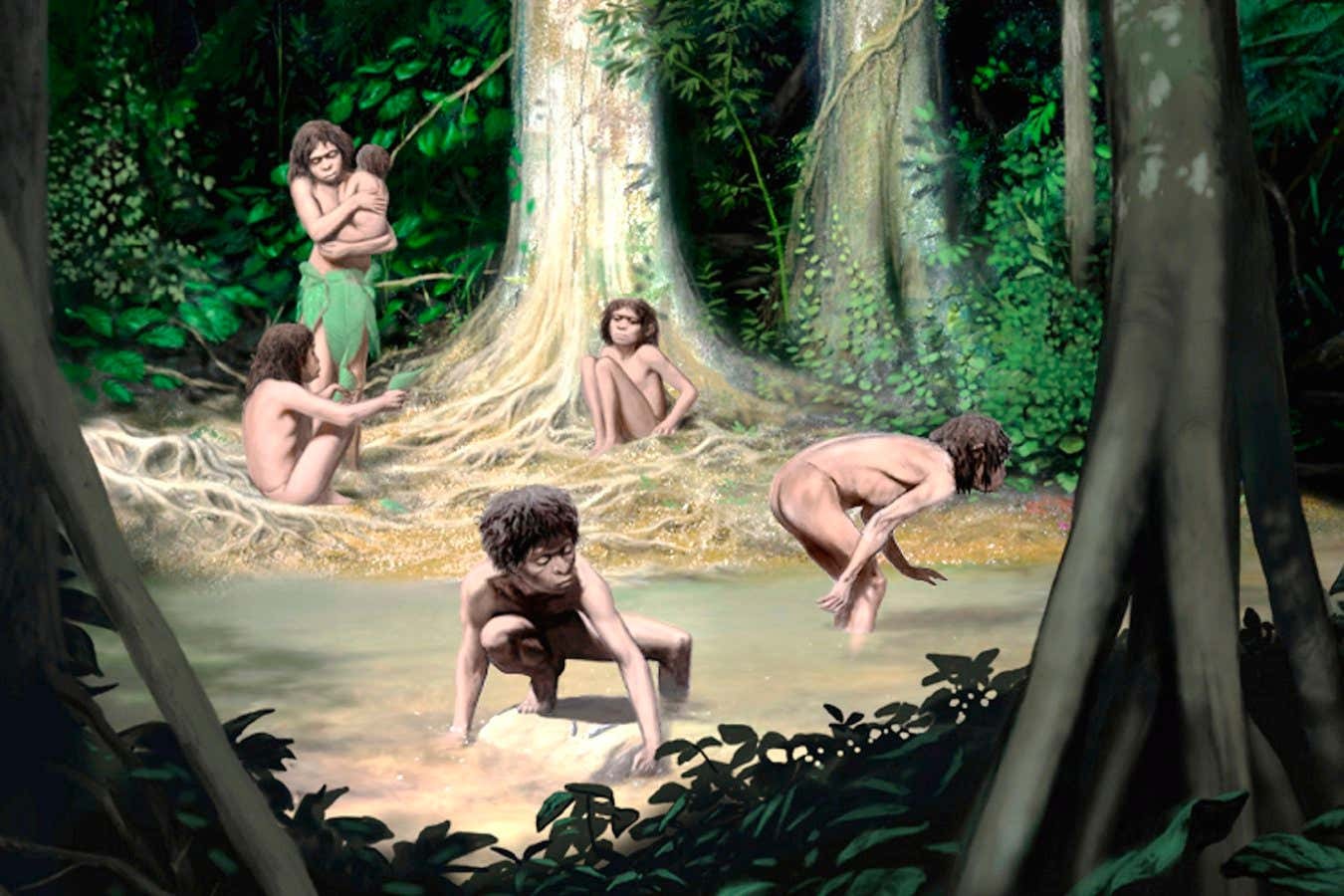
The Homo floresiensis hominins lived on the Indonesian island of Flores for thousands of years. They vanished roughly 50,00 years ago. Before that discovery in 2004, no one knew they existed. Small. Barely over a meter tall.
For a long time. Scientists assumed these little humans were tough. Hunters. Masters of fire. The evidence seemed to point there. Stone tools sat next to blackened bones in caves. It looked like controlled combustion. It looked like hunting giants.
Wrong.
At least. According to new research. It wasn’t a hunt. It was a cleanup crew operation.
The Komodo Connection
The bones found with Homo floresiensis belong to a dwarf elephant. Stegodon florensis. Heavy beasts. Impossible for a 4-foot-tall human with a tiny brain to kill. Not alone.
Elizabeth Veatch from the Smithsonian didn’t buy the hunter theory.
“Our field still holds onto the idea that they needed advanced cognition to survive there. Regardless of brain size.”
But brains don’t fill bellies. Teeth do. And on Flores, teeth belong to Komodo dragons. Giant reptiles. Apex predators.
Veatch and her team needed proof of what a dragon eats. You can’t just feed an extinct elephant to a dragon for science class. Ethics. Logistics. Extinction.
So. They went to Zoo Atlanta. They gave a Komodo dragon a dead goat.
Easy swap. Mammal bones look similar under pressure. The dragon ate the goat. The team watched. Then they counted.
Bone Dust
Seventy-two bones left. Two hundred sixty marked. Ninety-two teeth bites in total.
The dragon took the meat. Obvious. It ate the hindquarters. The forelegs. The juicy parts. It ignored the bones with little attached.
Now look at the Stegodon bones from the Liang Bua cave. Over three thousand fragments. All associated with Homo floresiensis.
The human tools made cuts on the worst cuts. Craniums. Thoracic vertebrae. The scraps. The leftovers.
If you hunt. You eat the steak. You don’t chip at the ribcage while someone else takes the thigh.
It makes zero sense unless someone else killed the elephant first.
“Zero burned bones in Homo floresiensis layers. Hundreds in modern human layers.”
Fire use was the second myth to collapse. Only one elephant bone showed heat damage. That one? Likely disturbed by humans much later.
Contrast this with rat bones. Rat bones found next to Homo sapiens layers show cooking signs. Lots of them. Modern humans cook rats. Hobbits didn’t cook elephants. Or rats.
Adam Brumm from Griffith University calls it convincing. The evidence suggests scavenging. Not hunting.
Why we cared
We wanted them to be smarter. Smaller.
Martin Porr from Western Australia notes that this finding brings Homo floresiensis in line with other small-bodied hominins. Like Australopithecines. Small body. Small brain. Limited tool use.
It fits. But Australopithecines were African. Flores is thousands of miles away.
Did they swim? Did they drift? Did a wider range of small ancestors exist before we dug them up?
Or did big humans like Homo erectus get small? Did island life shrink them until they lost the skills they once had?
We don’t know yet. The cave dirt keeps its secrets. The rats keep their cooked bones to themselves. The elephants remain dead.
Maybe that’s enough. Or maybe we need more digging. More time. More bones.