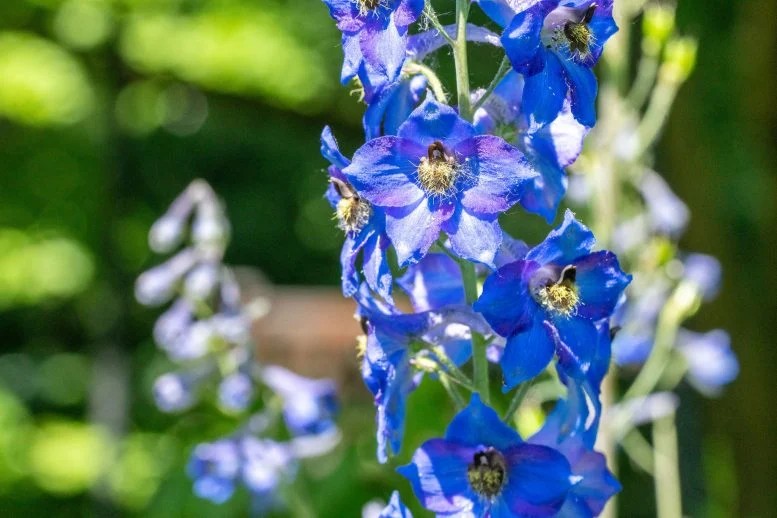
Wolfsbane doesn’t care if you survive it. A single drop of its extract can shut down your nervous system. Larkspur, its close botanical cousin, plays a similar game—paralyzing predators with lethal ease. But this chemical warfare has a flip side.
These same compounds, capable of stopping a heart or a brain in its tracks, are also potential cures for malaria, cancer, and chronic pain.
Until now, we’ve been at the mercy of nature’s scarcity. Extracting enough of these powerful molecules from plants is like mining gold with a teaspoon. But researchers have taken a massive step toward changing that. They’ve figured out how to recreate these complex chemistry sets in the lab.
The work, published in Molecular Plant, merges expertise from Michigan State University (MSU) and the Czech Academy of Sciences. It’s a bridge between ancient herbal remedies and modern genetic engineering.
“Plants are the best chemists around… Humans have found countless uses for these molecules.”
— Björn Hamberger, MSU Professor
Why Plant Chemistry Is So Hard to Copy
We think of plants as slow and simple. They aren’t.
Over millions of years, flora have upgraded their chemical arsenals to survive predation, disease, and climate stress. The result? Specialized metabolites with structures so intricate that even after two centuries of chemistry, many remain unsynthesized.
Take diterpenoid alkaloids. Found in larkspur (delphinium) and wolfsbane (monkshood), these molecules are molecular monsters. They combine features from the two largest and oldest groups of plant chemicals. The result is a structure so complicated that Aconitone—a famous toxic derivative—has never been fully built in a lab, despite being isolated nearly 200 years ago.
“If you have ten steps in a row… and suddenly one quits, the next stepscan’t happen,” explained Garret Miller, MSU alum and co-first author.
Trying to isolate these compounds from nature yields tiny amounts. It’s slow, inefficient, and environmentally taxing. We needed a better way. We needed an assembly line.
How the Collision Created a Breakthrough
The breakthrough didn’t come from a single lab. It came from a collision at a research conference in Barcelona.
Björn Hamberger’s team at MSU was studying larkspur. At the same event, Tomáš Pluskal’s group at the Czech Academy of Sciences was wrestling with the same class of compounds in wolfsbane.
It was the same problem. Different approaches.
“When this happens, we can either go我们的 own ways, or come together… it’s joining up that always leads the best science,” Hamberger said.
The two groups merged their resources. Their goal? Map the exact biochemical pathway that turns raw plant matter into these potent alkaloids.
The Genetic Assembly Line
To find the recipe, they didn’t guess. They hunted.
The team analyzed thousands of genes across multiple species. They looked for specific markers: which genes switched on in the right tissues, at the right time, to build the toxin.
They treated the plant’s biology like a factory floor. Each enzyme was a worker on the line. The goal was to identify every step from raw material to finished product.
Once mapped, these genetic instructions could be plucked from the plant and inserted into a host organism. Yeast? Tobacco? It doesn’t matter what the host is, as long as it can read the plant’s code and start manufacturing the compound at scale.
In an ideal scenario, this allows us to bypass farming entirely. No fields. No harvest. Just bioreactors.
Tobacco Plants Make the First Breakthrough
The researchers didn’t stop at theory. They tested it.
They took a promising set of genes from both wolfsbane and larkspur and inserted them into tobacco plants. They turned the crops into biological factories.
The result? Success.
Chemical analysis confirmed the tobacco produced atisinium, a diterpenoid alkaloid. The modified plants weren’t just making a fragment; they were completing the assembly. Six distinct enzymes worked in concert, guiding the molecule into its complex final shape.
Even more surprising, the process added a vital nitrogen source that the scientists hadn’t predicted.
“Our vision is to provide green, sustainable tools.”
— Björn Hamberger
What This Means for Medicine
This is just the first step.
Identifying the entry points of the biosynthetic pathway gives scientists a handle on the entire family of diterpenoid alkaloids. It opens the door to testing these compounds for medicinal properties without risking exposure to the raw, unrefined plant toxins.
We currently use plant-inspired medicines like capsaicin (pepper) or vanillin (vanilla). The next wave could include targeted anti-cancer agents or novel painkillers derived from the very plants that kill you.
But there’s a catch.
The path from “we made it in a lab” to “safe for human trials” is long. We don’t know yet which of these toxic skeletons will tame down enough to be useful drugs, and which will remain only curiosity.
The chemistry is solvable. The manufacturing is possible. The only question left is what we’ll actually do with it.