Entry-level astronomy gear is expensive. New refractors cost hundreds. Buying a “decent” scope for pocket change sounds like fantasy. The secondhand market says otherwise.
People buy telescopes on impulse. Then life gets busy. The gear gathers dust. That’s why deals appear on Facebook Marketplace. I spent a week scrolling. I needed light-gathering power. Department store 50mm refractors don’t cut it for deep-sky viewing. I wanted aperture.
I found a Celestron AstroMaster 170mm Newtonian reflector. Listed for $50. 15 miles away. Good condition. Box included. Optics clean. No scratches. I bought it. No hesitation.
Now? I’ve tested it. Solar views. Lunar detail. Planetary disks. It’s not perfect. But for $50? It’s a steal. Here’s exactly how it performed.
The Gear: What You Actually Get
This scope isn’t just a tube. It’s a system.
It comes with two Plössl eyepieces. That’s roughly 33x and 67x magnification. Low power for the moon. Higher power for Jupiter. It includes a red-dot finder scope. Essential for beginners. You point the red dot. You look through the eyepiece. Done.
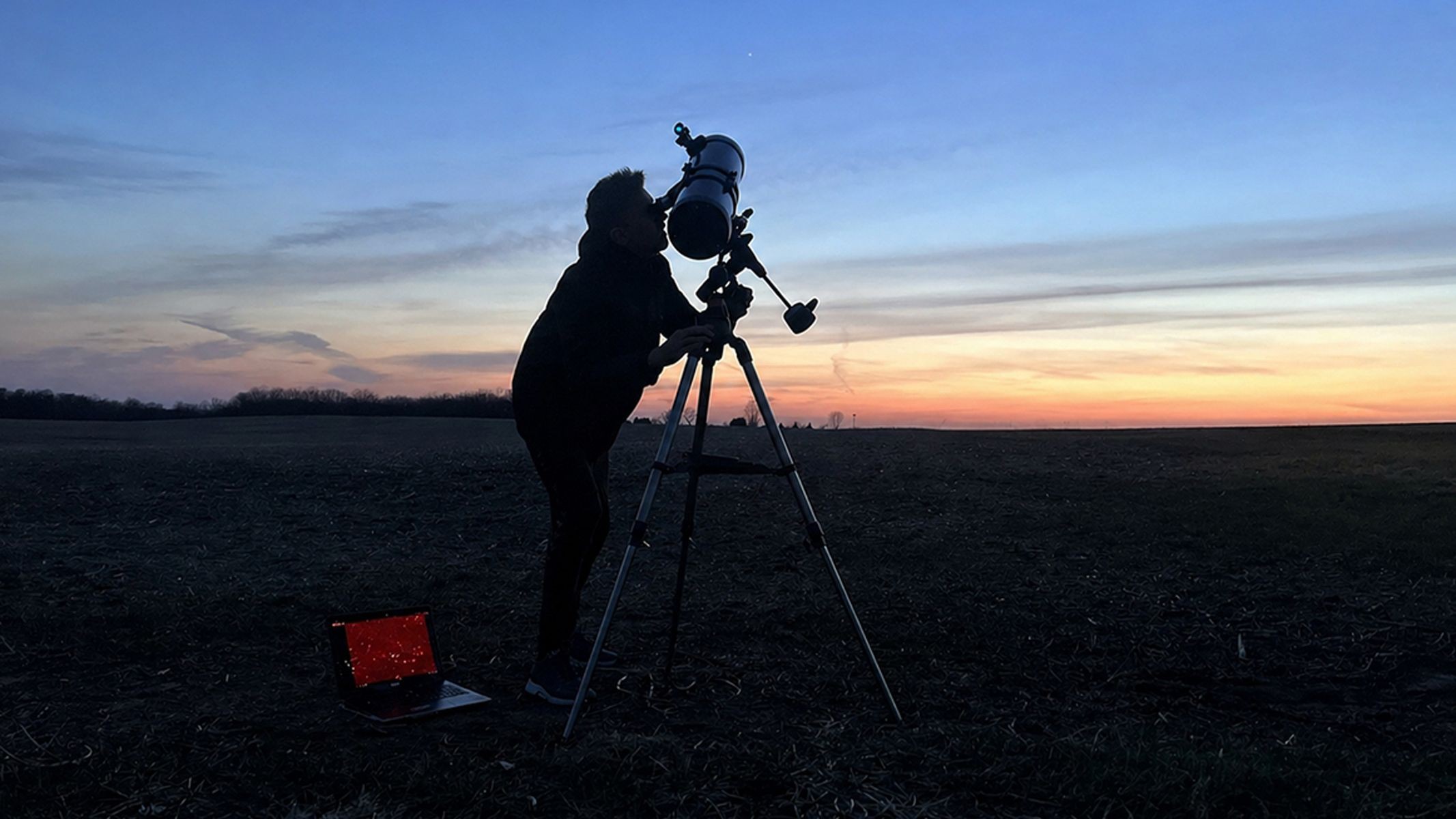
The mount is an equatorial design. It tilts to match Earth’s axis. You track objects by turning two slow-motion cables. No motors. No batteries. Just manual nudging. It’s primitive. But it works.
I had a spare 2x Barlow lens. Used it to boost planetary magnification. Barlows are cheap used. Pick one up if your scope doesn’t have one.
Collimation: The Ten-Minute Fix
Newtonian reflectors need collimation. Aligning the mirrors matters. If they’re misaligned, views are blurry.
This telescope arrived slightly off. Probably shipping damage. Or just bad handling. Fixing it took less than 10 minutes.
You don’t need a laser collimator. You can do it by eye. Sight down the focuser. Adjust the primary mirror screws. Center the reflection. Secondary mirror was fine.
One quick star test confirmed it. Pinpoint stars. No flares. If you skip this step, your images will suffer. Do it. It’s easy.
First Light: Planets and Sun
Venus was the first target. Gibbous phase. Sharp edges. No false color. Cheap refractors show purple fringes here. This Newtonian didn’t. The planet looked almost three-dimensional. Subtle shading. Unexpected for the price.
Jupiter was next. Great Red Spot visible. Four Galilean moons lined up. Sharp and point-like. I checked the optical quality on a bright star. Inside and out of focus. Optics were well-corrected. No major aberrations.
Solar viewing requires safety. Always use proper filtration. I made a DIY filter using Baader safety film. Stretched over cardboard. Fit snugly over the tube opening. NEVER point a telescope at the sun without a filter. It will destroy your eyes and your gear.
The filter showed sunspot groups. Umbra and penumbra details. Tracking was manual. Hard to keep steady. But the aperture was perfect for solar work. Not too large. Not affected as badly by daytime turbulence as bigger scopes.
Astrography on a Shoestring Budget
No motor drive means no long-exposure nebula photography. Skip that. Focus on the moon, sun, and bright planets.
I attached a Player One Uranus-C USB camera. Short video clips. About an hour of recording. Manual tracking was annoying. Nudged the Right Ascension cable every few seconds. Kept the planet centered. Results? Surprisingly reasonable.
The Moon: Craters. Shadows. Tycho crater came out best. Ray system visible. Resolving power better than small refractors. Fine lunar details clear.
Jupiter: Cloud bands. Great Red Spot slipping off edge. Ganymede’s shadow on the planet. Impressive.
Not observatory-grade. But proof that a $50 scope + decent camera can capture real detail. Patience and steady hands required.
Deep-Sky Observing: Escaping Light Pollution
City lights kill faint objects. Drove 45 minutes to a darker sky site. Visual observing.
Star-hopping works with the red-dot finder and equatorial mount. But you need knowledge. Or a star atlas. Or planetarium software on a laptop. You can’t just guess where M13 is.
M13 (Hercules Globular Cluster): Sparkling ball of stars. Core resolved. Faint outliers visible.
M5: Similar. Dense star cluster.
M81 & M82: Bright galaxy pair. Distinct shapes.
Double Cluster in Perseus: Stunning. Pin-point stars. Too many to count.
Virgo Cluster: Several bright galaxies.
NGC 4565 (Spindle Galaxy): Elongated shape. Ghostly sliver.
Manual tracking was a slight frustration. Constant drift. Counter it by turning the slow-motion knobs. I’m spoiled by GoTo mounts. But the views were enjoyable. Surprisingly good.
The Verdict: Pros, Cons, and Advice
Pros:
– 130mm aperture for the price. Massive light gather.
– Sharp planetary views. No false color.
– Good for solar and lunar photography.
– All essential accessories included.
– Resolves faint deep-sky objects under dark skies.
Cons:
– No motorized drive. Manual tracking only.
– No GoTo system. Requires sky knowledge.
– Collimation needed. (But easy).
– DIY solar filters are risky if not done right.
Should you buy it?
Yes. If you’re willing to search. Inspect mirrors. Test the mount. Ask about history. Check for all parts.
New scopes at $50 are toys. This used Newtonian is a tool. It outperforms cheap entry-level refractors in every way. Larger aperture means better views.
A tight budget doesn’t mean limited fun. It just means hunting. The used market is full of these deals. $50 to $200 range. Many options on Facebook Marketplace. Local groups. Even better finds nearby.
If you want a first telescope. Or a gift. Look used. Search hard. Be selective. You’ll find an amazing entry into the universe. For pocket change.