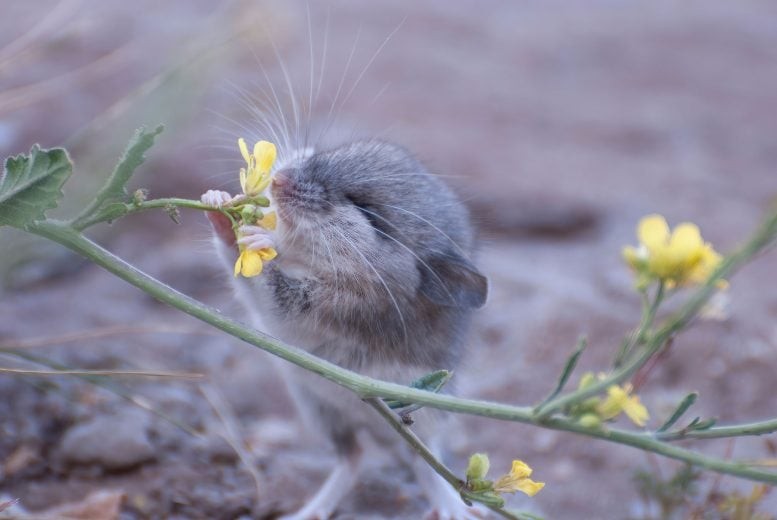
You lean in. You inhale. The brain decides if the cantaloupe is ripe or the milk is sour.
A mouse does this too, but faster. Frantically even.
New research from Northwestern University suggests that despite the speed difference, the neural machinery underneath is almost identical. It’s not just about sniffing. It’s about timing.
Two studies published in Science Advances reveal that how humans and mice process smells relies on an evolutionarily conserved system. Mice can execute single, intentional sniffs. Humans, despite breathing slowly, generate the same brain rhythms that rodents use when sniffing rapidly.
This isn’t just academic curiosity. It changes how we look at neurological decline.
The Evolutionary Logic Behind Shared Olfaction
The brain treats smell as an active decision, not a passive reception.
Animals control the flow of odor molecules. They dictate the timing. This matters because if you don’t control the intake, you don’t control the data.
Rodents are famous for their rapid sniffing rates. Humans? We take maybe one sniff every few seconds. It’s sluggish by comparison. For years, scientists wondered: How can a human identify a scent as quickly and precisely as a mouse if they are sampling the air ten times slower?
The Northwestern teams approached this puzzle from opposite ends of the mammalian tree.
One group studied mice. They watched them handle food, lift it to their noses, and pause. These weren’t the frantic search sniffs. These were single, deliberate breaths.
The other group recorded directly from human olfactory bulbs. These are the structures that receive the first neural signals from the nose.
The results converged. The timing is the same. The mechanism is shared.
“The true similarity is this single sniff… it’s volitional; they’re doing on purpose.” — John M. Barrett, Northwestern University
Dexterous Single Sniffs in Mice
The mouse study started with something you’d easily miss.
Researchers led by Gordon M. G. Shepherd used a robotic multi-camera system to track freely moving mice. They looked for moments where the animals paused and brought food to their noses.
Instead of the usual rapid-fire sampling, the mice took one carefully timed breath.
It looked like an inspection. A quick check before committing to the bite.
When the food was unappealing, the sniff was stronger. But odor alone didn’t trigger it. If researchers blinded the mice, they still performed the sniff. It stopped only when the motor cortex was silenced.
This proves the behavior is proactive, not reflexive. The mice choose to sniff.
“It turns out the mice choose to perform These quick ‘smell checks’… rather than being passively triggered to sniff. Mang Gao
This is the first time such intentional, non-reflexive sniffing has been documented in rodents during natural foraging. It mirrors the human act of lifting food to the nose to evaluate it.
Theta Oscillations: The Human Smell Signal
If mice use rapid sniffs to drive their olfactory processing, humans use something else.
The human study, led by Christina Zelano and Andrew Sheriff, recorded activity in the olfactory bulbs of volunteers. They asked participants to take a single, intentional breath.
That single inhalation triggered low-frequency brain waves. Theta oscillations. Specifically, rhythms in the 2–8 Hz range.
This is the exact frequency range rodents use for rapid sniffing.
In mice, the sniff and the theta wave are fused. They are nearly indistinguishable. Breathing is the rhythm.
In humans, breathing is slower. But the theta wave persists. It organizes the faster bursts of neural activity within that one breath. One slow inhale activates several internal processing cycles. The brain divides the data, analyzes the smell, and outputs a decision—all within the span of a single breath.
The human brain compresses the same temporal structure into a slower physical action.
“In humans, the slower sniff rate pulls them [sniffing and theta] apart, revealing the theta oscillation as distinct.” — Qiaohan Yang
This confirms that how humans and mice process smells is governed by the same underlying time windows, even if the physical execution differs drastically.
Why This Matters for Disease Detection
Understanding healthy smell circuits is the only way to spot when they fail.
Changes in sniffing behavior have long been associated with neurodegenerative conditions. Autism, Alzheimer’s, and Parkinson’s all show alterations in olfactory function.
If the underlying neural machinery is conserved across species, then disruptions in these shared rhythms might be early biomarkers for pathology.
“Knowing we have this evolutionarily cons set of mechanisms helps us understand… how they fail in pathology. Andrew Sheriff
We aren’t looking at two separate systems. We are looking at one ancient system, adapted to different breathing rates. Mice run it on high RPMs. Humans throttle it back but keep the core engine intact.
This shared design suggests that the way we gather information through smell is fundamental to our survival as mammals. It guides what we eat, what we avoid, and when we move.
The mouse checks the crumb. The human checks the melon. The brain does the rest.