It happens more often than you’d care to admit. You’re sitting at a dinner table, or maybe stuck in an elevator with coworkers you barely know, and someone drops a question that sounds like a test of logic but is actually a test of vocabulary. The prompt is deceptively simple. It usually involves counting, hidden meanings, or a play on words that trips you up if you aren’t paying attention to the small stuff.
The answer, more often than not, is the letter m.
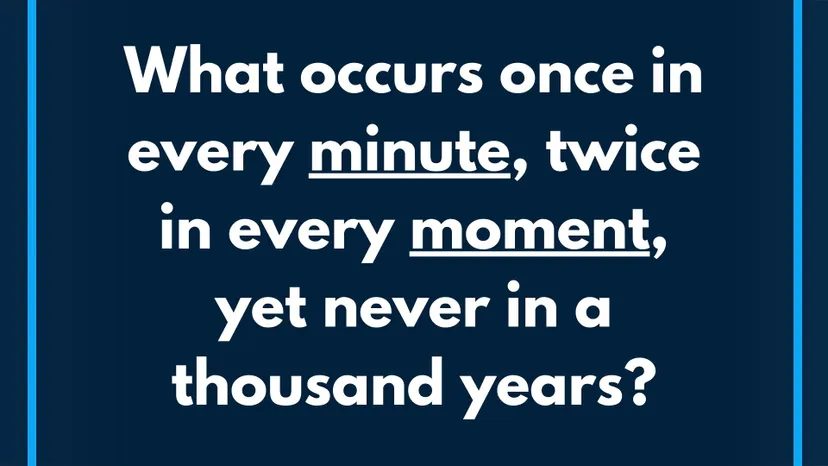
Think about the classics. “What comes once in a minute, twice in a moment, but never in a thousand years?” You might pause. You might try to do some math about the passage of time. You’re overthinking it. The answer relies on spelling, not calculation. There is one m in minute. There are two m ’s in moment. There are zero in thousand years. It’s a trick question designed to make you look like a genius or a fool, depending on how fast you catch the pattern.
This isn’t just one riddle. It’s a genre of linguistic traps where the letter M is the star. Consider another common query: “What word contains all five vowels in alphabetical order?” The answer here is usually cited as facetious or abstemious. But if you look closer at common riddles, you’ll find that many people confuse the letter m with the answer to “What is the beginning of the end?” No, that’s the letter E. The letter M shows up in riddles about silence, secrets, and hidden patterns.
Why does the letter M dominate these puzzles? It’s versatile. It’s a consonant that can act as a bridge in words, appearing frequently enough to be noticed but not so frequently that it becomes background noise. It has two distinct shapes, which helps in visual wordplay. It’s part of words like middle, memory, and month, all of which have structural quirks that riddlers love to exploit.
When you hear a riddle ask about something appearing “once in a minute, twice in a moment,” don’t reach for a calculator. Reach for your understanding of the alphabet. The answer is almost always the letter m. It’s a small character, but it carries a lot of weight in the world of pop culture trivia and late-night conversation starters. You don’t need to be a poet to get it. You just need to see past the noise.
And once you start looking for it, you’ll notice how often it slips into the answers. It’s there in the quiet moments. It’s there in the loud ones. It’s just waiting for you to notice.