The first thing you notice isn’t the technique. It’s the impact. Fists arrive from nowhere. There’s no time to duck. You take a direct hit to the nose. Eyes water. Spine tingles with shock. Balance vanishes. Blood pours out like a broken faucet. Swelling starts instantly.
Does that sound fun? For most people, absolutely not. For Jimmy Smith and Doug Anderson, it’s just Tuesday.
They are the co-hosts of Fight Quest, a Discovery Channel series that trades comfort for cultural immersion and physical trauma. The premise is simple, if brutal. Travel the globe. Find a local martial art. Train with a master for five days. Then, fight the country’s toughest competitor.
It’s educational. It’s travelogue. It’s also a collision of cultures and knuckles.
Two Paths, One Helmet
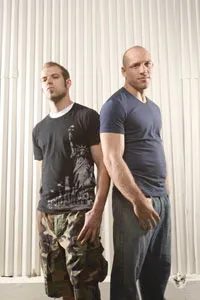
Smith and Anderson didn’t grow up on the same planet, let alone the same mat. Smith is a Southern California native. He spent years in Brazilian Jiu-Jitsu. Before the fame, he taught seventh-grade algebra. Now, he’s a pro MMA fighter. His record: six wins, one loss.
Anderson is different. He grew up in a rough New Jersey neighborhood near Philadelphia. He’s an Iraq War veteran. His style relies on boxing and military hand-to-hand combat. He’s looking to start his own MMA career with amateur bouts, hoping to go pro soon.
One brings grappling. The other brings grit. Together, they make for a chaotic chemistry.
The Casting Call That Changed Everything
How do you find two guys crazy enough to do this? You put out a call.
North South Productions, a New York-based production company, ran ads in martial arts publications and websites. They weren’t looking for silent experts. They wanted charisma. Intelligence. Engagement.
The ad read: “Outgoing, charismatic, engaging, smart and inquisitive personality.” It also added a warning. “This show will have you push your physical and emotional limits so you must be up to the challenge.”
Hundreds of tapes poured in. Fighters from across the US auditioned. The final line of the ad was the real filter: “must be willing to travel.”
That was an understatement. The show took them to ten different countries. Mexico. Indonesia. Everywhere. Smith and Anderson were the ones who answered the call.
The Brutal Reality of Training
I sat down with producer Chuck Smith, Jimmy Smith, and Doug Anderson. We met at their home gyms. They were training for upcoming MMA matches. They were excited. Eager to talk.
The footage showed the pain. The bruising. The exhaustion. But the interviews revealed the mindset.
Q: Was there any fighting style that made you nervous?
Anderson: I’m down for whatever. I was intimidated by a few going in. But my philosophy is simple. If another human can do it, I can too.
Q: Which styles did you enjoy?
Anderson: Stick fighting, or kali, was insane. Intense. I loved Kajukenbo too. Great technical blend. Useful for cage fighting.
Q: How would you sum up the experience?
Anderson: Half the time I’d look around and think, What am I doing here? This is the dumbest thing I’ve ever done. But then you make it through. No matter how hard it gets. You come back with a story. A cool one.
Q: Want a second season?
Anderson: Absolutely. That’s the ideal scenario. Another year traveling. Another year getting punched in the face. It doesn’t get better than that.
The production didn’t just film fights. They documented survival. The hosts pushed their physical and emotional limits. They learned new arts. They endured brutal training methods. They survived.
And they’re ready to do it again. Or maybe they aren’t. Maybe they’re just exhausted. Maybe they’re bruised. But the story remains.

Casting Real World: Rivals was less about finding the toughest brawler and more about engineering a specific kind of friction. The producers needed a dichotomy sharp enough to cut through the noise, even if that meant looking in the most inconvenient places.
Finding the veteran off the grid
T.J. Smith didn’t click “apply” for the show. Discovery Channel called a Brazilian Jiu-Jitsu school specifically hunting for Mixed Martial Artists, and Smith just happened to be the guy sitting there. He was available. He was ready.
The show’s creator, Amy Rapp, set up a phone interview. It went well enough that she scheduled an in-person audition. Smith wasn’t the only contender. Five other experienced MMA fighters showed up, all bringing serious credentials to the table.
But skill wasn’t the deciding factor.
“One of the reasons I got it, I think, is because I talked about everything but fighting.”
Fighters are trained to talk about toughness. To project invincibility. Smith realized quickly that that mentality doesn’t translate to television. It’s a different programming altogether. He had to consciously suppress the instinct to prove himself on the mats. He needed to be human, not just a weapon.
The viral tape that changed everything
Doug Anderson took a completely different route. He submitted an audition tape.
It wasn’t polished. It wasn’t a highlight reel of knockouts. It was just… funny.
“Doug was kind of out of left field. He sent in a tape that was really funny. We liked him immediately.”
Show producer Chuck Smith recalls the moment clearly. Anderson wasn’t on their radar until that video landed. It was amusing. It was unexpected. And it worked.
Why the contrast worked
The final cast wasn’t a collection of the best fighters. It was a collision of two opposing worldviews.
Smith brought veteran savvy. Institutional knowledge. A understanding of the sport’s deeper mechanics.
Anderson brought street-wise toughness. Inexperience. A raw, unfiltered attitude that couldn’t be taught.
Smith saw the symmetry immediately. The way they viewed combat was totally different. The way they viewed life was even more so.
“I think it really works for the show. The way we see fighting is totally different. Doug’s attitude is so different than mine, I think it worked and you got two contrasting sides on everything.”
That friction became the engine. Not the fights themselves. The people behind them.
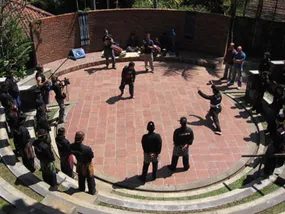

The producers had their two lead fighters locked in and ready to go. Now came the real puzzle: picking the countries and styles that would make for the best television. It wasn’t just about finding the most dangerous martial arts. It was about exoticism. Visual interest. The team wanted a specific rhythm, too. They split the pair up geographically. One guy trained in the city. The other headed out to the countryside.
No country said no. Although, some places were off-limits. Civil unrest made certain regions too dangerous to film in. But the masters? They were all in. Even the legendary instructors in Japan were eager. This was a chance to show off an art form that defines their culture. They wanted the world to see it.
The lineup was eclectic. You had Sanda from China. Kali from the Philippines. Kyokushin karate from Japan. Mexico sent its best boxers. Indonesia offered Pencak Silat. France contributed Savate. South Korea brought Hapkido. Brazil showed off Jiujitsu. Israel sent Krav Maga. And San Francisco rounded it out with Kajukenbo.
Assembling the Crew
Once the locations were set, Smith and his team pulled together a five-person crew straight out of New York. They weren’t going it alone, though. In each country, they lined up a local sound technician and a “fixer.” These fixers were lifelines. They acted as liaisons, helping coordinate the shoot and tearing down the language barrier. The crew arrived two days early. They spent that time shooting B-roll footage. They stayed an extra day after filming wrapped to relax and prep for the trip back to the States.
Each stop lasted twelve days. Then, there was a two-week break. This gave Anderson and Smith time to heal. To recharge. Smith described the recovery process with brutal honesty.
“The two weeks we had at home was pretty much enough to rehab yourself. Put ice on whatever hurts, stay in bed, take anti-inflammatories — just in time to get up and do it again.”
Originally, the plan was for Anderson and Smith to fight each other at the end of every episode. But after an initial sparring session, the producers changed their minds. It just didn’t make sense. Smith was way more experienced. Watching him beat up Anderson every week would have been bad TV. Plus, they got along well. Why ruin a good friendship for a staged fight?
The 10 Fighting Styles
There are at least ten good ways to take someone down. Here is exactly what they explored on Fight Quest.
- Sanda: Developed by the Chinese military, this is a full-contact martial art. It uses striking, kicking, sweeps, takedowns, and throws. It’s not pretty. It’s effective.
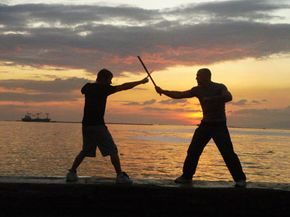
- Kali: This is a weapons-based art. Fighters use knives, swords, and escrima fighting sticks as primary instruments. Those rattan sticks are lightweight but designed to inflict maximum damage.
- Kyokushin Karate: Another full-contact style. A common tactic is taking the opponent off their feet. They build endurance through kumites, which are fights against multiple opponents at once.
- Boxing: The classic. Opponents face off in an enclosed ring for set rounds. Punching with heavy, padded gloves is the only way to attack. You win by knockout or by judges scoring the fight.
- Pencak Silat: An Indonesian art that originally relied on striking weapons. Today, fighters use a mix of weapons, kicks, and punches.
- Savate: Also known as French kickboxing. It uses hand strikes and a variety of kicks to subdue an opponent. It’s technical. Elegant, even.
- Hapkido: This style merges techniques from karate, judo, and aikido. It’s best known for impressive body throws and painful wrist locks used to disable attackers.
- Jiujitsu: Perhaps the most versatile art on the list. It uses strikes, kicks, throws, choke holds, and locks. Almost every other martial art has influenced it at some point.
- Krav Maga: Invented by the Israeli army. It’s a practical technique for street situations. It borrows from jiujitsu, boxing, and judo. It even incorporates weapons like knives and sticks.
- Kajukenbo: A hybrid art from San Francisco. It combines takedowns, throws, and hard striking. Limb breaking is a common, and brutal, method.
The Rise of Mixed Martial Arts
Mixed martial arts, or MMA, is a fast-growing combat sport. Multiple techniques are used in the ring. It’s also known as cage fighting. It was born in the early 1990s with the Ultimate Fighting Championship (UFC). The concept was simple. Fighters with different specialties get into a closed ring. They battle until one surrenders.
Boxing, wrestling, jiujitsu, and grappling are just a few of the styles you see in the cage. Royce Gracie, a Brazilian grappler, quickly became the sport’s most popular figure. He won three championships using his submission style. Grappling involves lying on your back in a defensive position. You use various submission holds instead of striking. You wait for the mistake. Then you end it.
You can read more about how the UFC works if you want the deep dive. But the cultural experience? That’s what made Fight Quest stick. From Buddhist temples in Japan to the training grounds of the Israeli army, Smith and Anderson didn’t just fight. They lived it.

Fighting as Cultural Mirror
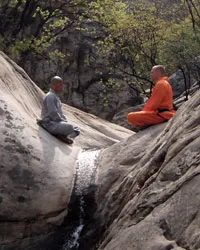
The magic of Fight Quest wasn’t just in the bruises or the sweat. It was in the backdrop. Anderson and Smith didn’t just spar; they traveled. From mist-covered Buddhist temples in the Chinese mountains to ancient Aztec ruins near Mexico City, the show leaned hard into location. The culture wasn’t a side quest. It was the main event.
Anderson loved the immersion. He didn’t just visit. He dug in.
“I love to experience new things and see new places — try to understand new people. I think that was really one of my favorite parts about the experience. Not only were we going to new countries, but we were fully immersed into a specific part of that country’s culture. I can’t think of one country where I didn’t absolutely love the cultural experience.”
This approach revealed something surprising. Fighting styles are cultural fingerprints. They reflect the national psyche.
In China, the art was graceful. Thoughtful. Not violent at all.
Korea offered a different lesson. The people were peaceful. Calm. Kind. Their fighting style mirrored that gentleness.
Japan was the opposite. Think kamikaze pilots. They charged. Gave everything. Would die on the mat. But honor was non-negotiable. You don’t give up.
It’s amazing how you can gauge a national mindset from the way people punch each other. The fight tells you who they are.
The Israeli Mindset and the Krav Maga Incident
The atmosphere in Israel hit Smith and Anderson like a physical blow. Smith describes a local population that moved through the streets with a hyper-vigilance that bordered on the pathological.
“I’ve never seen people walk around like they expect someone to jump out and attack them at any second,” Smith says. “To live with that kind of paranoia every day? It’s a hard mentality for me to wrap my head around. But that’s how they fight.”
Anderson’s trainer mirrored this intensity. She had a nervous twitch, constantly scanning the perimeter as if an ambush was imminent. The reality was stark: they were surrounded by enemies. Their survival depended on watching their backs and being prepared to strike from any angle.
This “surrounded” mentality culminated in a moment so volatile that producers had to intervene. During Anderson’s Krav Maga demonstration in Israel, the situation spiraled out of control. It was the only time Anderson has ever screamed in genuine pain.
The producers wanted to showcase the brutal efficiency of Krav Maga. They didn’t hold back. Anderson found himself in a ring facing fifteen opponents. They didn’t wait for a signal; they swarmed him. Dudes came from every direction, plowing into him, kneeing him in the face, and gouging at his eyes.
He was overwhelmed. He managed a groin strike, but his opponent was wearing an athletic cup, neutralizing the blow. Anderson was convinced the attacker was trying to rip his eyes out. He scrambled to escape the fray, but the aggression didn’t waver.
The chaos forced the production team to step in.
“Hey, you need to calm down,” they pleaded.
The Israeli combatants didn’t care. Their reaction was a string of expletives, and they kept coming, full force. It was insanity. A controlled demonstration had devolved into a genuine brawl, fueled by a culture where violence is a daily constant.
Training Methods
This intense, life-or-death training style stands in stark contrast to the bizarre and unconventional methods seen elsewhere. But before we get to the more exotic routines, we have to look at the physical toll these environments take. The next section will explore how traditional and modern disciplines clash, including the strange inclusion of chicken blood and fire curry in some training regimens.

The idea that martial arts mastery is just about muscle memory is a myth. Training in various disciplines did not prepare Will Smith and Jason Anderson for what they actually encountered during the production of The Matrix. They expected discipline. They got something closer to survival.
In every country they visited, local masters made one assumption immediately. They saw Smith and Anderson as actors first. Fighters second. This perception was an obstacle they had to dismantle quickly.
Anderson describes the dynamic clearly. Trainers either went easy on them. Or they went hard, hoping to watch the actors fold up and quit.
Neither strategy worked. By the end of the first day, both men were receiving the real deal. The masters often stated their intent plainly: “We’re gonna try to break these guys.”
Divergent Paths in the Philippines
Because they trained separately, their experiences diverged sharply. The Philippines offered a study in contrasts.
Smith stuck to a traditional, if rudimentary, gym setup. He worked with punching bags. He focused on standard conditioning. It was functional. It was safe.
Anderson found himself in a different world. It was less like a dojo and more like a jungle boot camp. He crawled face-down through mud pits. The environment was designed to strip away comfort.
But the physical toll was only part of the equation. Anderson underwent a series of ceremonies and rituals. One specific incident stands out.
He was laid on a cot. Eyes closed. Filipino kali masters beat his stomach and slapped his face. The session ended with a ritual sacrifice. A chicken was killed. Its blood was drizzled over Anderson’s face and body.
He didn’t flinch. He just kept going.
“It was the most grueling physical challenge of my life.”
This wasn’t just exercise. It was a test of will. The masters wanted to see if the actors could handle the intensity of the real martial arts world they were about to enter. They passed. Not by pretending. But by enduring.
The training wasn’t about looking good on camera. It was about changing the way they moved. And surviving the process.
What happens when you remove the safety net? The actors learned to trust their bodies in ways they hadn’t before. The mud. The blood. The beating. It all served a purpose.
The result was visible. The movement in the film felt heavier. More dangerous. Because it was.
Anderson’s description of the blood ritual highlights the cultural gap. For the masters, it was tradition. For Anderson, it was shock. For Smith, it was observation. But all three men were moving toward the same goal.
They wanted to be convincing. To make the impossible look believable.
The trainers didn’t care about Hollywood. They cared about strength. About resilience. About breaking down the actor to rebuild the fighter.
Smith and Anderson didn’t just learn moves. They learned pain. They learned fear. And then they learned to push past both.
The Philippines trip wasn’t just a location shoot. It was an initiation.
How many actors would stay in the mud? How many would walk away from the blood?
Few. But not them.
The training continued. The stakes rose. The line between performance and reality blurred.
They were ready. Or as ready as anyone could be

The Global Grind
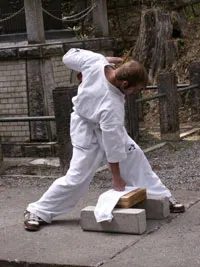
The training camps weren’t just about sweat; they were about survival. In Tokyo, Jimmy Smith threw himself into a local gym, pushing his limits while Doug Anderson fled the city for the northern mountains. The contrast was stark. Doug didn’t use pads or bags. He punched trees. Hard. He walked up stone steps on his knuckles, with a partner pinning his legs down for extra resistance. It was brutal, old-school conditioning designed to toughen bone and mind alike.
Jimmy stayed in the city, breaking boards, ceiling tiles, and baseball bats with bare fists and feet. He also survived the infamous “fire curry.” You know the one. It’s spicy enough to make grown men weep. He and his training partners sweated through their gear, chugging water just to keep going.
Then came Mexico. The altitude hit hard. Doug was taken to ancient Aztec ruins located 10,000 feet above sea level. Breathing became a workout in itself. He squatted with massive rocks and felled large fallen trees with an axe. It was physically demanding and mentally exhausting.
Jimmy’s location seemed easier on the surface. He lived and trained with Olympians and Golden Glove champions in Mexico City. But don’t be fooled. Those sessions were brutal. Jimmy described them as bordering on hazing. The intensity was unmatched.
Q&A with Jimmy Smith
We sat down with Jimmy to break down what actually happens when you’re thrown into the deep end.
Q: Were there any fighting styles that you were leery of?
A: Any kind of “street style” made me nervous. Krav Maga uses a lot of eye gouges and groin strikes. I’m not used to having to protect those areas. If something goes wrong by a couple of inches, you know, you’re blind.
Q: Will any of the training aid your MMA career?
A: Oh yeah. I practice jiujitsu, and in Brazil I worked with [legendary fighter] Hoyola Gracie a little bit. Working with a guy like that will elevate your game with a couple of sessions.
Q: Who were the most tenacious fighters you faced?
A: They were all tough, but the people Doug trained with in Israel were tenacious to the point of psychotic.
Q: Was five days enough time to train?
A: Never. Learning a new style in five days and taking on a black belt is virtually impossible. You could get a general idea of what the style was about and then it was time to fight. Seeing how we overcome it is pretty much what the show is about.
Q: How about a second season?
A: I’d do a second season in a heartbeat. It was the experience of a lifetime.
Fights and Injuries
The training was only half the battle. The real story begins when the gloves come off. We’ll look at the brutality of the final fights next. Broken faces. Infected feet. The cost of entry.

Watch Fight Quest and you’ll see blood, bruises, and genuine concussions. It isn’t a scripted drama with stunt doubles. The danger is real.
Brian Anderson had it the worst.
Smith says people misunderstand the show’s safety protocols. They think there’s a producer behind the scenes calling “cut” before things get too ugly.
“That never happened,” Smith says.
No one was protecting them.
Anderson took several hospital trips. His worst injury happened in Japan.
He weighed 145 pounds. His opponent weighed 210.
During training, the champion kicked him in the head.
Anderson went blind in his right eye instantly. It felt like staring into the sun. He had a blind spot. A concussion.
Then he had to run ten miles.
The vision came back after a day. The concussion wasn’t life-threatening. But his leg? It swelled up so badly he couldn’t walk for two weeks.
He also broke his face.
A punch shattered his cheekbone.
Real combat isn’t pretty. It’s messy. It hurts. And Fight Quest didn’t soften the blow.
Why do fans still argue about whether it was fake? Because the injuries look too specific. Too severe. But the scars prove otherwise.
Anderson kept fighting. Smith kept talking. The show kept airing.
Real pain doesn’t need a director.
The Japanese training ground was punishing, sure. But the real nightmare happened in Indonesia. It wasn’t a broken bone or a torn ligament. It was a foot. Specifically, a foot that got kicked by an opponent, blocked by a forearm, and turned into a biological hazard.
Anderson walked away with a contusion the size of an egg. It sat right under the skin. It throbbed. It annoyed him. He called it “pretty painful.” That’s putting it mildly.
The Loaf of Bread Solution
Smith described the swelling as looking like a loaf of bread.
No medic was on set. No doctor. Just a bunch of guys in a van. At the end of the day, Anderson and his Indonesian counterparts were comparing bruises like kids trading baseball cards. They saw the foot. They laughed. Then they said the magic words: “Massage, massage.”
So they loaded up. Drove an hour and a half. Got out of the van and walked into a place best described as a crack den.
The Hard Rock Café Therapist
They brought him inside. Sat him down.
The therapist? A large man in purple sweatpants and a Hard Rock Café t-shirt. He was smoking cigarettes on a couch.
Anderson’s immediate thought: You guys brought me to the wrong place.
The guy didn’t care about credentials. He looked at the foot. Grabbed it. And started grinding the massive lump like he was trying to smash a walnut. He basically forced the bruise out of the foot by brute force.
The Aftermath
Blood dispersed throughout the entire foot. It wasn’t a sound medical procedure. It was a violent, unhygienic workaround.
The result? Infection.
The pain was intense. Crazy intense. Anderson couldn’t walk for three weeks.
Three weeks on foot. No walking.
If you want more details on Fight Quest and the reality of martial arts training, check the links on the next page.