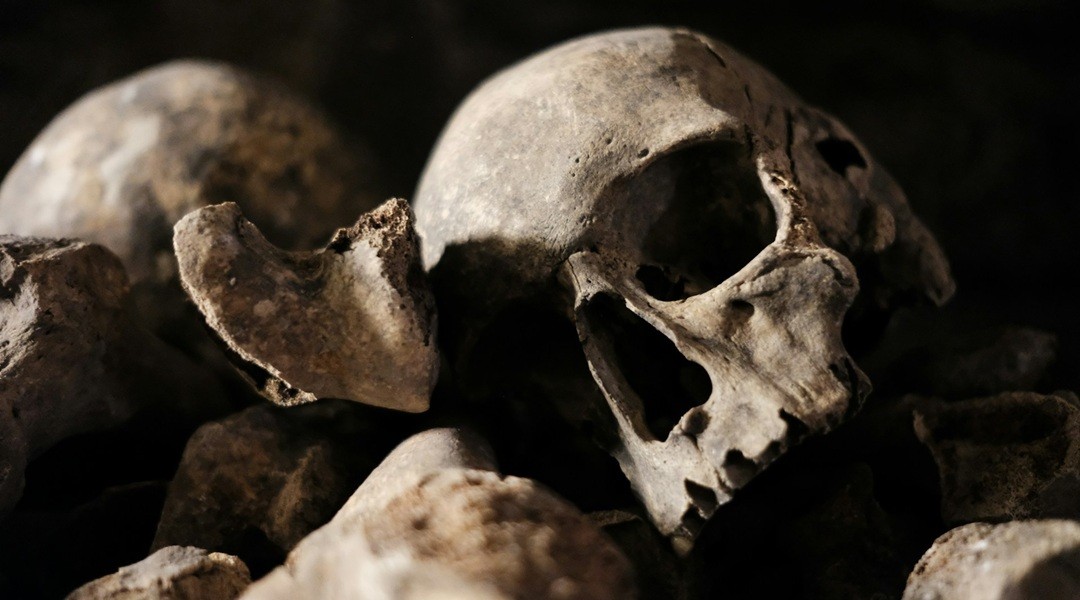
For decades, paleontologists have been guessing.
They hold a fossilized skull. They look inside. They see faint ridges and bumps. And then? They guess what part of the brain made them.
It is subjective. Messy. Now, a team from the Musée National d’History Naturelle in Paris has built an actual framework. A key. A “Rosetta Stone,” they call it, for reading the imprints of ancient minds.
The Scan
Antoine Balzeau and his colleagues recruited 75 people. Real, living volunteers. They went to Pitié-Salpêtrière hospital for MRI scans. Why MRI?
No radiation.
The study, part of the PaleoBRAIN project required high-resolution data to compare the wet, squishy brain directly against the bone impression it makes. For two years, the team reconstructed 3D models of every subject’s brain, their brain lining, and the hypothetical endocast the skull would record if those brains died and fossilized today.
The result?
Objectivity.
“For 75 individuals, we analyzed… what they actually correspond to,” Balzeau said.
There is no more guessing. No more subjective interpretation. Every direction. Every mark. The data is open.
Broken Lines, Not Perfect Maps
Old school analysis relied on brain atlases.
These atlases assume sulci (the grooves) are uniform. Elongated. Straight. They expect clean lines on the fossil. But human brains are chaotic. Each person has a different pattern. A unique map.
The study found that most sulci don’t mark the whole skull.
Instead?
Short lines. Disconnected segments. Gaps. The marks are fragmented, especially near the top of the skull where contact is weak. They cluster lower down, where the brain presses harder against the bone.
The old view was wrong.
Endocasts aren’t negative casts of a smooth map. They are mosaics. Discontinuous. Variable. Recognizing this range is essential. If we keep looking for long straight lines in fossils, we are reading nonsense.
The Ghost Marks
Then there is the mystery.
About 12% of marks on the endocasts—mostly near the top—do not match any sulci on the brain underneath.
They call them MNAS (Marks Not Associated with Sulci).
They look like brain furrows. They should be furrows. But they aren’t. Some other tissue, perhaps blood vessels, perhaps membranes, presses into the bone there. Or maybe just random variance. It does not matter why, exactly, right now. What matters is knowing they are not sulci.
Ignoring this causes errors.
Researchers have historically interpreted these MNAS marks as brain grooves. This distorts the anatomy of our ancestors. Balzeau warns that interpretations must stick to established markings. The new framework identifies exactly which marks are sulcal and which are these mysterious MNAS entities.
“We propose… an objective basis,” he wrote.
Big Brains
There is more.
Paleontologists often estimate ancient brain size by measuring the empty space inside the fossil skull—the endocranial volume. Is it a good proxy?
Yes.
Balzeau’s data confirms the assumption holds. Changes in brain volume correlate with changes in the space they occupy in the skull. Hominin brains did get bigger. The measurement method was valid.
But size is easy.
Function? Hard.
Next Steps
The team has moved past anatomy. Now they look at behavior.
They recorded data on handedness for all 75 subjects. Strength. Precision. Dexterity. The goal? Find a link between how a person uses their hands and asymmetries in their brain structure.
Right-handed people have different brain asymmetries than left-handed ones. Do those differences show up in the bone impressions?
If yes, then fossil skulls might tell us about behavior. Not just shape. But function. What our ancestors did.
The data is all online. The models are public.
It changes everything.
Or does it?
Fossils remain fragments. Time remains the enemy. We have the code, but we still lack most of the messages.