We assume nature heals when people vanish.
Wrong.
At least, that is the counterintuitive story told by 100 European sites. Pollen records stretching back two millennia reveal that plant diversity actually collapsed during the Black Death. It did not recover until farmers returned.
Large-scale agri-business definitely harms biodiversity now. No one argues against that. But looking further back—past the industrial age—the data suggests human presence has often flourished alongside plant variety. Jonathan Gordon from the University of York found that as humans spread over the last 12000 years, biodiversity rose too.
Opposing correlations? Maybe.
Past farming differs wildly from today’s monocultures. The Black Death provided a perfect “natural experiment” for Gordon’s team. A sudden drop in population meant sudden abandonment of farmlands. If humans create diverse landscapes, does their disappearance kill them?
“Our hypothesis was that… the sudden population collapses… should have resulted in biodiversity losses,” Gordon writes.
The 13th century brought urbanization and subsistence agriculture that evolved into something more complex. Then came the 14th century slaughter. The Great Famine followed by the Black Death wiped out roughly a third of Europe.
People fled to established centers. Marginal settlements died.
Gordon and his colleagues drilled into sediments at bogs and lakes across the continent. Radiocarbon dating on those core samples acts like a time machine, showing exactly which plants lived where. They tracked pollen patterns across three historical phases.
From the start of the Common Era to 1900, diversity climbed.
Why?
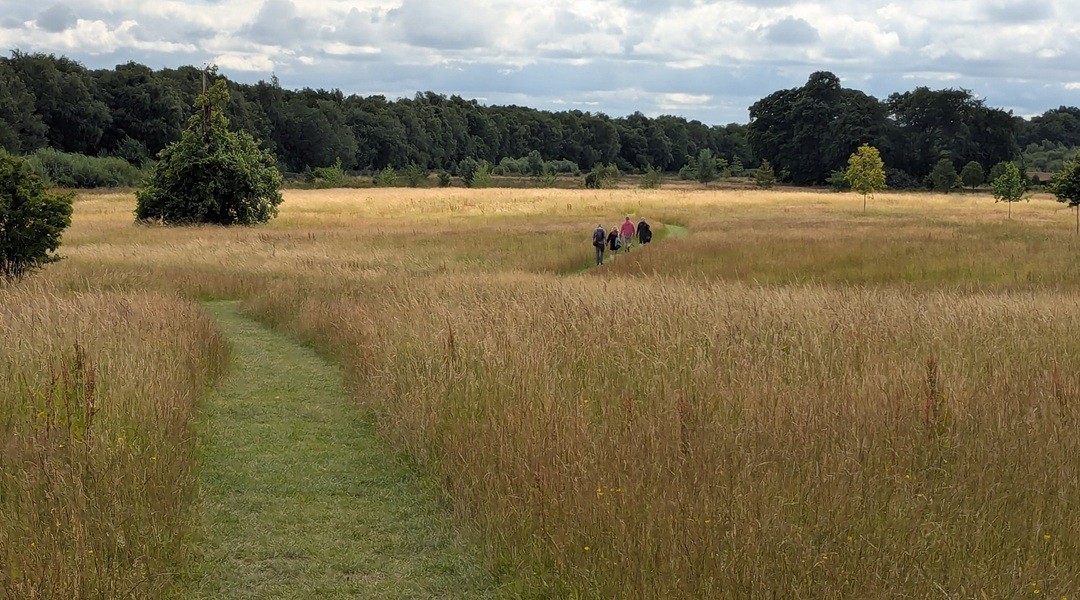
The rise and fall of the Roman Empire created a demand for varied crops. Even outside imperial borders, barley, rye, and animal husbandry painted a mosaic across the landscape. Wild heaths separated cultivated plots. Woods broke up the fields. It was a patchwork. Diverse. Human-shaped, yes. But alive.
Then 1900 hit. Or rather 1400.
Between 1300 and 1450, plant diversity plunged.
Surviving humans concentrated in dense towns. Farmland was abandoned. Cereal pollen levels dropped. And the landscape simplified. Tree cover matters too. Areas with around 40% woodland remained relatively stable. Landscapes that were already too open or too dense saw extreme losses.
Silence kills complexity.
“The Black Death disrupted this by reducing Human disturbance. The result was a LESS patchy landscape.”
From 1500 onwards, populations grew again. So did farming. And so did the flowers.
Modern monocultures are bad for nature. Gordon admits that. Overgrazed pastures harm the land. But the history books suggest farming can boost biodiversity if done correctly. Low intensity. Mixed systems. Semi-natural elements sharing space with crops.
High Nature Value farmlands in parts of Europe still do this. Grazing meets mixed farming.
Conservationists currently push rewilding. Release feral cattle. Let wolves wander. Assume that limiting human touch is the only way to save ecosystems.
“Yet our work shows that rewildings… are not the ONLY solution.”
Traditional land management creates the same patchiness through human disturbance. Sometimes people do not want wild predators on their doorstep.
So conservation needs more than just fences and fences.
Low intensity farming might be the other tool in the box.