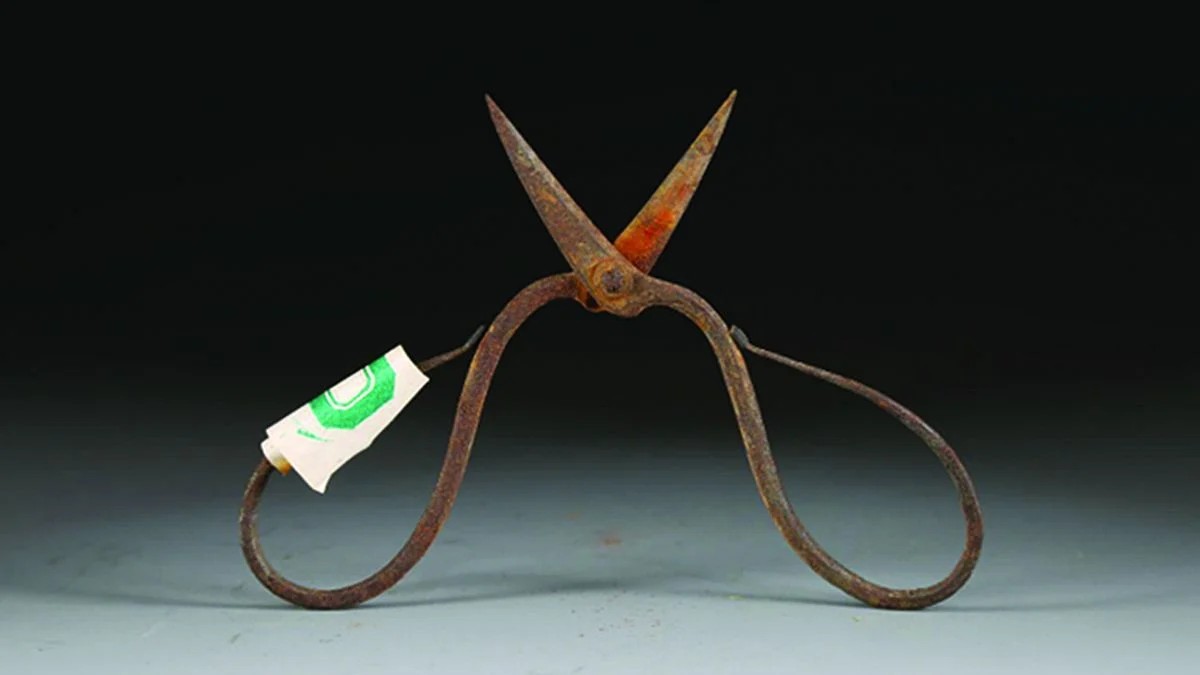
Red crust.
That’s all that’s left of the anesthesia.
Not a bottle. Not a vial. Just tiny reddish flakes crusted onto metal scissors and tweezers from the Ming Dynasty. Scientists found these tools in Jiangyin County China. They came from the tomb of Xia Quan a surgeon who lived around the late 14th and early 15th centuries. The grave was opened back in 1974 but the tools sat rusting away until modern technology could look closer.
Fifty years ago no one could see the residue.
Now we can.
Using Stimulated Raman scattering microscopy a laser light technique that reads chemical signatures without damaging the artifacts researchers identified the substance. It was aconitine. That’s a highly toxic compound derived from Aconitum carmichaeli or Chinese wolfsbane.
Wait.
Wolfsbane is poisonous.
So how does this mean better medicine?
The presence of this poison on surgical instruments implies Xia didn’t just cut into patients while they screamed. He numbed them first. This is the earliest direct chemical evidence we have of surgical anesthesia. Before this discovery texts claimed ancient physicians understood pharmacology but physical proof was scarce. Ancient herbs rot away. They don’t leave trails on steel like this.
The researchers had to be creative.
The Jiangyin Museum wouldn’t let the artifacts leave its halls. So they brought a portable analyzer to the tools. They focused on the crevices. Specifically the handles where grime hides. Protected from cleaning for six centuries. They found three particles. One on the tweezers two on the scissors.
All three matched aconitine.
“This is the first time humanity has found… direct chemical evidence… proving that our ancestors already knew how… safely alleviate patients’ pain…” — Congcang Zhao
How did they keep people from dying of toxicity while trying to numb them?
Texts from that era suggest wild preparations. They likely used urine from young boys. They boiled the herb in vinegar. They soaked it in a black soybean mix. These steps broke down the worst of the poison. Then the powdered remainder was rubbed on the skin. A topical anesthetic.
Doesn’t that sound risky?
Yes. It is risky.
But it shows precision. You don’t get these tools with specific chemical traces unless the surgeon had a plan. They balanced the drug’s power against its lethality. They controlled the dose. The residue tells us Xia Quan knew exactly what he was doing.
It wasn’t just blind stabbing in the dark. It was calculated.
The texts say they used these methods. The lasers say they did it. The two records meet in the red dust on an iron blade. It suggests Ming Dynasty surgeons had a sophisticated grasp of local anesthetics long before the modern era invented ether.
We usually assume the past was brutal because it was unmedicated.
But Xia Quan had options. He just kept his receipts on his tools.