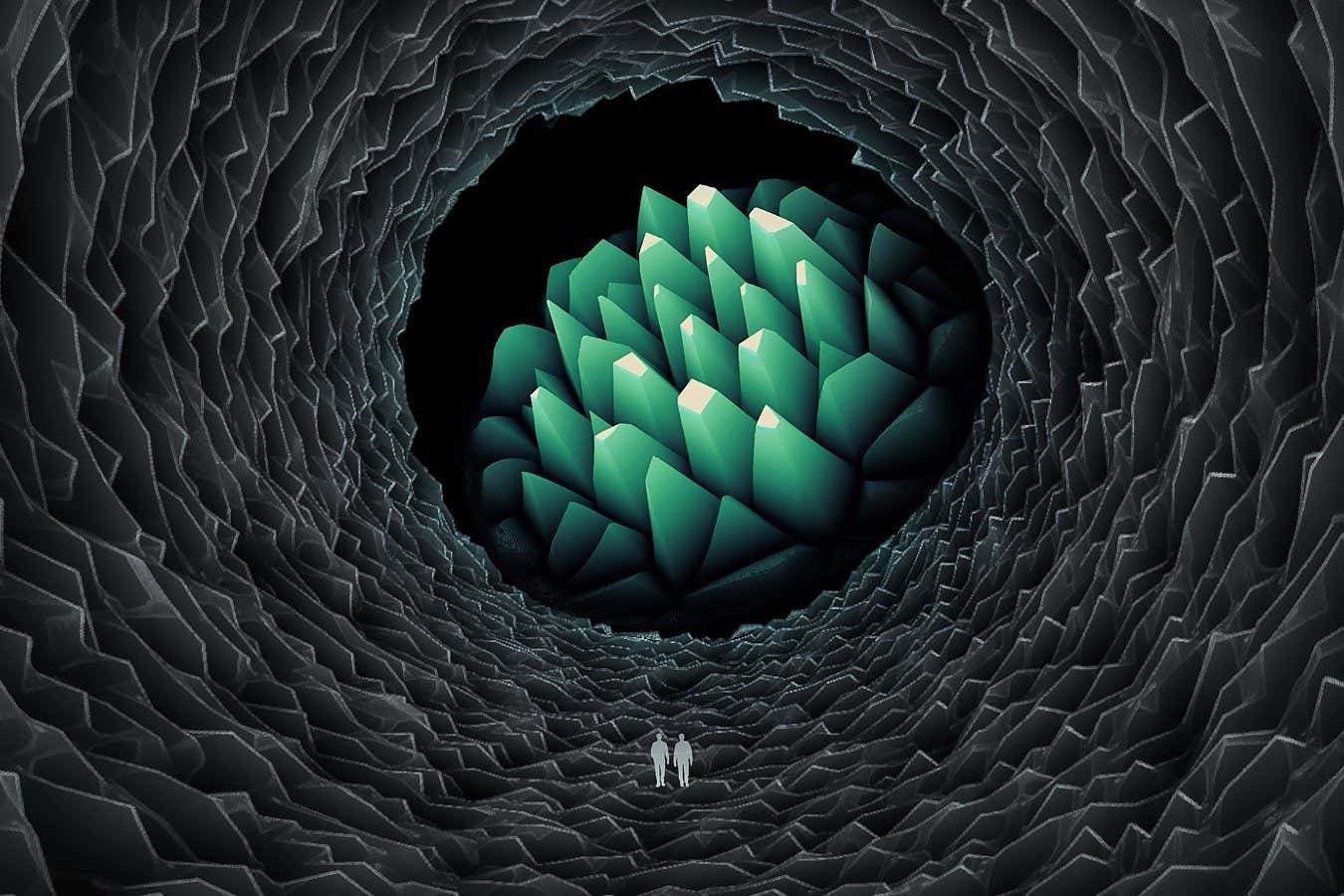
The Core Insight: A rare mineral, herbertsmithite, may finally be confirmed as a “quantum spin liquid”—a state of matter where magnetic spins never settle, remaining in a state of perpetual quantum entanglement. This discovery could revolutionize quantum computing by providing a natural source of error-resistant quantum states.
From Desert Mines to Quantum Frontiers
The story begins not in a high-tech laboratory, but in the dusty desert near Anarak, Iran. In the 1970s, mineralogists Joachim Otteman and Darius Adib discovered a bluish-green, glassy mineral in the Kali Kafi mine. They named it anarakite, cataloged it, and largely forgot about it for decades.
They had no idea they were holding a potential key to one of physics’ most elusive puzzles. Today, this mineral—renamed herbertsmithite —is at the center of a 50-year scientific quest to prove the existence of a quantum spin liquid (QSL).
What Is a Quantum Spin Liquid?
To understand why herbertsmithite matters, we must first understand what it isn’t. In ordinary magnets, atomic spins (which behave like tiny bar magnets) lock into a fixed pattern when cooled. This alignment creates a stable magnetic field.
In 1973, physicist Philip W. Anderson theorized a different possibility. He imagined a material where quantum effects prevent spins from ever locking into place, even at temperatures near absolute zero. Instead of freezing, the spins would remain in a state of constant, chaotic fluctuation—a “liquid” of spins.
Why this matters:
* Entanglement: In a QSL, spins are maximally entangled. This means the state of one particle is inextricably linked to the others, creating a complex, hive-mind-like network.
* Computing Potential: Current quantum computers struggle with errors that cascade through qubits. If we can harness the natural, robust entanglement of a QSL, we might build quantum computers that are inherently more stable and error-resistant.
As Michael Norman of Argonne National Laboratory puts it: “If nature does it better than us, that would be great.”
The Case for Herbet-Smithite
Herbertsmithite is a prime candidate for a QSL because of its unique atomic structure. It consists of flat layers of magnetic copper atoms separated by non-magnetic zinc. These copper atoms form a “Kagome lattice” —a pattern of interlinked triangles (resembling six-pointed stars).
This geometry creates frustration. In a standard triangle of magnets, if one spin points up, its neighbor must point down. But the third spin has no stable orientation relative to the other two. This geometric frustration prevents the spins from settling, theoretically keeping them in a perpetual state of quantum jiggling.
For decades, however, proving this was nearly impossible. Directly measuring quantum entanglement in a solid chunk of matter is currently beyond our technological reach. Furthermore, theoretical models were inconclusive, and impurities in natural samples obscured the data.
A Breakthrough in Synthesis and Measurement
The tide turned in 2007 when researcher Young Lee at SLAC National Accelerator Laboratory successfully synthesized herbertsmithite in the lab. This allowed scientists to control the purity of the samples, eliminating the “noise” from natural impurities.
But the real breakthrough came recently with advanced inelastic neutron scattering experiments at Oak Ridge National Laboratory. Lee and his team bombarded synthetic herbertsmithite—and a related mineral, zinc barlowite —with neutrons at temperatures just 2 Kelvin above absolute zero.
By analyzing how the neutrons bounced off the samples, they reconstructed the behavior of the spins. The data revealed signatures consistent with spinons —emergent particles that only exist in QSLs. The findings were so consistent across two different minerals with similar structures that Lee believes the case is closed.
“I certainly have my own biases, but I think reasonable minds should already be convinced,” Lee says.
The Skeptics: Is the Evidence Airtight?
Despite the optimism, the physics community remains cautious. Confirming a QSL requires ruling out alternative explanations, particularly material disorder.
Critics like Steven Kivelson of Stanford University and Michael Norman point out that herbertsmithite contains “orphan spins”—copper atoms that don’t fit neatly into the Kagome lattice. These impurities can create magnetic signals that mimic those of spinons. If the observed effects are just “messy magnetism” rather than true quantum entanglement, the QSL claim falls apart.
However, there is a strong counter-argument: consistency across materials.
* Herbertsmithite and zinc barlowite have slightly different structures and different distributions of impurities.
* Yet, both show the same QSL-like signatures.
* It is statistically unlikely that random disorder would produce identical quantum signatures in two distinct materials.
As Kivelson notes: “One is increasingly confident that Lee’s seeing a QSL.”
A Web of Evidence
The case for QSLs is no longer resting on herbertsmithite alone. A “web of evidence” is forming from multiple angles:
- 3D Materials: Researchers led by Hitesh Changlani have found QSL signatures in a 3D material made of cerium, zirconium, and oxygen, proving that QSLs can exist beyond flat planes.
- Yttrium Compounds: Zi Yang Meng’s team detected sharp spinon signatures in a yttrium-copper-bromine compound.
- Theoretical Consensus: While a single “smoking gun” experiment (such as directly manipulating spinons) is still pending, the convergence of data from different materials and techniques is strengthening the consensus.
“Often what happens is that you end up with a web of evidence… even if one branch of the web turns out to be flawed, it doesn’t change your understanding of what is true,” says Kivelson.
The Road Ahead: From Theory to Technology
If herbertsmithite and similar materials are indeed QSLs, the implications for technology are profound. Controlling the motion of spinons could allow for topological quantum computing, where information is protected from errors by the very nature of the quantum state.
Interestingly, quantum computers themselves may help solve the final puzzles. Future quantum processors could simulate QSLs directly, using qubits to emulate the behavior of spins in a synthetic QSL. This would allow scientists to test theories and design materials without relying solely on difficult chemical synthesis.
While existing quantum computers are not yet powerful enough for these simulations, industry roadmaps suggest they may be within reach in the next five years.
Conclusion
The 50-year search for a quantum spin liquid has moved from theoretical curiosity to experimental reality. While absolute certainty awaits further verification, the convergence of data from herbertsmithite, zinc barlowite, and other materials suggests that nature has indeed created a state of matter that defies classical magnetism. This discovery not only deepens our understanding of quantum mechanics but also opens a new pathway toward building more robust, error-resistant quantum computers.