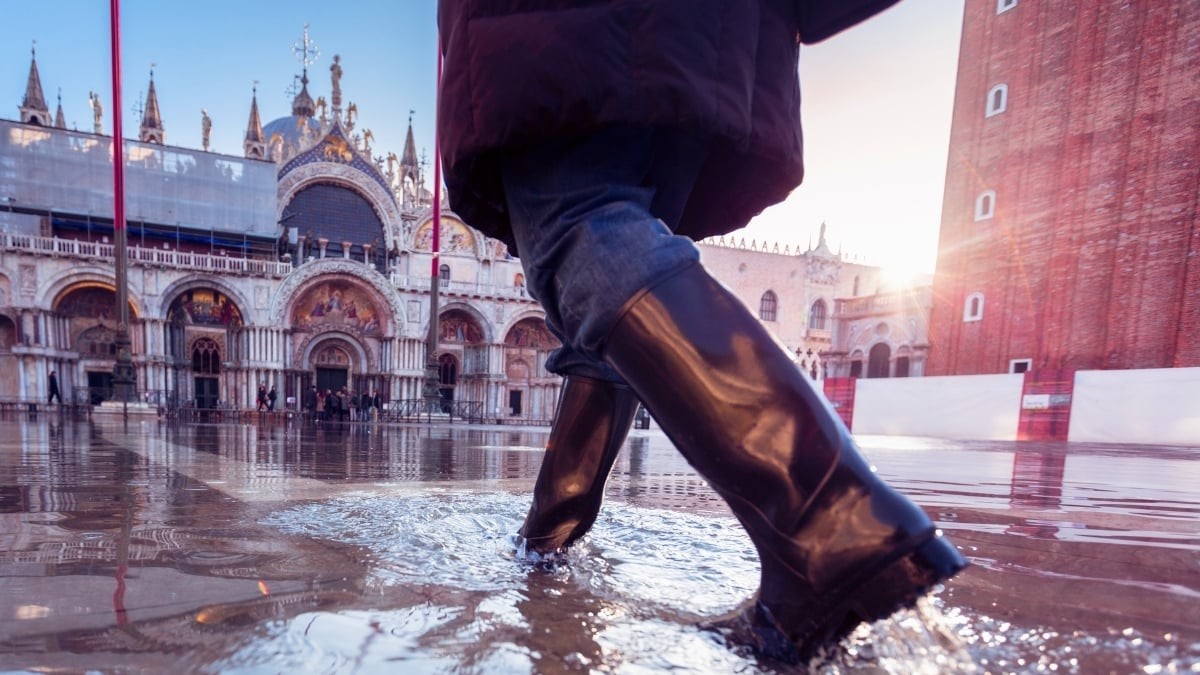
Venice is facing an existential threat. As global sea levels rise and the city itself continues to sink, a new study led by oceanographer Piero Lionello from the University of Salento warns that this UNESCO World Heritage Site could be lost within the next three centuries.
The research, conducted by an international team of scientists, outlines four distinct pathways for the city’s survival. Each option presents a profound trade-off between engineering feasibility, economic cost, and the preservation of the city’s unique cultural and ecological identity.
The Dual Threat: Rising Seas and Sinking Land
Venice is caught in a “pincer movement” of environmental forces. On one side, global warming is driving sea-level rise through two primary mechanisms: the melting of polar ice and the thermal expansion of warming ocean waters. On the other, the city is physically sinking—a process of land subsidence that has plagued the region for centuries.
The urgency is underscored by recent data: of the 28 extreme flooding events in Venice’s history where over 60% of the city was submerged, 18 have occurred in just the last 23 years. Current protections, including the movable barriers installed in 2022, are increasingly insufficient against the accelerating pace of change.
The Four Survival Scenarios
The scientific team has categorized the potential futures for Venice into four distinct strategic models:
1. The “Open Lagoon” Strategy (Incremental Protection)
This is the current approach, which relies on closing lagoon inlets with movable barriers during high tides.
* The Reality Check: While it has cost €6 billion so far, this method has a “shelf life.” Models suggest these barriers will become ineffective once sea levels rise by 1.25 meters —a threshold likely to be crossed by the year 2300 even under low-emission scenarios.
* The Risk: Frequent closures increase the likelihood of mechanical failure and could lead to stagnant water, requiring massive, expensive pumping and sewage systems to maintain hygiene.
2. Ring Dikes (Localized Isolation)
This involves constructing circular barriers approximately 3 meters high around Venice’s main islands to isolate them from the lagoon.
* Pros & Cons: This could protect the city against sea-level rises of up to 6 meters and is relatively affordable (estimated between €0.5 and €4.5 billion ).
* The Trade-off: It would sever the city’s connection to the lagoon ecosystem, potentially damaging the “vibe” and cultural essence that drive Venice’s tourism.
3. The Closed Lagoon (Total Enclosure)
A much more aggressive engineering feat, this involves damming the lagoon inlets entirely and raising the barrier islands to a height of 5 meters.
* Pros & Cons: This offers robust protection against sea-level rises of up to 10 meters, effectively preserving the city’s monuments and housing.
* The Trade-off: It would cost at least €30 billion, destroy the natural lagoon ecosystem, and end Venice’s function as a working port. Constant pumping would be required to prevent the enclosed water from becoming toxic.
4. Managed Retreat (Relocation)
The most radical and heartbreaking option: abandoning the city entirely by relocating residents and moving historic monuments to safer ground.
* The Cost: This is the most expensive path, estimated at €100 billion, covering both the physical relocation of heritage sites and compensation for displaced citizens.
* The Result: The lagoon would be left to succumb to deeper, warmer, and saltier waters, with unknown ecological consequences.
The Race Against Time
The choice facing policymakers is not merely one of engineering, but of values. Do we prioritize the preservation of a living ecosystem, the protection of historical architecture, or the economic stability of a global tourism hub?
“Given grossly insufficient international efforts to reduce greenhouse gas emissions and the inertia of sea level rise, it is essential to contemplate radical transformations for the city of Venice and its lagoon,” the research team concludes.
The study serves as a stark warning: large-scale engineering projects of this magnitude can take up to 50 years to implement. Even if a decision is made today, the window to act before the “open lagoon” strategy fails is rapidly closing.
Conclusion
Venice is running out of time to choose its future. Whether through massive sea walls or a total relocation, the city’s survival will require unprecedented financial investment and a fundamental reimagining of what it means to be a “floating city.”