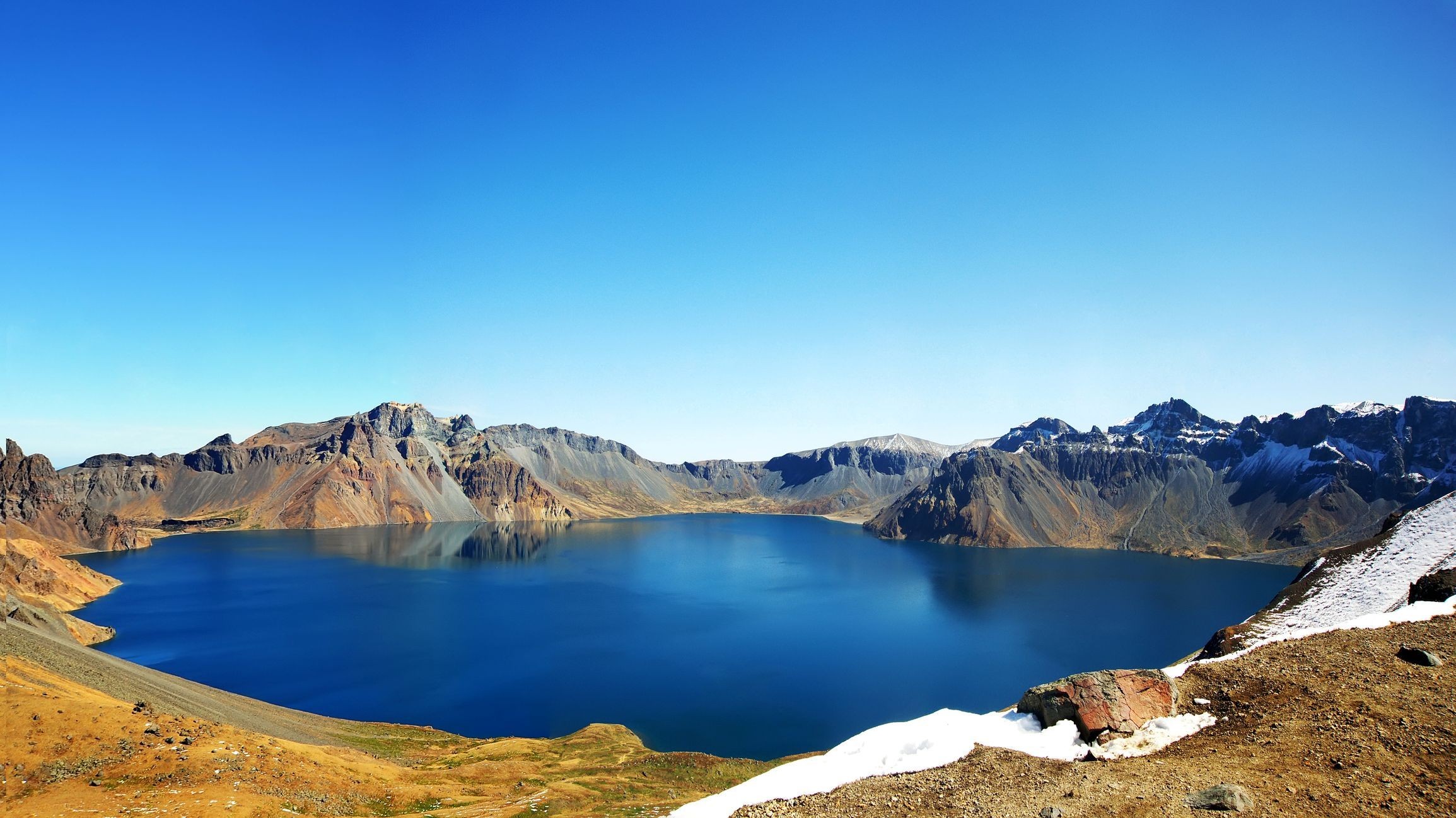
It sits right on the border. Frozen at times, mysterious always.
Heaven Lake—called Tianchi by the Chinese—is the deepest body of water in China. A study released this March confirmed what we already suspected but wanted to be sure about. It reaches down to 1,224 feet. That’s nearly a third of a kilometer of vertical darkness.
But the water is only the interesting part. The rock underneath is what makes it dangerous. What makes it happen.
Built on Explosions
This isn’t just any mountain. Mount Changbaishan is a colossal dormer volcano. It formed over 2.6 million years of repeated eruptions. The lake itself sits in a caldera. A giant crater. The big one happened in 946 AD. They call it the “millennium eruption.”
That blast was massive. One of the largest in recorded history.
But water started pooling earlier. Long earlier. After the Tianwenfeng eruption some 70,00 years ago, rain and snow had somewhere to go. They fell into the summit. Now the lake empties and refills constantly. Geothermal vents push water up from below. Snowmelt pushes it in from above. It’s a system in flux.
The Horse Head Monster
People love to lie about water. Or maybe they love to imagine.
In the early 200s reports circulated. Wild stories of a creature in Heaven Lake. It allegedly had the head of a horse. Hundreds of eyewitness accounts. Tourists swore they saw it.
Scientists don’t care.
Skepticism remains high. The lake is too deep. Too cold. Too nutrient-poor to support large predators.
The mystery persists though. People need something to fear in the deep dark.
An Open-Air Classroom
Geologists look at Mount Changbaishan and see a library.
It is one of the best-preservation stratovolcanoes left. Stratovolcano means “composite.” Layers of lava. Layers of ash. Layers of rocky debris. Stacked up like sediment in a glass of stirred mud. You can read the different stages of eruptions in the walls. UNESCO called it an “open-air classroom.”
The name matters too. In North Korea they call it Paektu. Meaning “white-topped.” The Chinese name implies a mountain forever covered in white. Same view different language.
A Border Drawn in Treaty Lines
The mountain divides countries.
China North Korea and South Korea all fight over the symbolism. The physical geography doesn’t change but the political maps do. Treaties in 1962 then 1964 split the lake in two.
Not evenly.
North Korea gets 54.5 percent of the water. China gets the rest. You don’t just share a lake; you share the pressure beneath it.
Development is accelerating on the Chinese side. A new airport. A railway connecting the eastern mountains to the rest of the country infrastructure follows prestige. In 2024 the Chinese site became a UNESCO Global Geopark. Recognition matters for tourism. It brings the crowds.
Who owns a volcano? Who owns the sky above it?
The lake is quiet right now. The vents are silent. Until they aren’t.