We keep looking for aliens in the radio frequencies.
Wrong place.
If they are smart, and if they are old, they will be hoarding energy. Not just sipping from a river. Drowning in it.
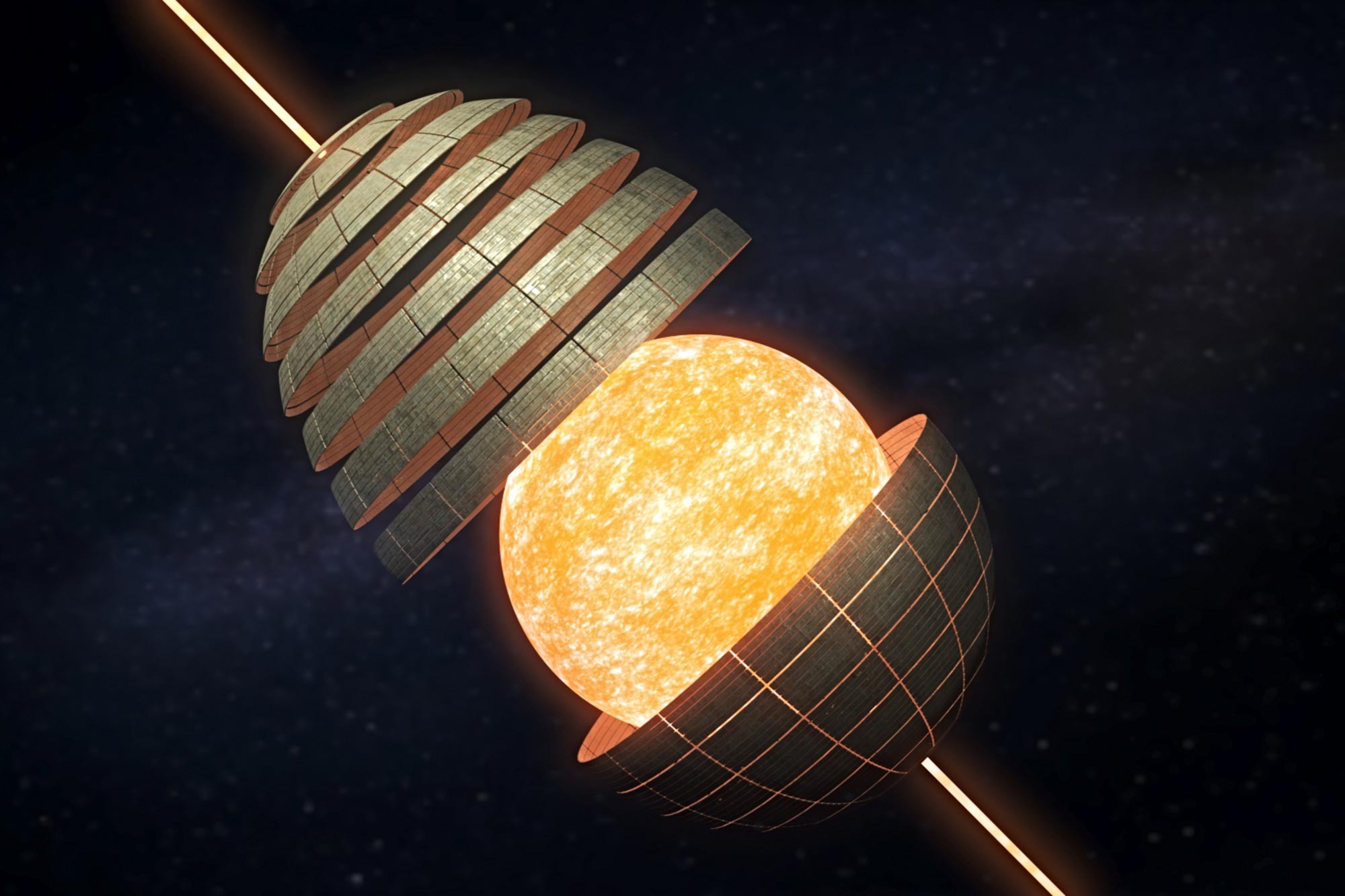
Freeman Dyson suggested this in 1960. The idea is simple enough. A civilization that has outgrown its planet doesn’t build a house around a star. That is structurally insane. Instead. It builds a swarm. Billions of independent collectors floating in a tight orbit.
Capturing nearly every joule the star emits.
It is the ultimate rent-seeking behavior. But it leaves a signature. A cold one.
A new paper on arXiv by Amir Amiri of the University of Arkans asks where we should look first. The answer isn’t our Sun.
It is the stars that burn slow. And the stars that have already burned out.
The Quiet Targets
Red dwarfs.
They are everywhere in the Milky Way. Cheap. Abundant. Long-lived. Some of them will still be glowing when the rest of the universe has gone dark. They last trillions of years.
Since they are small. You don’t need much material to enclose them.
Imagine placing your collectors just 0.05 AU from the surface.
That is close. So close the engineering becomes plausible.
But white dwarfs are even better.
Think about the geometry. A white dwarf is a corpse. A dense. cool. remnant of a star like ours. It has shrunk. Its radius is now about 1% of what it was.
You can wrap a Dyson swarm around a white dwarf at just a few million kilometers.
The surface area you need to cover? Tiny.
The energy output? Steady for billions of years.
It is a reliable power source. And the construction costs are negligible compared to enclosing a giant star.
Why would a Type I civilization build a sprawling city on a sprawling planet when they can wrap a net around a diamond-hard core and get all the juice they need.
The Thermal Tell
Here is the trick.
When a Dyson swarm wraps a star it blocks the light. All of it.
The star vanishes from optical surveys.
But energy does not disappear. It cannot.
The swarm absorbs the starlight. It does whatever the aliens want with that energy. Computation? Fusion? Luxury yachts?
We do not care.
The waste heat must go somewhere.
So the structure re-emits the energy.
As infrared radiation.
Heat.
On a Hertzsprung-Russell diagram which maps stars by temperature and brightness this creates a glitch. The luminosity stays the same. It is just shifted in spectrum. But the temperature drops. Hard.
A red dwarf burns at 3000 Kelvin.
A Dyson sphere around it glows at 50 Kelvin.
Two orders of magnitude cooler.
There are no natural objects in the universe that are that dim yet that cold and compact.
If you see it you know something is wrong.
“The key takeaway is how much further to the right the object appears on the chart.”
Cleanliness matters too.
Natural stars have debris disks. Dust. Silicates. They emit specific spectral lines that look like smudge on a lens.
A Dyson swarm is an artifact. It is built. It has no dust.
The signal should look suspiciously clean.
Too clean for a natural process.
Hunting with Old Tools
We have the telescopes.
James Webb is great at infrared. Obviously. But we do not need new toys to find ghosts.
The WISE telescope has been doing this.
In May 2024. Project Hephaistos sifted through 5 million stars.
They found seven red dwarfs acting strangely. Cold. Bright in the wrong places.
One turned out to be a supermassive black hole in the background. A coincidence. An optical illusion.
Bad luck.
But six. No wait. Five.
Five remain.
They are not confirmed. Of course they are not.
They are just data points that refuse to behave naturally.
Maybe they are something else. Maybe our models are wrong.
Maybe they are just empty space and cold physics.
Or maybe they are watching back.
Amiri’s work gives us a better map. It tells us which corners of the H-R diagram to scrutinize. We are not shooting in the dark anymore.
We know what cold looks like.