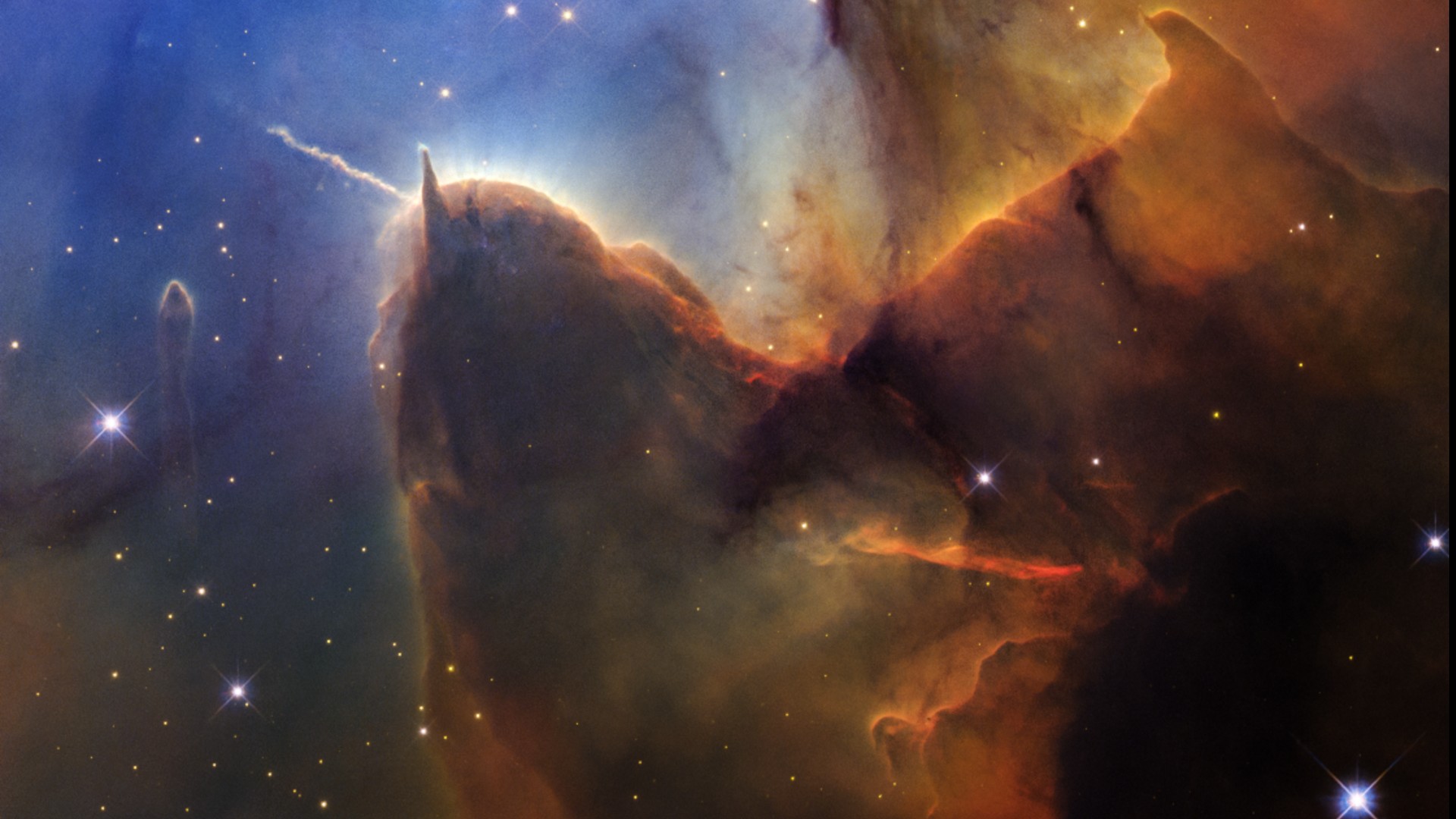
To celebrate its upcoming 36th anniversary, the Hubble Space Telescope has turned its gaze back toward a familiar celestial landmark: the Trifid Nebula (Messier 20). This new snapshot provides more than just a stunning visual; it offers a profound look at how our ability to observe the universe has evolved.
A Stellar Nursery in Focus
Located approximately 5,000 light-years away, the Trifid Nebula is a massive, glowing expanse of gas and dust. It serves as a “stellar nursery”—a region where gravity pulls cosmic material together to ignite new stars.
While the nebula itself is a vast, chaotic cloud, the high-resolution imagery reveals intricate structures that define its character:
– The “Body”: A dense collection of interstellar dust and gas.
– The “Antenna”: A striking protrusion that resembles a horn or antenna. This is not a solid structure but a plasma jet being ejected by a young protostar deep within the nebula.
Why This Comparison Matters
The significance of this new image lies in its relationship to Hubble’s previous observations. The telescope first captured the Trifid Nebula nearly 30 years ago, in 1997. By revisiting the same coordinates, astronomers can achieve two critical goals:
- Observing Cosmic Evolution: While 30 years is a blink of an eye in cosmic terms, comparing images allows scientists to look for subtle changes in the movement of gas and the behavior of star formation.
- Technological Progress: The difference in quality between the 1997 image and this new version is a testament to human engineering. Following the STS-125 shuttle mission in 2009, Hubble was upgraded with more sensitive cameras and a wider field of view. This improved hardware allows us to see through the dust more effectively, revealing details that were previously invisible.
The “Cosmic Sea Slug”
The visual composition of the nebula has captured the imagination of the public, with many noting its uncanny resemblance to a sea slug. This organic, fluid shape is a result of the complex interplay between radiation from newborn stars and the surrounding clouds of gas, which sculpt the nebula into bizarre, life-like forms.
This revisit highlights the dual nature of Hubble: it acts as both a time machine, looking back at what we once knew, and a high-definition lens, revealing what we previously missed.
Conclusion
By revisiting the Trifid Nebula with upgraded technology, Hubble demonstrates how improved instrumentation can transform our understanding of distant star-forming regions. This milestone celebration underscores the telescope’s enduring legacy in mapping the evolution of our universe.