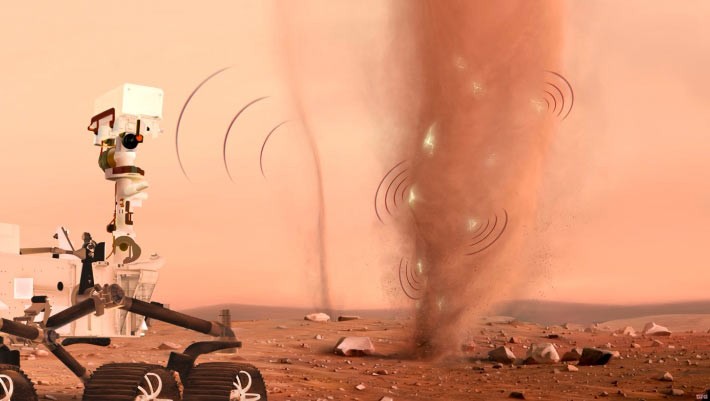
NASA’s Perseverance rover has directly detected electrical discharges in the Martian atmosphere, confirming long-held theories about the planet’s electrical activity. Using its SuperCam microphone, scientists recorded 55 triboelectric events linked to dust devils and storms over two Martian years.
Evidence of Martian Electricity
For decades, researchers have predicted that Mars, like Earth, Saturn, and Jupiter, should exhibit electrical phenomena. Now, data collected by Perseverance provides the first direct evidence of such activity. The study, published in Nature on November 26, 2025, analyzed 28 hours of SuperCam recordings to identify acoustic signatures consistent with electrical discharges.
How It Happens: Dust and Wind
The findings reveal that strong winds play a critical role in generating electrical charge on Mars. Specifically, 54 of the 55 detected events coincided with the most intense wind gusts recorded during the study. Sixteen events were also linked to dust devils, suggesting that even smaller-scale dust lifting can trigger electrical activity.
This differs significantly from Earth, where electricity is largely produced by charge buildup in clouds and violent lightning strikes. On Mars, the thin, dry atmosphere and abundant dust particles create conditions for weaker, yet persistent, discharges through collisions in whirlwinds and dust storms.
“Mars is a cold, dry dusty world… where the wind is sometimes very strong, blowing in gusts and creating whirlwinds,” explains Dr. Agustín Sánchez-Lavega of the University of the Basque Country.
Implications for Future Missions
Understanding the electrical environment on Mars is crucial for both scientific discovery and mission safety. The planet’s surface chemistry is affected by these discharges, and future robotic or human missions must account for the potential hazards of atmospheric electricity. This includes ensuring that equipment is shielded from static buildup and that habitats are designed to minimize risks from dust-related electrical activity.
What’s Next?
The study opens new avenues for research into the Martian atmosphere. Scientists are now eager to investigate how these electrical discharges interact with the planet’s unique chemical composition and whether larger-scale storms generate even more intense electrical phenomena. The discovery suggests that Mars, despite its harsh environment, is far from electrically inert.
This research highlights the importance of in-situ observations for unraveling planetary mysteries and paves the way for a more comprehensive understanding of atmospheric electricity in our solar system.
B. Chide et al. 2025. Detection of triboelectric discharges during dust events on Mars. Nature 647, 865-869; doi: 10.1038/s41586-025-09736-y