A remarkable piece of Roman history has emerged from the soil of Scotland, offering a rare glimpse into the secretive spiritual lives of soldiers stationed at the edge of the empire.
Discovered in 2010 during preparatory work for a cricket pavilion in Lewisvale Park, near Edinburgh, the Altar to Sol is a 1,900-year-old monument dedicated to the Roman god of light. Its recent acquisition by National Museums Scotland brings this unique artifact out of the dark and into the public eye.
A Masterpiece of Light and Shadow
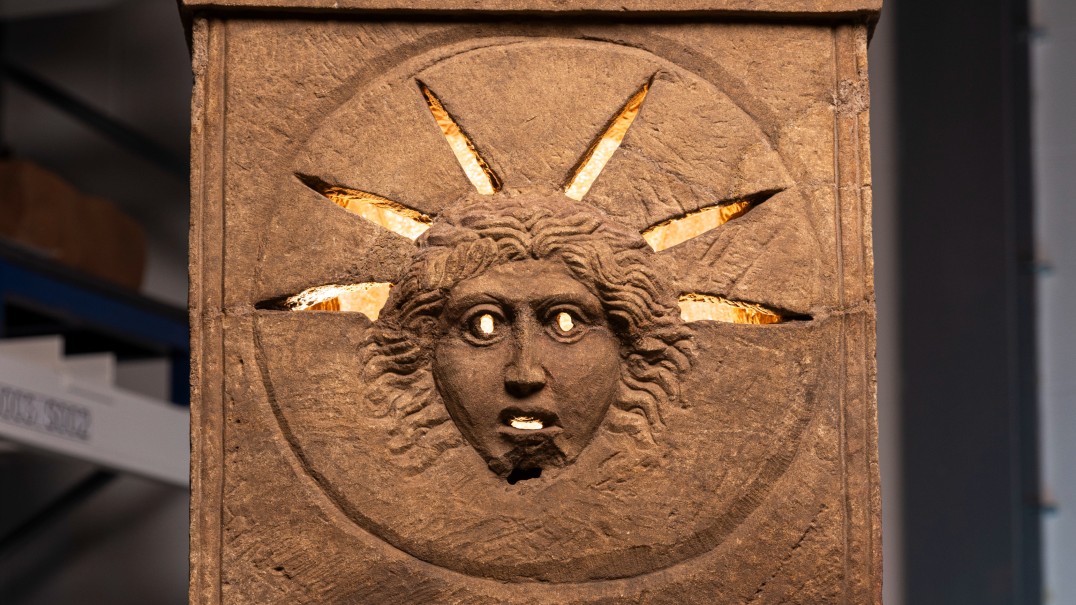
The altar, crafted from buff sandstone, originally stood approximately 1.23 meters (4 feet) tall. It is not merely a stone slab but a sophisticated piece of religious engineering designed to interact with light.
The monument features several intricate carvings:
– The Seasons: Four female busts representing the seasons adorn the top of the altar.
– The Sun God: At its center, the face of Sol rises from an incised circle.
– Illumination Effects: In a striking detail, the eyes, mouth, and the six rays of Sol’s crown were pierced through the stone. This allowed light to shine from behind the altar, creating a glowing, lifelike effect.
– Decorative Details: Traces of red paint remain on the front, while the sides are decorated with carved laurel wreaths.
The Soldier Who Built It
Inscriptions on the altar suggest it was commissioned by a man named Gaius Cassius Flavianus. Historians believe Flavianus may have been the commander of the Roman military base at Inveresk.
Established around A.D. 142, the Inveresk fort served as a vital outpost along the Antonine Wall, which marked the northernmost frontier of the Roman Empire. The presence of such a high-quality, personalized monument suggests that even on the rugged fringes of the empire, Roman officers maintained a high level of cultural and religious sophistication.
Secrets of the Mithraic Cult
The discovery of the Altar to Sol is particularly significant because of its connection to the Mithraic cult, a mysterious and exclusive religious movement popular among Roman soldiers.
The altar was found alongside a second monument dedicated to Mithras, a deity often equated with Sol. This connection points to a specific type of worship characterized by:
– Exclusivity: Membership was restricted to men.
– Secrecy: Rituals were held in Mithraea —temples specifically designed to be located underground.
– Symbolism: The cult celebrated the eternal triumph of light over darkness and good over evil.
“In the dark of the temple, you would see the rays and the eyes of the sun god glaring at you,” says Fraser Hunter, curator at National Museums Scotland.
For the soldiers stationed in the cold, often bleak climate of northern Scotland, these rituals provided more than just spiritual solace; they offered a sense of cosmic order and the promise of life after death.
Historical Significance
These altars are unique within Scotland. They serve as physical evidence of the complex psychological and spiritual landscape of the Roman military. By studying these artifacts, historians can better understand how soldiers managed the isolation and hardship of life on the frontier through shared, secretive traditions.
The Altar to Sol and the altar to Mithras will be on public display at National Museums Scotland starting November 14.
Conclusion: The discovery of these rare altars provides a profound connection to the private lives of Roman soldiers, revealing how they used light and ritual to find meaning in the darkness of the northern frontier.