SET is the kind of game that looks easy until you realize you’re doing advanced geometry without even trying. It is simple. It is deceptive. And it is deeply mathematical.
Every card in the deck varies on four specific traits:
- Shape: Oval, squiggle, or diamond
- Color: Red, green, or purple
- Shade: Solid, striped, or outlined
- Count: One, two, or three symbols
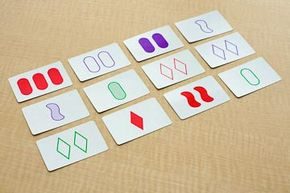
You lay out 12 cards. Your job is to find a SET among them. A SET consists of three cards. For a group to count, every attribute must be either all the same or all different.
Take this example. One card has a solid red oval. The next has two striped green diamonds. The third has three outlined purple squiggles. They look nothing alike. Yet they form a valid SET. Why? Because for each trait, the cards are all different. No two cards share the same value for shape, color, shade, or number.
The rule from the creators is blunt: “If two are… and one is not, then it is not a SET.”
This logic wasn’t pulled from thin air. It was born in 1974. Marsha Jean Falco, a population geneticist, needed to visualize complex data. She drew symbols on cards to represent genetic combinations. The exercise helped her research. It also turned out to be fun.
Her friends and family played along. They pushed her to sell it. By 1990, the game hit U.S. stores. It exploded. Today, hundreds of thousands of copies are in circulation.
The game spans generations. Tournaments draw players ranging from six-year-olds to seniors. The New York Times runs an online version daily. You can play it on a smartphone. You can play it on an iPad.
At its heart, SET relies on set theory. This branch of mathematics studies relationships between sets and dates back to the late 1800s. Playing the game sharpens observation. It teaches problem-solving.
Researchers have even linked the game’s structure to computer coding and geometric simplification. It sounds intimidating at first. It isn’t. Once you see the pattern, the rules click.
We have covered the basics. The next step is mastering the game. We will share tips and a 12-card puzzle on the next page.

Why SET is a Brain-Training Staple
If you want to get better at SET®, you aren’t just playing a game. You are sharpening three specific cognitive muscles: concentration, pattern recognition, and quick thinking. The game forces these skills into action every single time you pick up the cards.
It’s not just about speed. It’s about neurology. Playing SET builds connections between the right and left hemispheres of your brain. They partner up to evaluate, sort, and match the images on the cards. You don’t need a partner to get this benefit either. SET can be played solo, making it a convenient workout for your grey matter.
Classroom and Club Applications
But it’s not just a solo exercise. Multiple people can play simultaneously, racing to find the most SETs in the least amount of time. The competitive edge keeps players on their toes.
Beyond casual play, the game has serious academic roots. Some mathematics club meetings are organized entirely around it. Teachers use it in classrooms, spanning from elementary through high school. The goal? To encourage students to whet their thinking skills and gain a hands-on understanding of mathematical theory.
Using the cards, students can work through set theory and its operations. This includes concepts like union, intersection, complement, and symmetric difference. It turns abstract math into something tangible.
The Rules of Engagement
So, how do you actually play?
Deal a 12-card spread. If that spread does not contain any SETs, three additional cards may be dealt. It can take up to 21 cards to find a single SET. All players try to find SETs. When one is found, the player points it out. The SET is removed, and three new cards are added from the deck.
If a SET cannot be made, three more cards are added. Play continues until the deck of 81 cards is depleted and all possible SETs are made. There may be six or nine cards left over that do not form a SET.
To determine a winner among multiple players, one point is awarded per SET found. One may be subtracted for each invalid SET pointed out. The player with the most points at the end of the game wins.
The Final Verdict
Whichever way you decide to play SET, one thing’s for certain: You’ll get a mental workout — whether you realize it or not.