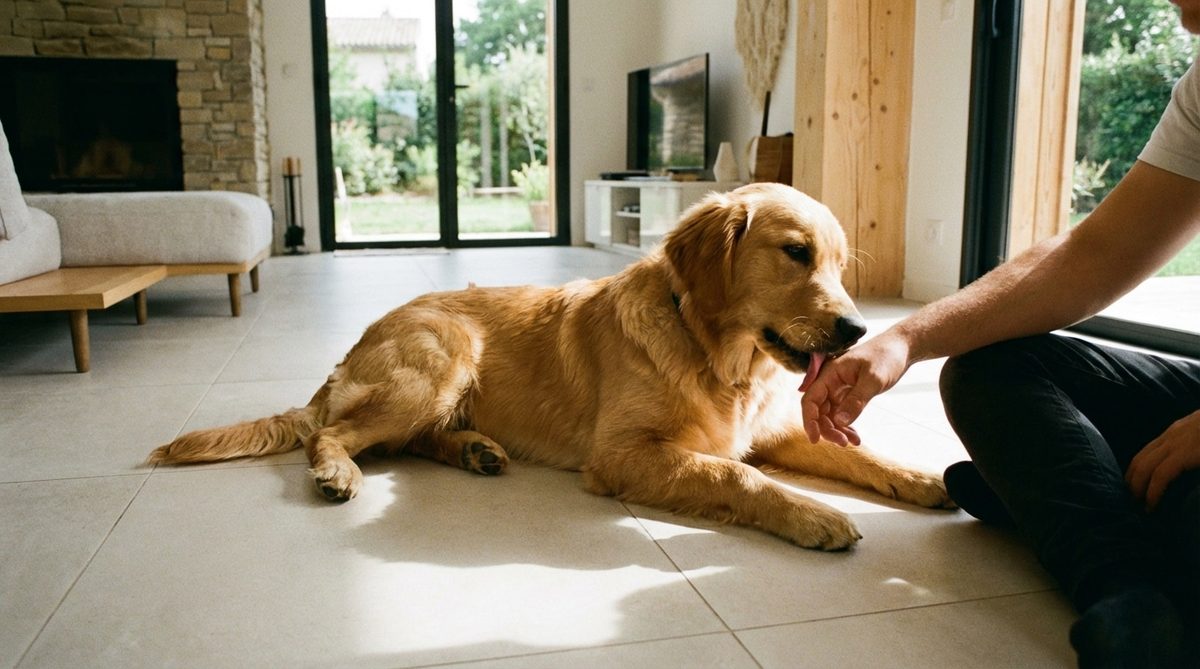
You love your dog. There is no debate there. But that wet, sandpaper tongue meeting your skin every time you try to collapse onto the couch? That is becoming a problem. It is late winter. We are stuck inside more than usual. The air is dry. The cohabitation is getting literal. Sticky, even.
The gesture usually starts with good intentions. Pack instinct. Affection. It transforms quickly into a daily nightmare. Your clothes become sponges. Your hands are perpetually damp. It is time to figure out what is happening in that canine head. You need to set boundaries. Healthy ones. Without hurting the dog’s feelings. Or your own sanity.
The hidden anxiety behind the compulsive lick
It is easy to see every lick as a kiss. A sign of unconditional love. But anthropomorphism lies. It blinds us to ethological reality. When the licking becomes repetitive and invasive, it is rarely innocent.
Is the tongue a barometer for stress or boredom?
Licking is a communication tool. It is an apaisement mechanism. Puppies are licked by their mothers. They lick to ask for food. They lick to show submission. This is normal.
Adults? Different story. If your dog grooms you for twenty minutes, we have left the realm of affection. This is often a sign of latent anxiety.
The act releases endorphins. Immediate soothing effect. It is behavioral self-medication. The dog licks you to lower its own tension. Or to stave off mortal boredom. The tongue becomes a coping mechanism for stress.
Why your negative reaction feeds the need for interaction
This is where most households fail. The dog starts the big cleaning of your hand. What do you do? You push it away gently. You sigh. You say “stop it” with exasperation.
For an attention-seeking dog, any reaction is a victory.
Your irritation is perceived as social interaction. Paradoxically, in trying to stop the behavior, you validate it involuntarily. The dog learns that the tongue brings your gaze. It brings your voice. Even if that voice is scolding.
Strategic ignorance: the only way to cut the flow
If classic reprimands fail, you must change paradigms. Current veterinary data points toward a less intrusive approach. One that is redoubtably more effective. Behavioral extinction through non-response.
Why physical pushing or saying “no” is a win for the dog
Imagine the scene. The dog licks. You push it away with your hand. In its body language, you just initiated physical contact. Maybe even a play phase. The word “no”? It is a vocalization directed at it. Both are interactions. The goal—capturing your attention—is reached.
The vicious cycle sets in. The more anxious or demanding it is, the more it licks. The more you react, the more you reinforce this strategy. Understand this: for a dog, indifference is more punitive than conflict.
The statue technique: freeze and look away
Here is the method that saves frayed nerves. The statue technique.
The moment the tongue touches your skin, freeze. Cross your arms. Look at the ceiling. Say absolutely nothing. If the dog persists or jumps up, stand up calmly. Leave the room. No words. Close the door behind you for a few seconds.
The message is clear. Binary. Emotionless. Licking causes your immediate disappearance. It is radical. The dog, pragmatic by nature, will cease a behavior that offers no social benefit.
It takes patience. The extinction burst might come first—the dog licks harder, barks, whines. Wait it out. The silence is the tool. The absence is the reward. You are teaching the dog that the old lever no longer works.
It is not about love. It is about clarity. The dog needs to know that the behavior has consequences. Specifically, the consequence of nothing.
And you? You get your dry hands back. For now.
Stop Punishing, Start Rewarding the Quiet
Ignoring a nuisance behavior is only half the battle. If you simply stop the licking without offering a replacement, you create a vacuum. Nature abhors a vacuum, and so does a dog’s mind. Once you cut off the attention fueling the compulsive licking, you must actively validate the behavior you actually want: stillness.
Catching Calm Before It Happens
Timing is everything. Do not wait for the dog to jump up or salivate before you react. Watch the animal. Is he lying quietly in his bed? Is he sitting beside you without trying to initiate contact? That is the exact moment to intervene.
A gentle stroke, a soft word, or a small treat validates that state of peace. The dog learns quickly that attention is earned through restraint, not through excessive saliva. This is a complete rebalancing of the relationship. You are rewarding serenity rather than fighting against agitation. It shifts the dynamic from correction to cooperation.
Channeling Energy into Mental Calm
If the licking stems from boredom or stress, that energy must be redirected elsewhere. Instead of serving as the object of this compulsion, offer appropriate chewing or licking activities. Licking mats smeared with pâté or natural rubber toys stuffed with treats are excellent tools.
These items allow the dog to satisfy the physiological need to lick—which releases calming hormones—but on a designated object. You save your skin while respecting the animal’s natural instincts. It is a practical solution that addresses the root cause, not just the symptom.
Reclaiming Your Dry, Peaceful Home
Getting back to a dry, comfortable daily life is not magic. It requires consistent, benevolent rigor. By stopping responses to invasive solicitations and valuing every moment of calm, you transform an anxiety-inducing habit into a relaxed bond.
Think about it. Is it not more pleasant to share a moment of silent companionship by the fireplace in the late season, rather than constantly wiping your hands? The choice is between managing a problem or enjoying a partnership. The path is clear.