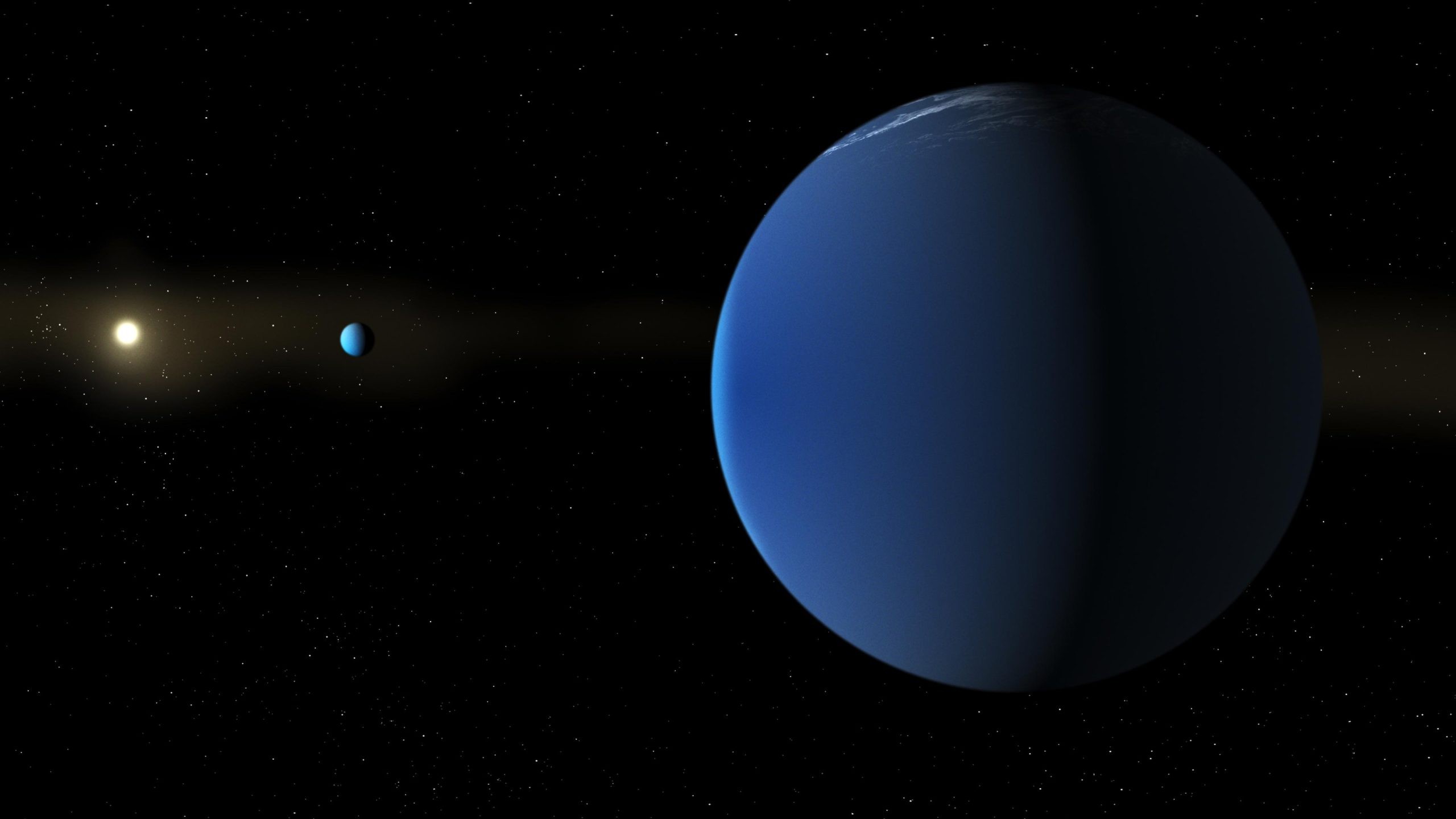
The cosmos is messy. Sometimes, it breaks the rules.
Two new planets, TOI-791 b and c, have just shattered expectations for what a giant world can look like. They are super-puffs. Not just fluffy, but impossibly light. Less dense than the cotton candy you’d buy at a state fair.
An international team led by the University of Oxford spotted them. The findings land in Monthly Notices of the Royal Astronomical Society. This isn’t just another exoplanet. It’s a puzzle piece that doesn’t seem to fit the picture we’ve built.
The Densities Are Absurd
Here is the baseline: Jupiter. It’s the king of gas giants. Average density? 1.33 grams per cubic cm. Solid. Compacted. Heavy.
TOI-791 b? 0.038 g/cm³.
TOI-791 c? 0.047 g/cm³.
Earth? 5.5 g/cm³. A rock.
Cotton candy? About 0.05 g/cm³.
These planets are lighter than sugar spun into clouds. They are the size of Jupiter but contain a fraction of the material. If Jupiter were a bowling ball, these two would be beach balls filled with helium. How did this happen? Physics suggests matter clumps. Gravity pulls. But here, the clump is barely holding on.
The star they orbit? An F7-type dwarf. 1,110 light-years away. In Volans, a southern constellation you probably won’t spot from your backyard.
A Rare Twin Dance
Most single-planet systems are boring. Or so we thought.
TOI-791 has two. Both are super-puffs.
Only four other known systems have more than one. This rarity makes TOI-791 a goldmine. It’s a natural laboratory. The planets formed from the same dust disk. They are siblings. But they didn’t just drift apart. They are locked in a 5:3 mean-motion resonance.
Let that sink in.
For every five orbits the inner planet completes, the outer one does almost exactly three. Their gravity tugs on each other. It’s a gravitational handshake, repeated for millions of years. This pull changes the timing of their transits. They cross the star’s face not on the beat, but off-key. Slightly early. Slightly late.
That wobble told the astronomers how much these planets weigh. Even though they look huge, they are barely there.
Citizen Scientists and Antarctic Cold
Who found them?
Volunteers.
Via Planet Hunters TESS. These aren’t PhDs staring at code. They are everyday people scanning data from NASA’s Transiting Exoplanet Satellite Survey (TESS). They saw the dips. The shadows. In 2019 and again in 2023.
Then the pros stepped in. Telescopes across the globe. Data crunching. Mass calculation. Density confirmation.
But the key? The ice.
The ASTEP telescope. Located at Concordia Station in Antarctica.
Why Antarctica? Because during winter, the sun doesn’t rise. Not for weeks. Or months. Continuous darkness. No daylight to ruin the view. You need that. To catch a transit that lasts 11 hours straight. You need an unbroken eye on the sky.
These were the longest continuous ground-based transits ever recorded. The planets took more than half a day to pass in front of their star. And thanks to the Antarctic winter, the astronomers didn’t blink.
Why Are They So Puffy?
We don’t know yet.
That’s the honest answer. Scientists are guessing.
Hypothesis one: Massive atmospheres. Envelopes of hydrogen and helium so thick they balloon the planet out. The core might be small. The gas takes up space. It expands until… something stops it? Gravity? Thermal pressure?
Hypothesis two: They formed far away. Cold. Far from the heat of the star. Gas cooled quickly. Accumulated around a core. Created a lightweight outer shell. Then maybe migrated inward? Or maybe they stayed put?
“Only a handful of these super-puffy planetes are known, and it is even rare to find two in the same system.”
— Dr. George Dransfield, University of Oxford
The low density is the mystery. If they are mostly gas, why isn’t gravity crushing them? Why is the envelope so tenuous?
What Comes Next?
The James Webb Space Telescope.
It’s the next step. The UK Principal Investigator for ASTEP, Professor Amaury Triaud, wants to look at the chemistry. Carbon. Nitrogen. Oxygen.
If you can read the atmospheric fingerprint, you can trace the history. Where did the materials come from? What was the temperature when they formed? Did they evaporate? Did they stay intact?
Professor Tristan Guillot sees the bigger picture. Multi-planetary systems. Long-term interactions. Evolution over tens of years. This requires teamwork. Antarctica. Space telescopes. Observatories on other continents. All linked.
Without that collaboration, the truth stays hidden in the dark.
We are looking at ghosts. Giant, gas-filled ghosts that shouldn’t exist according to our models. They defy density. They defy simplicity. They are super-puff planets.
And we’re just starting to understand them.