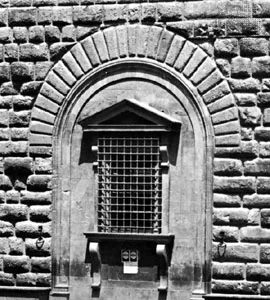
Stone walls don’t always have to be smooth. They can be rough. jagged. Bold. This is the essence of rustication. It is a masonry technique in which architects cut the ridges of the stones into flat planes, while the center of the block is either deeply textured or protrudes aggressively. The result is a surface that feels heavy, solid and visually striking.
The roots of this style go back further than most people realize. Early examples can be found in the tomb of Cyrus the Great in Pasargadae, Persia. This platform dates back to around 560 BC. It wasn’t just decorative either. Greek and Hellenistic builders used it for retaining walls and terraces. They needed structure. They needed it to look strong.
The Romans took this utilitarian approach and ran with it. They used it to build aqueducts. But they also saw the potential for beauty. They used it for decorative purposes. Look at the Porta Maggiore from the first century AD. The stones there are roughly hewn. Look at the Temple of Augustus in Vienne, France. There, the rustication is more refined, but the effect is the same: the texture creates interest.
Then came the renaissance. Italian architects in the 15th century concluded that this was not just retaining walls. It was for palaces. They made it the star of the show.
This is clearly visible in Florence. Pitti Palace (1458). Medici-Riccardi Palace (1444–1459). Strozzi Palace (circa 1489). In all these cases, careful rustication is not an afterthought. It is the primary decorative element. The walls themselves become art.
Later episodes pushed it further. Mannerist and Baroque designers got creative. They wanted a fantastic finish. They invented vermiculated work. That’s where the stone looks like it was eaten by worms. Wavy, serpentine depressions cover protruding parts. Or they use vertical shapes that look like dripping wax. Sometimes they beveled the sides until the stone formed a sharp ridge in the middle. It was dramatic. It was theatrical.
This style eventually crossed the channel. Inigo Jones brought rustication to England. In the 17th and 18th centuries it was everywhere in English masonry.
Why is it important today? Because rustication changes the way we perceive weight. A smooth wall feels light. It feels like skin. A rusticated wall feels like it was carved from the earth itself. It anchors the building. It shows you that it’s what’s inside that matters because the foundation seems to be able to hold the world.
There’s a reason why these walls still make us stop and look. It’s not just history. It’s texture. It is the difference between surface and substance.