


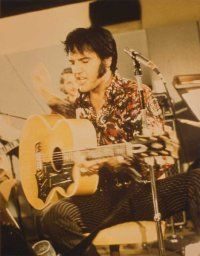
MGM didn’t just release movies starring Elvis Presley. They released documentaries. Real ones. Two feature-length films captured his live performances at the absolute peak of his career. These weren’t polished Hollywood musicals. They were raw, unvarnished records of a man back on stage.
Elvis — That’s the Way It Is came first. Released in November 1970, it was built around his August engagement at the International Hotel in Las Vegas. The film gives you the full experience. About half the runtime is pure performance. You see him onstage in the main room. Specific segments, like his renditions of “Mystery Train” and “Tiger Man,” were actually filmed at a Phoenix concert. But the rest? That’s the behind-the-scenes chaos.
You see him in rehearsal. He whips his band into shape. He masters new material for the act. Intercut with that are shots of the massive promotional buildup in Las Vegas. The team even sent a film crew to Luxembourg to record an Elvis Presley convention. It was a global moment.
Denis Sanders directed the film. He had already won an Oscar for Best Documentary for Czechoslovakia 1968. The cinematography was handled by Lucien Ballard. He used eight Panavision cameras to catch the excitement. The result was immediate. The film opened to good reviews. The Hollywood Reporter noted that Elvis was likely the only entertainer alive who could draw enough people into a theater to make a documentary profitable. It introduced him as a live performer to a young audience. They didn’t remember the 1950s. They only knew the movies. This film changed that.
Elvis on Tour and Critical Acclaim
Two years later, MGM released another feature-length documentary. Shot in the spring of 1972, Elvis on Tour focused on his road show during a 15-city tour. This film captures the final phase of his career at its highest point.
Pierre Adidge and Robert Abel produced it. They had won critical acclaim for their rock documentary Joe Cocker: Mad Dogs and Englishmen. The editing was supervised by Martin Scorsese. He also worked on the editing of Woodstock. Andrew Solt did research on the film. He later coproduced This Is Elvis and Imagine, a film about John Lennon.
The film won a Golden Globe for Best Documentary of 1972. It remains the only Elvis Presley movie to be honored with an award of any kind.
The Cost of the Road
Elvis’ return to concert performing probably contributed to the disintegration of his marriage to Priscilla. He was gone from Graceland much of the time. He saw less of Priscilla and his daughter, Lisa Marie, as his career and lifestyle took a different direction. The pace was horrendous. Performing in a different city every night made traveling together difficult.
Elvis enforced a “no-wives” rule while on the road. It applied to himself and all members of the Memphis Mafia. Priscilla left Elvis in early 1972. Elvis sued for divorce the following August. His lawyer summed up the problem succinctly. He released a statement saying Elvis had been spending six months a year on the road. That put a tremendous strain on the marriage.
The couple officially divorced in October 1973. It was an amicable split. They held hands during the proceedings. They walked out of the courtroom arm in arm.
The years 1969 through 1973 were incredibly creative for Elvis. He returned to performing live. He developed a new sound. He developed a new image. It completely replaced the singing-movie-star image he believed never matched his talents. Dressed in gold and jewels, this Elvis Presley lived up to the titles “World’s Greatest Entertainer” and “The King of Rock ‘n’ Roll.”
By the mid-1970s, the constant touring began to wear on him. The physical toll was mounting. The mental strain followed. The end of the road was approaching.
For more fascinating information about Elvis Presley, see:
-
Elvis Presley
-
Elvis Presley Quotes
-
Elvis Presley Collectibles
-
Elvis Presley Songs
-
Elvis Presley Movies


