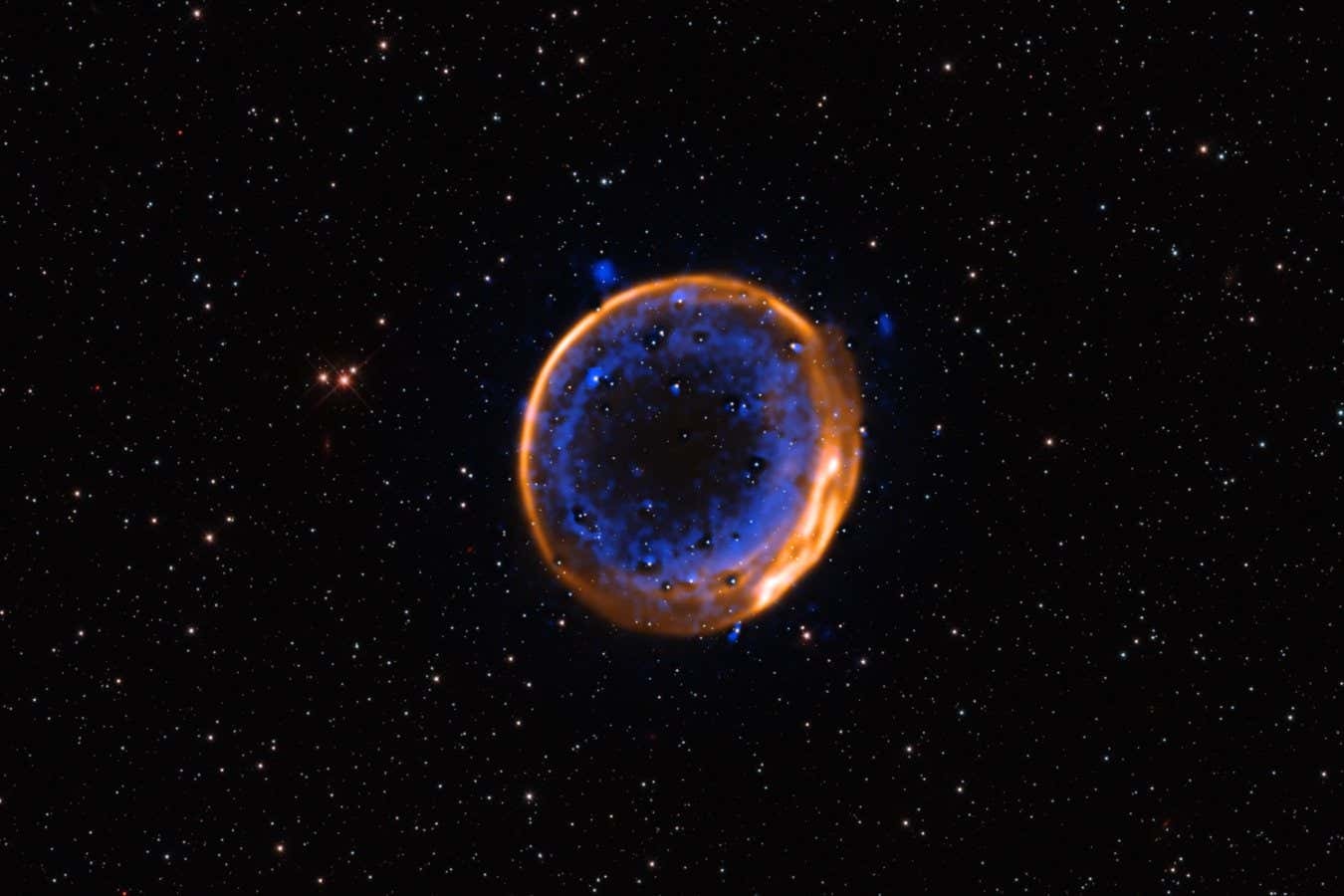
2025 has been a landmark year for space exploration, marked by both spectacular successes and fiery setbacks. From rare astronomical events to groundbreaking commercial landings, the cosmos delivered awe-inspiring visuals that redefine our understanding of the universe.
Double-Detonating Supernova: A Stellar Afterlife
One of the most remarkable images captured this year depicts a rare double-detonating supernova, observed by the European Southern Observatory’s Very Large Telescope in Chile. This two-toned sphere is the result of a white dwarf star, once similar to our Sun, exhausting its fuel and exploding after siphoning helium from a companion star. The initial explosion occurred roughly 300 years ago; had it not been obscured by the Sun, it would have been visible as one of the brightest objects in the southern sky. This event illustrates the violent end-stages of stellar evolution, reminding us that even stars meet a dramatic fate.
SpaceX Starship: Triumph and Turbulence
SpaceX’s Starship, the most powerful rocket ever built, experienced a turbulent 2025. While a successful orbital test flight in August offered a glimpse of its potential for future Mars missions, previous launch attempts ended in spectacular failures – or “rapid unscheduled disassemblies,” as SpaceX calls them. One such incident was captured by James Temple, who witnessed the fiery breakup of the seventh test flight over the Turks and Caicos Islands. Starship’s development highlights the inherent risks of pushing the boundaries of space technology, where failure is often a stepping stone to innovation.
Commercial Lunar Landings: A New Era of Exploration
Firefly Aerospace’s Blue Ghost lander achieved a historic milestone in March, becoming only the second commercial spacecraft to land on the Moon – and the first to do so upright. After a 45-day journey, it touched down in Mare Crisium, snapping a selfie of its own shadow under the distant Earth. This success demonstrates the growing role of private companies in lunar exploration, signaling a shift from traditional government-led missions.
Space Station Logistics: Filling the Gap
With NASA’s Starliner spacecraft deemed unsafe for crew returns, SpaceX continued to fill the gap, ferrying astronauts to and from the International Space Station. One image captured a SpaceX Dragon capsule splashing down near a pod of dolphins, carrying two NASA astronauts who spent nine months stranded on the ISS. This situation underscores the critical role SpaceX now plays in maintaining human presence in low Earth orbit, especially as NASA navigates challenges with its own programs.
Rubin Observatory: Mapping the Cosmos
The Vera C. Rubin observatory began operations this year, poised to scan the night sky daily for the next decade. Its first images included the Trifid and Lagoon Nebulae, stellar nurseries 4,000 to 5,000 light-years away, stitched together from 678 exposures over seven hours. Rubin’s continuous monitoring will revolutionize our understanding of transient phenomena in the universe, from supernovae to asteroid movements.
Lunar Eclipse Over Tokyo: A Celestial Spectacle
In September, a lunar eclipse transformed the Moon into a striking red hue, visible in Tokyo and around the world. This color shift occurs because Earth’s atmosphere scatters sunlight, leaving red wavelengths to illuminate the lunar surface. The event served as a vivid reminder of the dynamic interplay between Earth and its celestial companion, capturing the imagination of observers worldwide.
The images from 2025 represent not just scientific achievements, but a testament to humanity’s enduring fascination with the cosmos. Each photograph encapsulates a moment of discovery, risk, and beauty, solidifying space exploration as a defining endeavor of our time.