We might have found dark matter by accident. Back in 2019, really.
It isn’t a confirmed hit. Not yet. But scientists are looking at the debris of black hole collisions—ripples in spacetime—and they think there’s a ghost in the machine. Specifically, the shadow of a dark matter cloud.
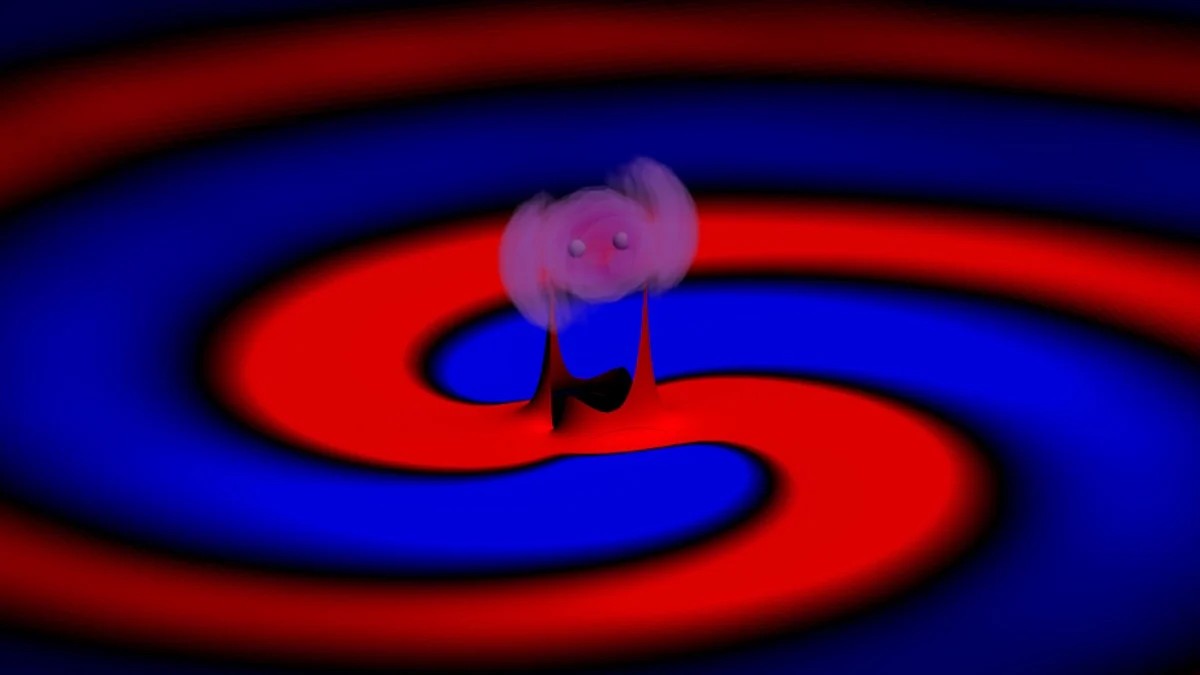
Physicists from the US and Europe have a new theory. If two black holes smash into each other inside a thick cloud of this invisible stuff, the gravitational waves screaming out across the cosmos carry a unique signature. Like a fingerprint left in the dust.
They tested their math on dozens of recorded events. Almost all of them were boring vacuum mergers. Just standard cosmic violence in the emptiness.
One was different.
One event from July 2019—designated GW190720—doesn’t fit the mold of a clean merger. It fits the model of black holes dancing through a dense fog of ultralight particles.
It’s provocative. It’s not proof. But it’s a hint.
“Using black holes to look for dark matter, would be fantastic.”
Rodrigo Vicente at the University of Amsterdam thinks this opens a whole new scale for exploration. Smaller scales. Places we can’t touch, only listen to.
Here is the background, because you need to understand the history to get the hype.
In 1916 Einstein said gravity was the curvature of spacetime. He predicted that massive objects moving fast enough—like neutron stars or black holes—would shake the universe like a bell. Those ripples are gravitational waves.
It took until 2016 to hear that ring clearly. LIGO caught the sound. Since then, hundreds of chimes have been recorded. Every signal tells a story about the masses involved. Usually it’s straightforward. A big hole eats a small hole. Two neutron stars kiss and explode.
But what else is in the room when they merge?
The new study asks that.
Dark matter makes up most of the matter in the universe. We don’t know what it is. We just know it pulls on things. One popular theory says it’s made of ultralight particles that act like waves. If you put a spinning black hole near that wave field, it drags the stuff around. It twists the fog.
When a second black hole comes in to collide with the first one, that fog resists. It changes the dance. The resulting gravitational wave looks slightly off. Different than a merger in a hard vacuum.
The researchers built a model of that interference. Then they checked 28 signals from the LVK network—that’s LIGO in the US, Virgo in Italy, KAGRA in Japan.
Twenty-seven were vacuums. Clean. Predictable.
Event GW190729 showed up with the messier signature. The kind you’d expect if dark matter were there, thick and present, interfering with the final moments before collision.
Is it definitive?
No.
Josu Aurrekoetxea at MIT says the statistics aren’t strong enough to claim a victory. He says independent groups need to check the work. Right now, we’re just scratching the surface.
“Without waveform models like ours, could be detecting black hole mergers, in dark matter, but classifying them as, having occurred, in vacuum.”
That’s the risk. We might have been hearing them all along, but calling them something else.
Still, the uncertainty remains massive. Maybe dark matter doesn’t form clouds. Maybe it’s WIMPs. Maybe it’s MACHOs. Maybe it interacts with electromagnetism. Maybe it doesn’t exist at all, and we just have a bad understanding of gravity.
The sky is loud. The data is there. But the answer is still hiding in the static. We keep listening.