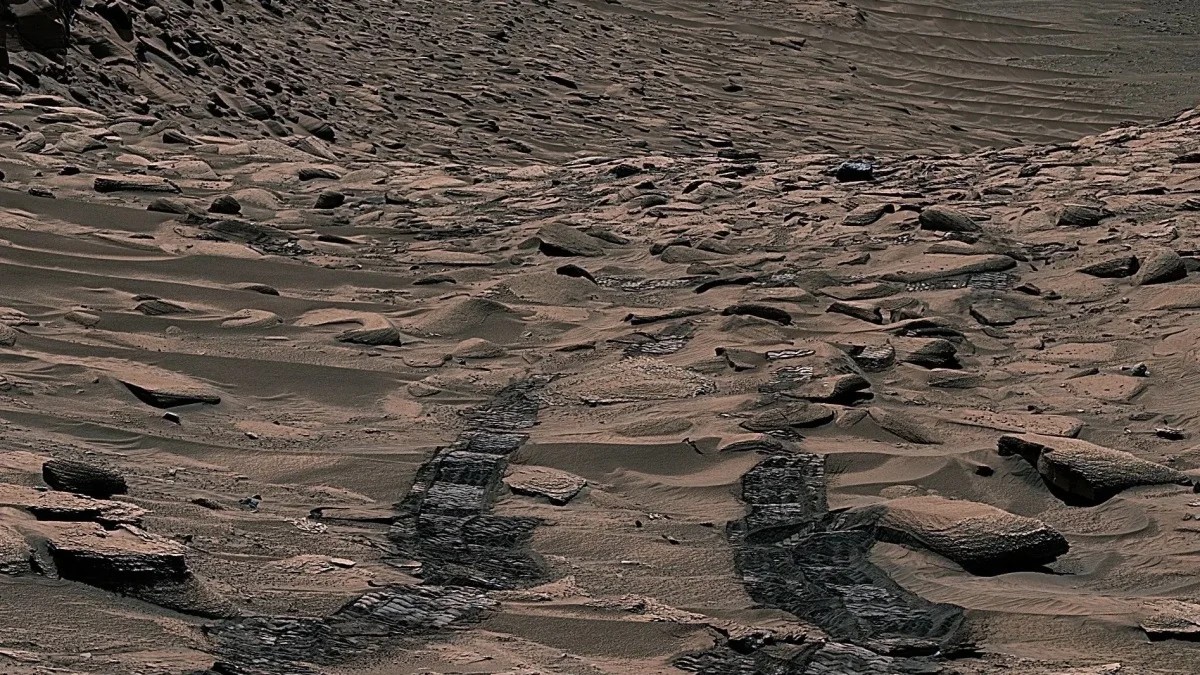
A new two-minute video from NASA’s Curiosity rover is more than a cinematic tribute to six years of exploration; it is a critical scientific instrument.
While the footage offers a stunning visual summary of the rover’s ascent up Mount Sharp inside Gale Crater, its primary purpose is analytical. By tracking the movement of sand and dust on the rover’s deck and within its treads, scientists can distinguish between debris displaced by the vehicle’s own motion and particles shifted by Martian winds. This distinction provides vital data on seasonal atmospheric changes on Mars, helping researchers understand how weather patterns evolve over time.
Decoding Martian Weather Patterns
The timelapse was compiled from images captured by Curiosity’s right navigation camera between January 2, 2020, and March 8. As the rover traverses the crumbling lithic landscape, the camera records the behavior of fine particles on its surface.
“Distinguishing between sand jostled by each drive and wind gusts can provide new information about seasonal changes in the atmosphere,” NASA stated.
This method allows scientists to isolate wind activity from mechanical disturbance. By analyzing these shifts, researchers can build a more accurate model of Mars’ current climate dynamics, which is essential for understanding the planet’s environmental history and future potential for exploration.
The Quest for Ancient Life
Curiosity’s mission, which began with its landing on August 5, 2012, after a 352-million-mile journey, was fundamentally designed to answer one question: Did Mars ever have conditions suitable for life?
The answer came quickly. Within a year of landing, the rover drilled into an ancient lakebed and confirmed that the region possessed the necessary chemical ingredients and potential nutrients to support microbial life in the distant past.
Since then, Curiosity’s internal chemistry lab has continued to yield significant discoveries. A recent study highlighted the detection of 21 different organic molecules in a single rock sample—the largest variety found on Mars to date. These include preserved complex carbon materials. While these molecules could be biological in origin, NASA cautions that non-biological processes, such as chemical reactions between water and rock, could also produce them.
Engineering Against the Elements
Beyond scientific discovery, the mission faces constant physical challenges. The Martian terrain is harsh, with sharp rocks that have severely damaged Curiosity’s wheels since the mission’s early days.
To mitigate this wear and tear, engineers have implemented several strategic adjustments:
* Driving in reverse: This technique helps reduce the stress on damaged wheels.
* Software upgrades: New controls allow for more precise management of individual wheel speeds, helping the rover navigate jagged surfaces with greater care.
These adaptations have kept Curiosity operational, allowing it to travel 23 miles across the Martian surface despite the physical toll.
In contrast, the newer Perseverance rover, launched after Curiosity, was designed with lessons from these challenges in mind. Perseverance features harder wheels made from thicker aluminum, with each wheel powered by its own motor. This design allows for greater agility and durability, enabling the rover to dodge hazards more effectively.
The Dust Threat
Wheel damage is not the only existential threat on Mars. Previous missions, such as Spirit and Opportunity, ended when dust storms choked their solar panels, cutting off their power source.
Curiosity and Perseverance avoid this specific fate by using radioisotope thermoelectric generators (RTGs) for power, which are not dependent on sunlight. However, dust accumulation remains a concern for mechanical components and instruments. The ongoing monitoring of dust movement—captured in the recent timelapse—helps engineers predict and manage these environmental hazards, ensuring the longevity of current and future missions.
Conclusion: The Curiosity rover’s timelapse serves a dual purpose: it visually documents a historic journey while providing precise data on Martian atmospheric behavior. This blend of aesthetic appeal and scientific utility underscores the rigorous engineering and observation required to sustain long-term exploration on another planet.