


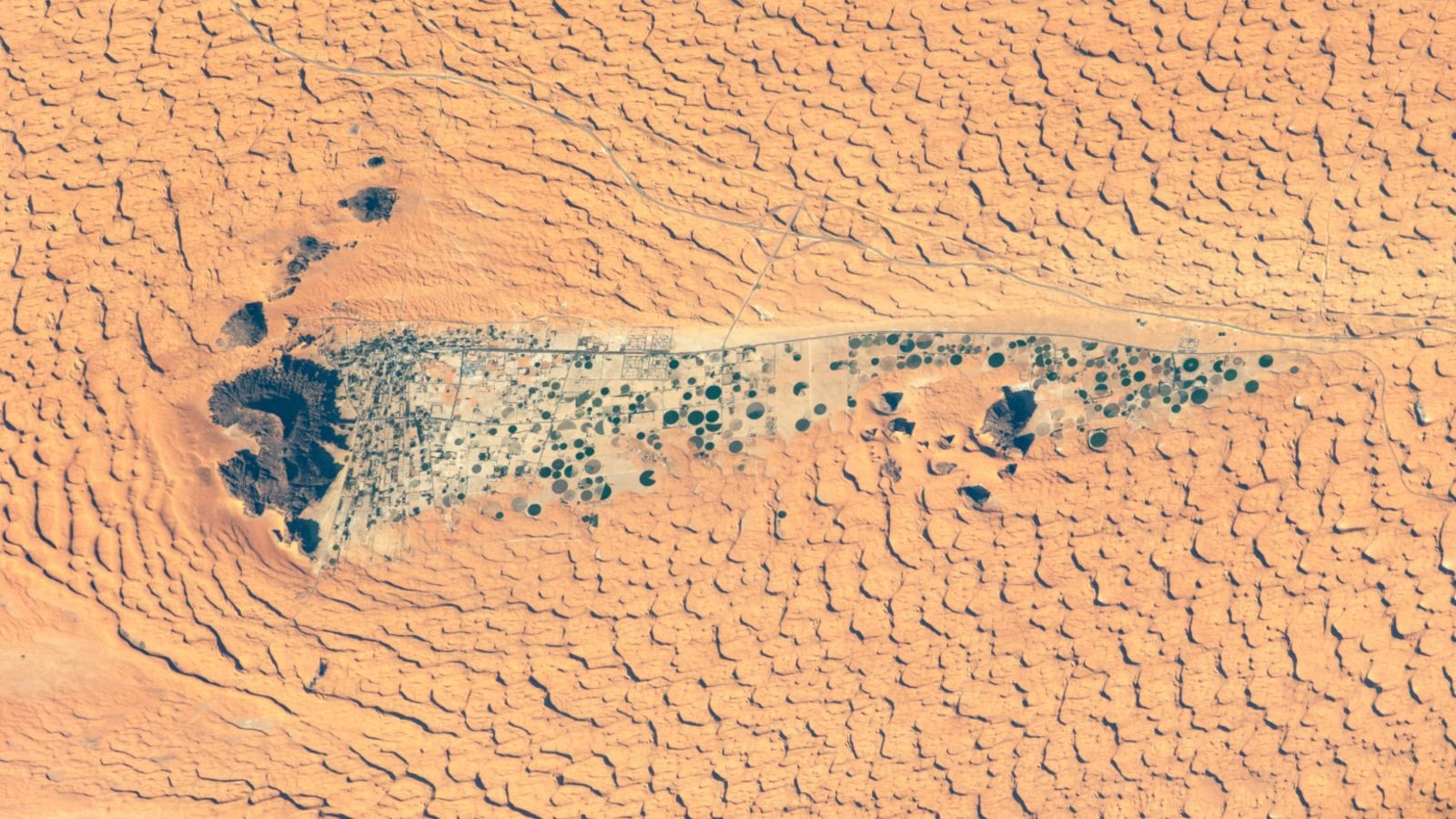
The harsh Saudi Arabian desert conceals a remarkable secret: the town of Jubbah, an agricultural settlement thriving within the ancient bed of a long-vanished lake. Recent astronaut photography reveals the town’s unusual circular fields – resembling crop circles from space – nestled in the shadow of Jabal Umm Sinman, a distinctive “camel-hump” mountain. This unlikely oasis is not just a modern agricultural center but also a site steeped in 10,000 years of human history.
A Paleolake’s Legacy
Jubbah sits within a 12.5 by 2.5-mile depression formed by a paleolake that dried up around 5,000 years ago, though subsurface water kept it alive longer. The town itself lies hundreds of feet below the surrounding dunes, a testament to its unique geological setting. This persistent water source is why Jubbah has remained an agricultural hub, now utilizing center-pivot irrigation which creates the striking circular patterns visible from above.
The Wind Shadow and the Camel Mountain
Jubbah’s survival is partly due to Jabal Umm Sinman, the 4,144-foot mountain resembling a two-humped camel. The mountain creates a natural wind shadow, blocking sandstorms from burying the town. Prevailing winds blow from west to east, meaning the town is shielded.
A Prehistoric Crossroads
Before the Arabian Peninsula became arid, Jubbah Lake was one of many freshwater sources. Its longevity likely made it a crucial landmark for early humans. Evidence suggests prehistoric travelers used a route matching the faint road visible in satellite images. These early visitors left behind a rich legacy: over 5,500 inscriptions and 2,000 animal depictions carved into the surrounding rocks. The art includes ibex, leopards, ostriches, and over 1,000 camels, dating back at least 10,000 years. This site is now a UNESCO World Heritage Site alongside Shuwaymis.
Broader Archaeological Significance
The region is a treasure trove of Paleolithic remnants. Jubbah is near the Al Naslaa rock, a split sandstone slab covered in ancient carvings. Recent findings suggest that similar structures in the area may hold the world’s oldest megastructure blueprints, dating back 8,000 years.
The survival of Jubbah and its rich history demonstrate the resilience of human settlement in the face of environmental change, as well as the enduring power of natural landmarks to shape human movement and culture.
The discovery highlights the importance of preserving such sites, which provide insight into ancient trade routes and the adaptability of early civilizations.


