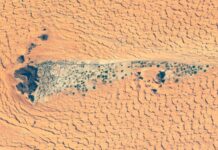
The surface of Mars, often perceived as static, is in constant, albeit slow, transformation. Recent images captured by the European Space Agency’s (ESA) Mars Express orbiter showcase dramatic evidence of this: vast formations known as yardangs, sculpted by relentless winds over potentially thousands of years. These striking features are not sudden geological events like volcanoes or earthquakes; they are the result of gradual erosion, akin to a natural sandblasting process reshaping the Martian landscape.
What are Yardangs and Why Do They Matter?
Yardangs are streamlined, wind-carved ridges that form in soft rock or sediment. The ESA image reveals a field of these formations near the Eumenides Dorsum mountains, all consistently aligned with the prevailing wind direction. This alignment is not random; it indicates that the same winds have been actively eroding the material for an extended period.
The scale is remarkable: this single view covers an area comparable to Belgium. What appears as subtle “wind ripples” from a distance transforms into a sprawling, tens-of-miles-long pattern of erosion. The very existence of yardangs here proves that Mars has a sustained, directional wind system strong enough to reshape the terrain over time.
A Layered History: Volcanoes and Wind
The formations were found atop ancient lava flows, suggesting that volcanic activity initially created the landscape, and then wind erosion arrived later to rework it. This layered history is common on Mars.
The images were taken by the Mars Express’s High Resolution Stereo Camera (HRSC), which has been mapping the planet in high detail for decades. The HRSC’s work allows scientists to trace how Mars’s landscapes evolve from top to bottom.
Location and Significance
These yardangs lie near the northern end of the Eumenides Dorsum mountains, within the expansive, dusty Medusae Fossae Formation. The region is not far from the massive volcanic province of Tharsis. The fact that erosion is occurring in this area highlights that even regions shaped by ancient volcanism are still subject to modern atmospheric forces.
“Mars can look ‘frozen in time’ at first glance, but images like this are a reminder that the planet is still actively changing,” notes ESA.
The yardangs provide valuable real-world data to test and refine atmospheric models. By reading wind direction directly from the terrain, scientists gain a clearer understanding of how dust and sand are transported across the planet today. This information is crucial for future Mars missions, particularly those involving human exploration or resource utilization.
The existence of these formations demonstrates that while Mars may appear dormant, it remains a dynamic world where even the winds can leave lasting marks on the landscape.