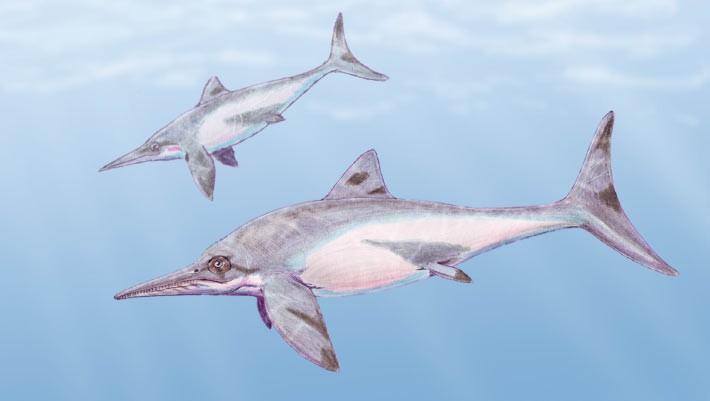
A remarkably complete ichthyosaur fossil, dating back roughly 145 million years, has been discovered in a cave system in western Cuba. This find significantly expands the known prehistoric record of marine reptiles on the island and offers new insights into ancient Caribbean marine life.
Discovery and Preservation
The skeleton was found in 2023 within the El Cuajaní cave system, part of the UNESCO-designated Viñales Geopark and National Park. The fossil is embedded in a rock slab forming the cave ceiling, approximately 60 meters from the entrance.
Researchers, led by Dr. Manuel Iturralde-Vinent of the Academia de Ciencias de Cuba, recovered a well-preserved section including the characteristic U-shaped vertebral column, ribs, individual vertebrae, and a single hindlimb.
Expanding Cuba’s Ichthyosaur Record
Until now, Cuban ichthyosaur fossils were primarily found in older Oxfordian deposits. This new specimen extends the timeline of ichthyosaur presence on the island into the Tithonian age of the Late Jurassic. The researchers call it the El Cuajaní ichthyosaur and note that this is the most complete ichthyosaur recovered from Cuba to date.
Phylogenetic Analysis and Ancient Marine Connections
While the exact species classification remains uncertain, anatomical analysis suggests a close relationship to the Ophthalmosauridae family. Specifically, the hindlimb morphology resembles that of Tithonian platypterygiine ophthalmosaurids like Caypullisaurus bonapartei and Aegirosaurus leptospondylus.
The discovery also sheds light on the ancient Caribbean seaway. This region served as a critical marine corridor connecting the Eastern and Western Tethys—distant parts of the Jurassic world—facilitating faunal dispersal between Europe, the Gulf of Mexico, and the Pacific Ocean. The corridor’s origins trace back to intercontinental rift valleys in west-central Pangea during the late Triassic-Early Jurassic periods.
“This fossil represents the most complete ichthyosaur recovered from Cuba to date,” said Dr. Iturralde-Vinent. “It extends the temporal record of ichthyosaurs on the island, which previously only included specimens from the Oxfordian.”
Biogeographic Significance
The El Cuajaní ichthyosaur adds to a growing body of Late Jurassic ichthyosaur discoveries in the region. The team expects that further study will improve understanding of the ichthyosaurs’ biogeographic history. Their research was published on February 6 in the Journal of Vertebrate Paleontology.
This discovery highlights the Caribbean’s role as a key marine pathway during the Jurassic period, and underscores the value of continued paleontological exploration in Cuba’s unique geological formations.