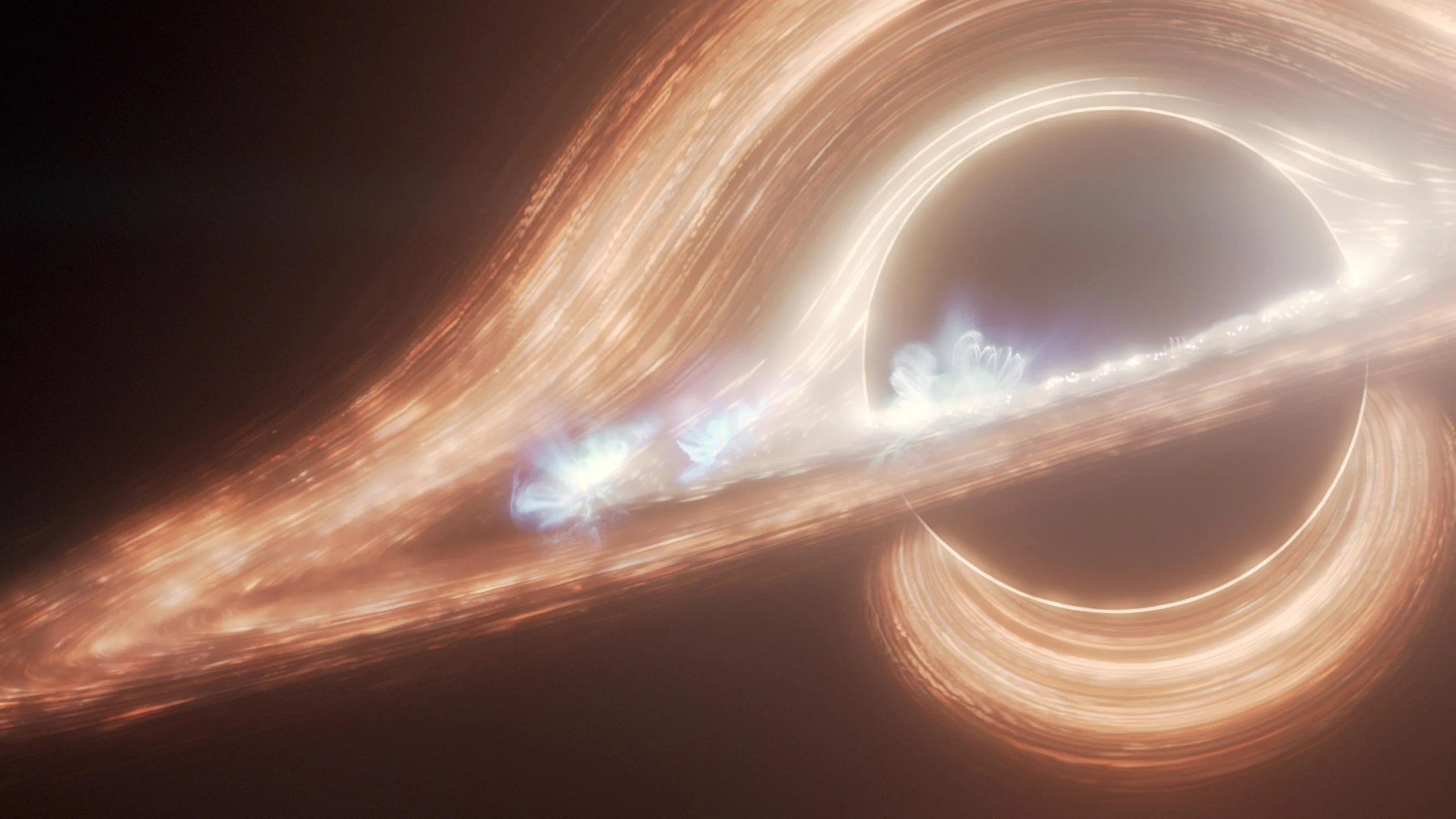
For years, astronomers have puzzled over strange, compact clouds of gas drifting toward the center of our galaxy. These mysterious clumps, known as the “G-clouds,” appear to be crucial for understanding how the supermassive black hole at the heart of the Milky Way, Sagittarius A (Sgr A ), consumes matter. Now, a new study led by researchers at the Max Planck Institute for Extraterrestrial Physics (MPE) has solved the mystery: these clouds are not random debris, but structured fragments created by a massive binary star system.
The Mystery of the G-Clouds
The Galactic Center is a chaotic environment, dominated by the immense gravity of Sgr A. In 2012, astronomers detected a dense cloud of ionized gas named G2 . It contained roughly the mass of Earth and moved on a stretched orbit toward the black hole. Shortly after, researchers identified similar objects— G1 and a trailing fragment called G2t *—following comparable paths.
These objects were significant because they offered a rare opportunity to observe how gas interacts with a supermassive black hole in real-time. If such clumps fall inward every decade, they could provide enough material to sustain the black hole’s current level of activity. However, their origin remained unclear. Were they leftover debris from stellar explosions? Material stripped by gravity? Or something else entirely?
Tracing the Source
To find answers, an international team used advanced infrared spectrographs—SINFONI and ERIS —to analyze the hydrogen emissions from these clouds. By mapping their positions and velocities, the researchers reconstructed their orbits with high precision.
The results were striking. G1, G2, and G2t share nearly identical orbital shapes and orientations. The probability of three unrelated objects coincidentally sharing such specific trajectories is negligible. This strongly suggested a common origin.
By tracing the gas streamer backward through space and time, the team identified a likely source: IRS 16SW, a massive contact binary star located in the clockwise disk of young stars orbiting Sgr A*.
How a Binary Star Creates Clouds
Hydrodynamical simulations revealed the mechanism behind this phenomenon. IRS 16SW consists of two massive stars orbiting each other closely. Their powerful stellar winds collide, creating a shock wave between them. This collision compresses the gas, causing it to accumulate and eventually break away as distinct clumps.
These clumps then travel inward along a streamer, forming the connected structure observed as the G1–2–3 streamer. The slight variations in the orbits of G1, G2, and G2t can be explained by the binary star’s own motion as it orbits the black hole.
Why This Matters
This discovery reshapes our understanding of how black holes are fueled. It suggests that massive stars near the Galactic Center play an active role in feeding their central black hole through their stellar winds. Rather than relying solely on random gas clouds or distant accretion, the black hole may receive a steady supply of material from nearby stellar systems.
This finding links stellar evolution, gas dynamics, and black hole feeding into a single coherent picture, demonstrating how star formation and black hole activity are intimately connected even within our own galaxy.
Conclusion
The identification of IRS 16SW as the source of the G-clouds provides a clear mechanism for how matter reaches Sagittarius A*. It highlights the dynamic interplay between stars and black holes in the Milky Way’s core, offering new insights into the lifecycle of galactic centers. As we continue to observe these interactions, we gain a deeper understanding of how supermassive black holes grow and influence their surroundings.