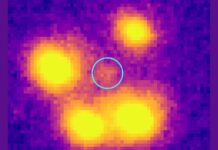
In a discovery that challenges our intuitive understanding of physics, researchers have successfully observed “pinpricks of darkness”—tiny, empty voids—moving faster than the speed of light. While this sounds like a violation of Einstein’s fundamental laws, the phenomenon actually confirms a profound nuance in how the universe operates.
The Nature of the “Void”
To understand how something can outrun light, one must first understand what these voids actually are. They are not physical objects, but rather singularities —points of absolute nothingness created by wave interference.
Imagine the surface of a lake. When two waves meet, they can either combine to create a larger crest or cancel each other out to create a deep trough. If multiple waves interfere in a specific way, they can create a point where the wave’s magnitude drops to zero. This “null point” or singularity acts like a tiny, moving whirlpool of nothingness.
Why Relativity Remains Intact
Einstein’s theory of special relativity dictates that no matter, energy, or information can travel faster than the speed of light ($c$). This is the ultimate speed limit of the universe because matter and energy are the carriers of information.
However, these singularities are different:
– They are empty points of nothingness.
– They contain no mass, no energy, and no information.
– Because they are “absence” rather than “presence,” they are not bound by the cosmic speed limit.
In essence, the “void” is not traveling; rather, the location of the nothingness is shifting through the medium at speeds that can theoretically approach infinity.
The Experiment: Capturing the Unseen
Using advanced ultrafast electron microscopy, a research team led by the Technion-Israel Institute of Technology observed these phenomena within a thin layer of boron nitride. They focused on phonon-polaritons —quasiparticles that behave like a hybrid of light and sound waves.
The study, recently published in the journal Nature, highlights a remarkable characteristic of these voids:
1. Exponential Acceleration: When two singularities approach one another, they can accelerate exponentially.
2. The Limit of Observation: As these voids approach extreme speeds, they become increasingly difficult to detect, making their observation a significant technical feat.
Why This Matters for Science
This discovery is more than a mathematical curiosity; it provides a new lens through which to view the fundamental building blocks of reality.
1. Defining the Boundaries of Particle Physics
By studying these voids, scientists can better understand the line where “wave behavior” ends and “particle behavior” begins. While the voids ignore the speed of light, actual particles must obey it. Observing this transition helps physicists map the exact point where singularities stop acting like particles and start behaving like pure wave interference.
2. A New Tool for Discovery
The innovative microscopy techniques developed for this study are expected to have a ripple effect across multiple disciplines. The ability to observe extremely small, high-speed phenomena could unlock “hidden processes” in:
– Chemistry: Observing rapid molecular interactions.
– Biology: Tracking elusive cellular movements.
– Superconductivity: Understanding complex quantum systems.
“Our discovery reveals universal laws of nature shared by all types of waves, from sound waves and fluid flows to complex systems such as superconductors,” says Professor Ido Kaminer of the Technion-Israel Institute of Technology.
Conclusion
By observing singularities that outpace light, researchers have demonstrated that while matter is bound by relativity, the “emptiness” between waves is not. This breakthrough provides a new way to study the limits of physics and offers powerful new tools to observe the fastest, most elusive moments in the natural world.