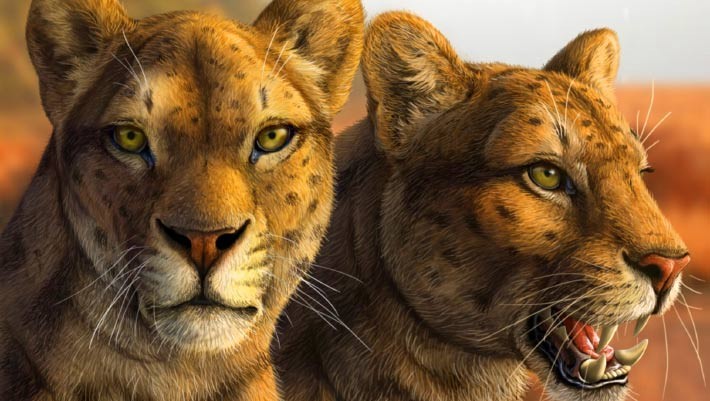
It has a new face.
For decades, we basically didn’t know what this thing looked like. Just fragments. Gossip in bone dust. But now, thanks to a nearly complete skull sitting in storage in New York, Adelphailurus kansensis finally gets an introduction.
This was a cat that prowled North America between 7 and 5 million years ago. It was big—cougar-sized, give or take. And it sat at the very base of the saber-tooth family tree. Early branching. Ancestors of the killers.
We first heard about the species in 1934. Back then, it was just a fragmentary jaw from Kansas. Paleontologists described it and moved on. Other fossils got lumped into this name over the years, mostly because it fit poorly into existing categories. Its actual anatomy remained a blurry guess. Until now.
“Pseudaelurus has been referred as a wastebasket genus for average-sized Miocene felids,” said researchers.
Basically, Pseudaelurus was the “we don’t know what you are yet” pile for Miocene cats. Many of the fossils currently assigned to Adelphailurus started there.
Then in 1983. Paleontologists found postcranial remains at a site in Mohave County, Arizona. The Wikieup local fauna. The bones ended up at the American Museum of Natural History. But they never really studied the full set. Not the cranium. Not the mandible. It sat there. Silent.
Narimane Chatar and Z. Jack Tseng from UC Berkeley finally pulled that box off the shelf. They examined the material closely. What they found changes the picture.
The skull is almost complete. Associated with jaw fragments and isolated upper canines.
This isn’t a Smilodon. No iconic sword-like teeth sticking out of the mouth. Those canines were short. Flattened. Serrated, sure. But subtle. This cat was just beginning the journey toward the hyper-specialized predator form we imagine when we think “saber-tooth.”
It had a narrow snout like Metailurus (the Eurasian cousin). But its skull shape? Rounding, similar to Yoshi. And those cheekbones? Unusually thin. Distinctive dental traits set it apart from both. It is a mosaic. A mix of old and new traits showing early divergence.
Why does this matter?
Chatar and Tseng point to something they call the “macroevolutionary ratchet.” Once an animal starts evolving super-specialized traits—like those massive fangs—it cannot go back. Efficiency comes at a cost. You become great at one thing. Hunting specific prey in specific ways. But if the environment changes? If the prey gets hard to find?
You die out.
“Once a group starts, they go crazy and then they go extinct,” Dr. Chatar said.
Shorter canines in ancestors support the theory. Evolution pushes hard. No retreat. Adelphailurus represents a species on the brink. Caught in that transition. Not fully there, but gone. Irreversible.
It also hints at migration. During the Late Miocene, the Bering Land Bridge allowed carnivores to shuffle between Eurasia and North America. This cat might be evidence of a separate, distinct migration of primitive saber-tooths into North America. Not part of the earlier wave. Something new. Arriving late. Finding a niche. Then leaving.
The fossil record is sparse. Gaps remain. But this reexamination of the AMNH material gives us the first clear look at the cranial anatomy of one of these early players. It anchors the timeline. Helps explain the spread.
Published in the Journal of Vertebrate Paleontology in June 2026. The mystery is gone. The cat has a face. It looks like it knows where it came from.
We probably know where it went, too.