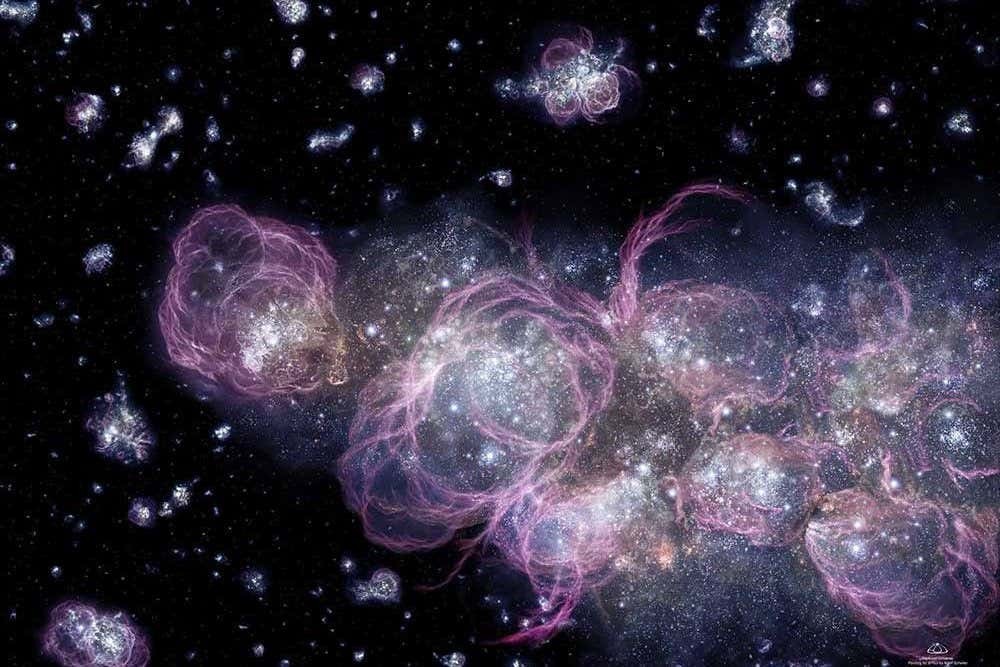
Astronomers have made a significant step toward identifying the universe’s first stars, a discovery that could rewrite our understanding of the cosmos’s early evolution. The galaxy Hebe, observed just 400 million years after the Big Bang, shows strong signs of being populated by “Population III” stars – ancient, massive objects unlike any we see today. This finding isn’t just about confirming the existence of these stars, but also about unlocking secrets of the early universe and how its first stars shaped everything that followed.
The Hunt for Population III Stars
The first stars were forged from almost pure hydrogen and helium, before heavier elements existed. These stars would have been colossal, hundreds of times more massive than our sun and burning at tens of thousands of degrees hotter. However, because they burned out quickly in spectacular supernovae, finding a galaxy still hosting them has been a major challenge. They lived fast and died young, leaving behind little trace in the modern universe.
Hebe: A Candidate from the Dawn of Time
Roberto Maiolino at the University of Cambridge and his team identified Hebe using the James Webb Space Telescope (JWST). The galaxy’s light exhibits a unique spectral signature: a strong concentration around the frequency of ionized helium, a byproduct of extremely hot stars. This signature, combined with a second detection of ionized hydrogen from the same source, strongly suggests the presence of Population III stars.
“All other explanations are highly unsatisfactory,” says Maiolino, underscoring the compelling nature of the evidence.
Why This Matters
Confirming the existence of Population III stars is critical because they seeded the universe with the first heavy elements. These elements were essential for forming later generations of stars, planets, and eventually, life. Understanding their properties – how massive they were, how many there were – helps us understand how the universe evolved from a simple soup of hydrogen and helium to the complex structure we see today.
Lingering Questions and Future Research
While the evidence is strong, some questions remain. Current simulations of the early universe suggest that Population III stars should have formed in smaller, more isolated clusters, making Hebe’s relatively dense population surprising. Additionally, astronomers haven’t reached the precision needed to definitively rule out the presence of trace amounts of heavier elements, which would classify these stars as a more mature “Population II” type.
The team has already used these observations to refine estimates of the first stars’ masses, suggesting they likely ranged from 10 to 100 times the mass of our sun, with fewer smaller stars. More observations and increasingly precise measurements will be needed to confirm these findings and resolve the remaining uncertainties.
The discovery of Hebe is a pivotal moment in cosmology. Whether or not it definitively proves the existence of Population III stars, the data is already teaching us about the early universe. The race to understand these ancient stars is not just about ticking off a box; it’s about unraveling the fundamental processes that shaped the cosmos we inhabit.