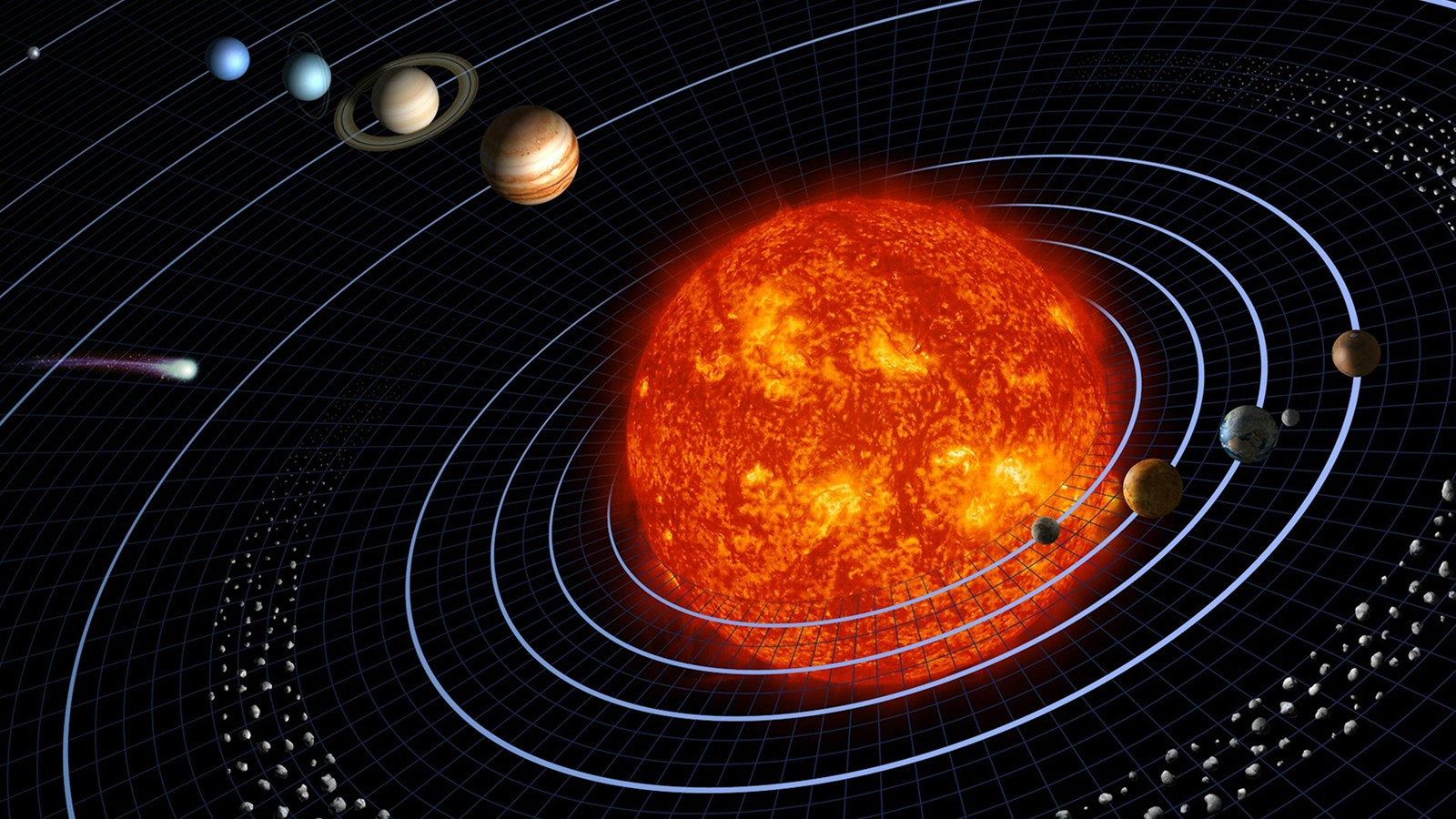
The solar system looks neat in illustrations: planets orbiting the Sun in a flat circle. But what about ‘below’ that plane? Why aren’t orbits chaotic, with planets flying every which way? The answer isn’t simple, and it stretches far beyond our Sun, revealing layers of cosmic organization.
The Illusion of ‘Up’ and ‘Down’
Our sense of direction comes from gravity. On Earth, ‘down’ is where things fall. But ‘down’ is relative. Someone on the other side of the planet sees your ‘down’ as their ‘up’. In space, the convention is that orbits above the solar system’s plane appear counterclockwise, and those below appear clockwise. But this is just a way to describe motion, not an inherent direction.
Beyond the Solar System: Galactic Planes
Zoom out, and the story deepens. The Milky Way galaxy, home to our Sun, also has a plane: the galactic plane where most stars orbit the galactic center. This plane isn’t aligned with the solar system’s ecliptic; they’re off by 60 degrees. This means our neatly arranged solar system is tilted within a larger, messier structure.
The pattern doesn’t stop there. The Milky Way itself is part of the Local Group, a cluster of galaxies. These also tend to align within another plane, the supergalactic plane, nearly perpendicular to the galactic one. This stacking of planes suggests something fundamental governs how structures form in the universe.
How Structures Align: The Collapse of Clouds
The key lies in how these structures originated. The Sun and planets formed from a massive, rotating cloud of gas and dust called the solar nebula. As gravity pulled this cloud inward, any initial rotation increased in speed. Collisions between particles within the cloud gradually flattened the structure into a disc. Particles with tilted orbits collided and reoriented, eventually settling into a shared plane.
This process repeats at larger scales. The Milky Way’s stars settled into a galactic plane through similar interactions, and the galaxies in the Local Group aligned into the supergalactic plane. The initial spin of the original cloud determined the orientation of everything that formed from it.
The Perspective of the Universe
So, what’s ‘below’ Earth? Not much orbiting in that direction, but if you traveled far enough, you’d find other stars and planets with wildly different orientations. Other galaxies would point in entirely different directions.
The universe doesn’t care about our ‘down’. Our perspective is limited to our solar system, galaxy, and immediate surroundings. On cosmic scales, direction is relative.
This illustrates a humbling truth: the universe isn’t built around us. ‘Down’ is just a local convention, and the grand structures of space are shaped by the chaotic, yet patterned, collapse of ancient clouds.