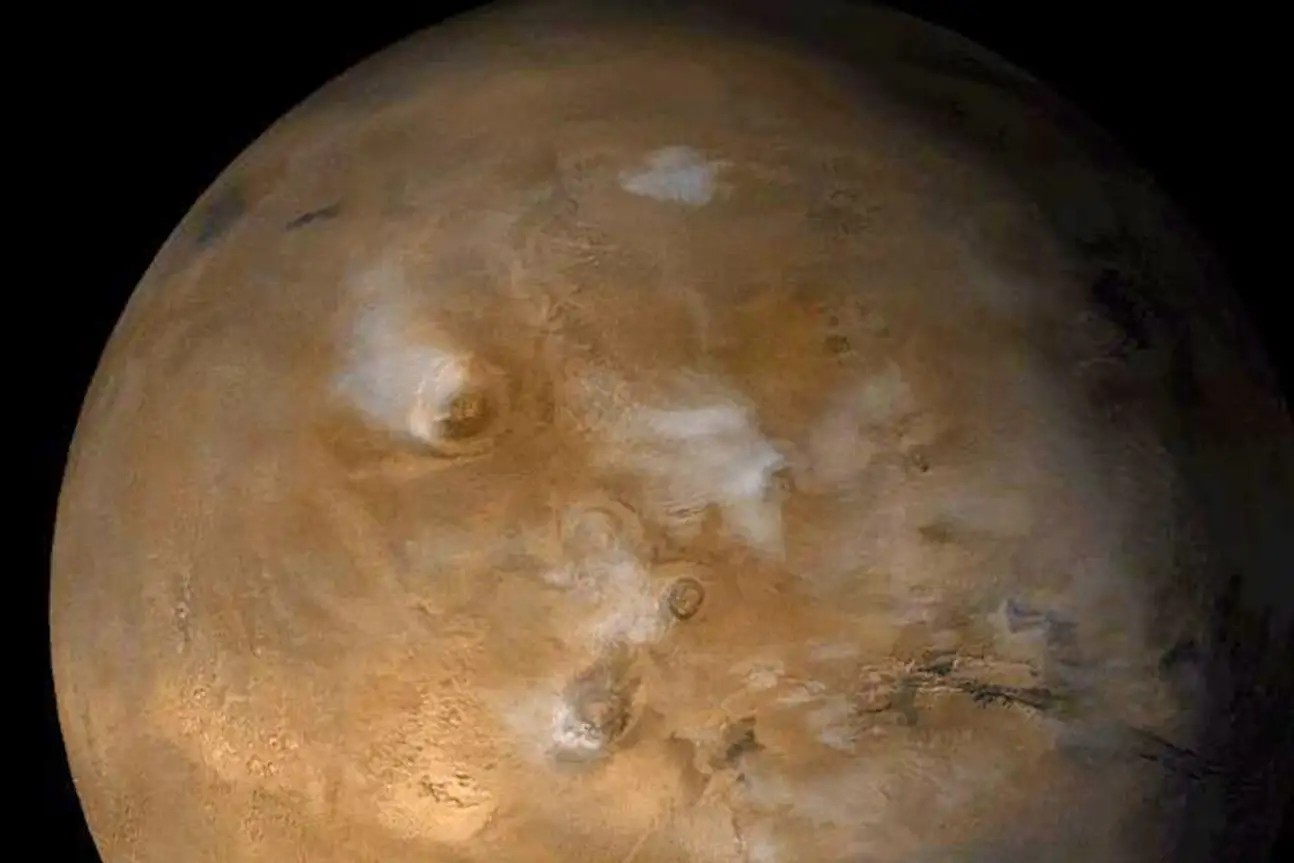
New research reveals that Mars exerts a surprisingly strong influence on Earth’s long-term climate cycles, including the timing of ice ages. This discovery underscores the importance of considering the gravitational effects of even small planets when assessing the habitability of worlds beyond our solar system.
The Simulation: Mars’s Gravitational Impact
Researchers led by Stephen Kane at the University of California, Riverside, conducted simulations varying Mars’s mass from negligible to 100 times its current size. The results demonstrated that Mars directly impacts Earth’s orbital eccentricity and axial tilt, key drivers of climate change. The study originated from skepticism: it seemed counterintuitive that a planet so small could have such a significant effect.
Key Orbital Cycles Governed by Mars
Earth’s climate operates on several long-term cycles, including the 2.4-million-year “grand cycle” that governs the shape of Earth’s orbit and influences sunlight distribution. The simulations showed that removing Mars entirely eliminated both the grand cycle and a 100,000-year eccentricity cycle. This suggests that while Mars isn’t the sole determinant of ice ages, it fundamentally shapes their frequency and intensity.
Stabilizing Axial Tilt
Beyond eccentricity, Mars also appears to stabilize Earth’s axial tilt, which normally wobbles over a 41,000-year period. Increasing Mars’s mass shortened and intensified these cycles, while reducing its mass made the wobble more frequent. The influence of Venus and Jupiter on Earth’s climate remains significant, but Mars plays a crucial, stabilizing role.
Implications for Exoplanet Research
These findings have profound implications for the search for habitable exoplanets. Scientists must account for the gravitational effects of smaller planets – often overlooked – when evaluating the climate stability of distant worlds. The architecture of exoplanetary systems, including the presence and mass of smaller planets, can dramatically alter a planet’s climate over geological timescales.
“We really need to know the orbital architectures of exoplanet systems really well to be able to reasonably have a grasp on the possible climate fluctuations on those planets,” says Sean Raymond of the University of Bordeaux.
The study serves as a warning : ignoring smaller planets in exoplanetary system evaluations could lead to inaccurate habitability assessments. Mars’s influence is greater than previously assumed, highlighting the need for a more holistic understanding of planetary interactions.
In conclusion, Mars is far more than just a red dot in the sky. Its gravity is a critical component of Earth’s climate system, and its influence must be considered when evaluating the potential habitability of planets throughout the universe.