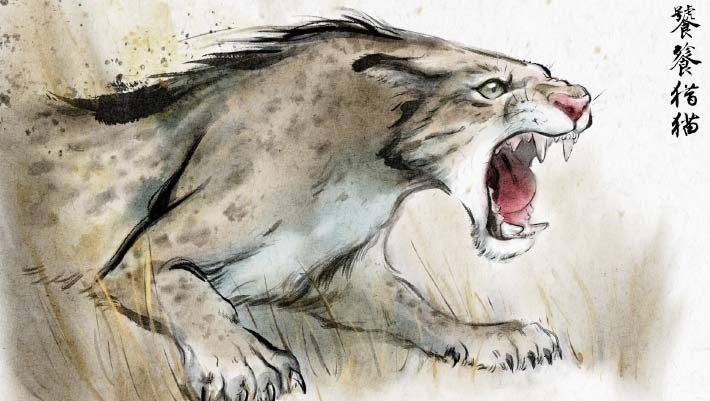
Paleontologists in China have unearthed a previously unknown species of ancient predator, Taotienimravus songi, a member of the extinct Nimravidae family—often called “false saber-toothed cats.” The discovery, detailed in a recent publication in the Proceedings of the Royal Society B, fills a critical gap in understanding how early carnivores evolved to dominate large-prey ecosystems.
The Rise of Early Big Predators
Taotienimravus songi lived approximately 28 million years ago, during the middle Oligocene epoch. This period was a turning point in mammalian evolution, as carnivores began to grow larger and specialize in hunting bigger animals. The Nimravidae family represents one of the earliest groups to achieve this, predating the modern cat-like predators (Felidae).
Why this matters: The fossil record of early large carnivores is patchy, especially outside North America. This discovery from northern China offers a rare glimpse into how these predators evolved in Eurasia, where fossil preservation is often less complete.
Unique Bone-Cracking Adaptations
Unlike many saber-toothed cats that relied on slashing bites, Taotienimravus appears to have specialized in crushing bone. Paleontologists note its unusually wide palate, enlarged premolars, and short, robust canines—features not seen in most other Nimravids.
Key features of the new species:
– Very short and robust upper canines.
– A broader palate than other known Nimravids.
– Enlarged premolars without gaps between the teeth.
This suggests a unique killing strategy, similar to modern hyenas, which use powerful bites to shatter bones and access marrow. The animal likely exploited a niche unavailable to other predators at the time.
Competition and Niche Evolution
The emergence of Taotienimravus coincides with the decline of another early carnivore group, the Oxyaenidae. Scientists believe the rise of Nimravids may have been driven by competition dynamics.
The bigger picture: The Nimravidae family thrived by occupying ecological niches that were not yet exploited by modern cats. Their success suggests that early carnivores were not limited by direct competition within their own group, allowing them to diversify and dominate large-prey ecosystems.
A New Branch on the Evolutionary Tree
Phylogenetic analysis confirms Taotienimravus is a close relative to other Nimravids from Europe and North America. This suggests that the family may have been more widespread than previously thought, with different species adapting to local environments.
The discovery underscores the importance of both environmental and ecological factors in shaping the evolution of predators. Understanding these dynamics is crucial for reconstructing the ancient ecosystems in which these animals thrived.
The team’s research highlights that the study of niche change and evolution must be grounded in both abiotic and biotic considerations.
The new species underscores how early carnivores successfully occupied ecological niches that were not exploited by Felidae, likely due to limited competition during their evolutionary history.