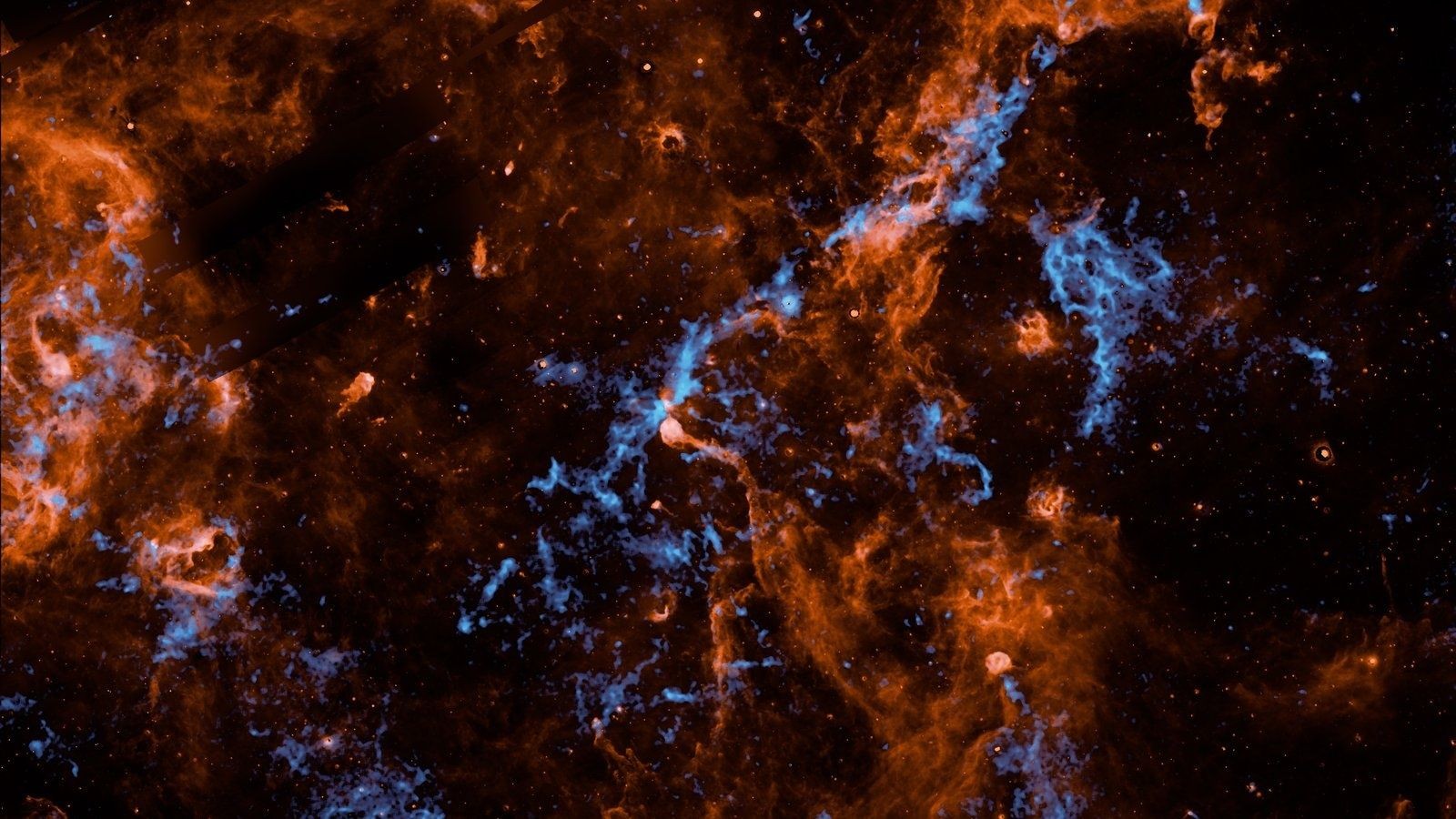
New imagery from NASA’s SPHEREx space telescope has revealed vast, sprawling reservoirs of water ice within the Cygnus X region—one of the Milky Way’s most turbulent and active stellar nurseries. These findings offer a profound look at the “delivery system” for water in the universe, suggesting that the oceans on Earth may have their origins in these massive, frozen cosmic structures.
Mapping the Chaos of Cygnus X
The Cygnus X region is a massive complex of gas and dust where stars are born at a rapid pace. Using data collected in 2025, the SPHEREx mission has produced a detailed map of this region, visualizing:
– Water ice represented in bright blue.
– Intertwining dark dust lanes that weave through the complex.
– Newborn stars appearing as tiny points of light amidst the clouds.
Unlike previous observations that typically only detected ice when it was backlit by individual bright stars, SPHEREx has achieved something much more significant. It has captured diffuse background light passing through entire clouds of dust along the galactic plane. This allows scientists to see not just isolated pockets of ice, but the broad, spatial distribution of these materials across the galaxy.
The Chemistry of Life
The “glaciers” identified by researchers are not made of pure water alone. They are complex chemical reservoirs composed of:
– Water ($H_2O$)
– Carbon dioxide ($CO_2$)
– Carbon monoxide ($CO$)
These molecules tend to freeze onto the surfaces of microscopic dust grains—particles no larger than the smoke from a candle. This process is critical because these ice-coated grains act as a chemical foundation. As new planetary systems form from these clouds, these frozen materials are incorporated into nascent planets, comets, and asteroids.
“These vast frozen complexes are like ‘interstellar glaciers’ that could deliver a massive water supply to new solar systems that will be born in the region,” says Phil Korngut, a SPHEREx instrument scientist at Caltech.
Protection Amidst the Storm
One of the most important takeaways from this research is how these ices survive the harsh environment of a stellar nursery. Newly born stars emit intense ultraviolet (UV) radiation, which would normally break down fragile molecules like water.
However, the study found that water ice is not distributed randomly; it concentrates in the densest regions of cosmic dust. These dense clouds act as protective shields, absorbing the destructive UV rays and allowing the ice to persist for eons. This concentration ensures that when gravity eventually pulls this material together to form planets, a significant amount of water and organic building blocks remains intact.
Why This Matters
This discovery bridges the gap between interstellar chemistry and planetary habitability. It suggests that the ingredients for life—water and carbon-based molecules—are not accidental occurrences on individual planets, but are part of a widespread, structured distribution throughout the galaxy.
As SPHEREx continues its two-year all-sky survey, astronomers aim to create an even more comprehensive map of how these molecules respond to radiation and how they are spread across the Milky Way.
Conclusion
By mapping these “interstellar glaciers,” scientists are uncovering the cosmic plumbing that delivers water to developing solar systems. This research reinforces the idea that the fundamental building blocks of life are woven into the very fabric of our galaxy’s star-forming regions.