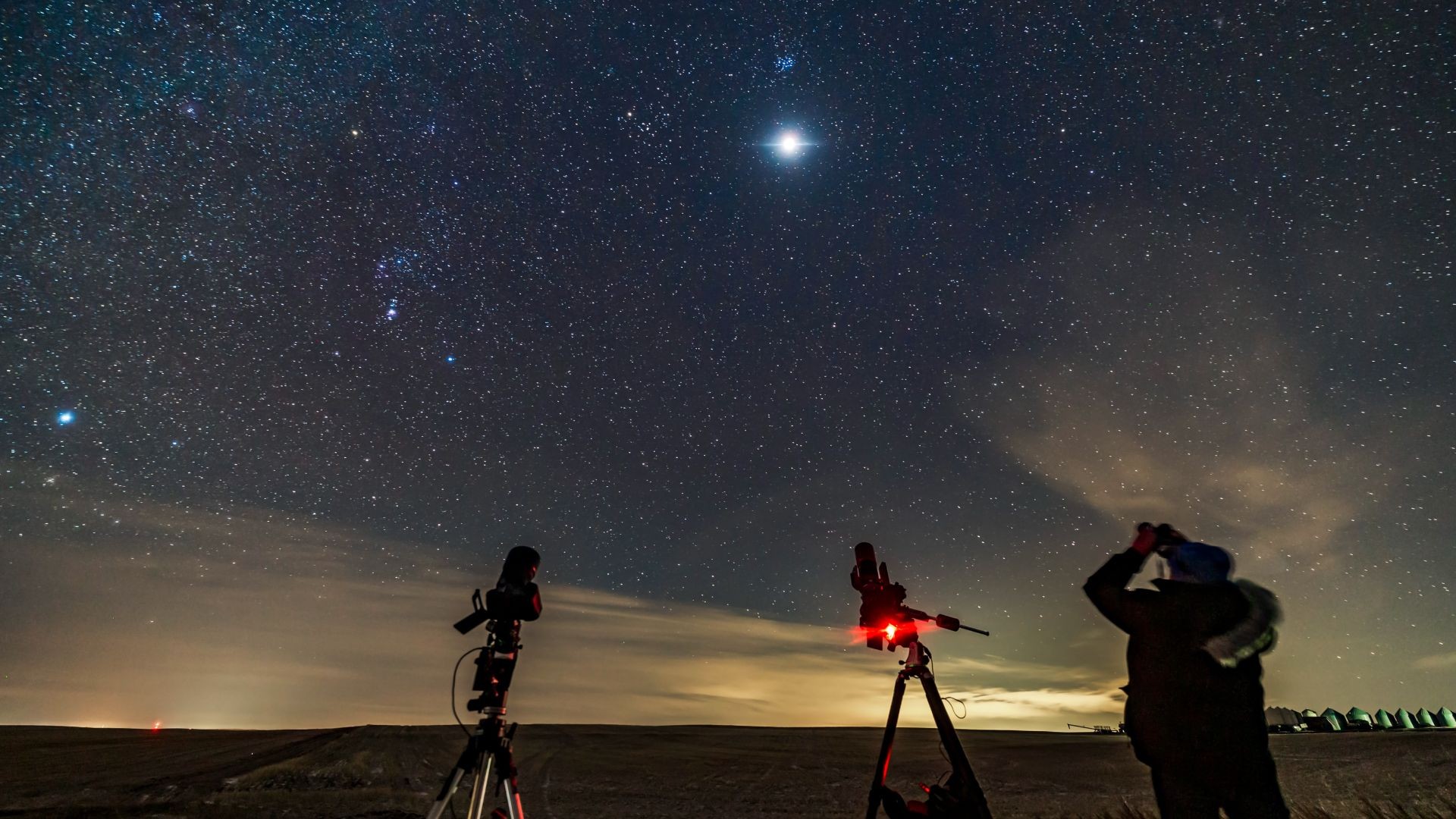
The moon and the star cluster known as the Pleiades, or the Seven Sisters, will appear close together in the night sky tonight, February 23rd. This event is visible to the naked eye, but binoculars and telescopes will reveal even more detail.
What You’ll See
Look toward the southwestern horizon shortly after dark. The waxing gibbous moon will be positioned just above the Pleiades cluster, less than 5 degrees apart—roughly the width of three fingers held at arm’s length. The Pleiades appears as a tight grouping of bright, bluish-white stars.
The Seven Sisters are named after the daughters of Atlas in Greek mythology: Asterope, Alcyone, Electra, Celaeno, Merope, Maia, and Taygete. Binoculars will reveal not just these seven brightest stars, but also fainter companions and the subtle glow of a nearby nebula.
Exploring the Moon’s Surface
Using a telescope, shift your view from the Pleiades to the moon itself. The terminator—the line between the lit and dark sides of the moon—offers the most striking views. This is where shadows accentuate craters and ancient lava flows.
Specifically, look for Mare Serenitatis (the Sea of Serenity) and Mare Tranquilitatis (the Sea of Tranquility), the landing site of Apollo 11. These dark basaltic plains are remnants of volcanic activity billions of years ago. Impact craters along the terminator reveal the moon’s violent history, with overlapping rims and central peaks formed by cataclysmic collisions.
Viewing Times and Tips
The moon will appear to move relative to the Pleiades throughout the night, eventually setting below the northwestern horizon around midnight for observers in New York. Exact timings vary based on location; use a moonrise calculator (such as the one provided by Time and Date) for precise details.
To enhance your viewing experience, consider using binoculars or a telescope. The best equipment for stargazing can be found in current roundups of telescopes and cameras suited for astrophotography.
The conjunction of the moon and the Pleiades is a beautiful reminder of the dynamic cosmos, readily visible to anyone looking up tonight. Observing this celestial event provides a tangible connection to mythology, geology, and the history of space exploration.