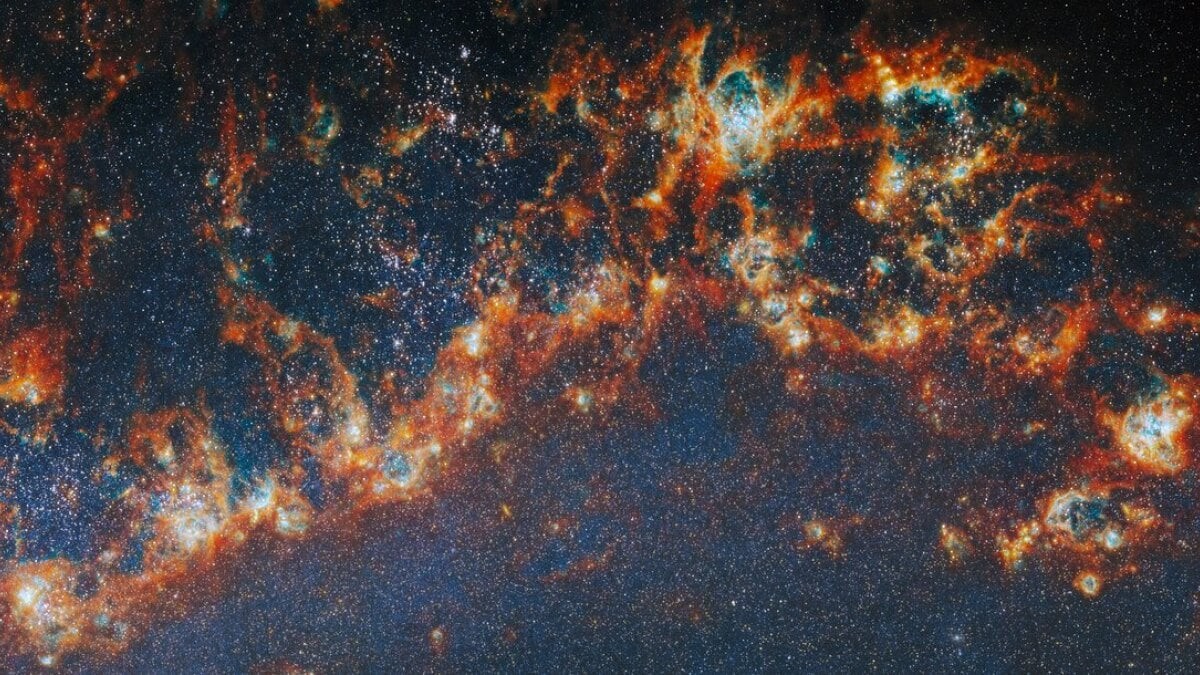
Newborn stars do not all emerge from their cosmic birth clouds at the same pace. According to a comprehensive new study, the speed at which a star cluster clears away its surrounding gas and dust depends heavily on its mass. Massive stellar clusters tear themselves free from their natal environments significantly faster than their smaller counterparts.
This finding, published in Nature Astronomy, provides crucial data on “stellar feedback”—the process by which young stars influence their surroundings through radiation, winds, and explosions. By establishing a concrete timeline for this phenomenon, astronomers can better understand how galaxies evolve and why planet formation is such a fragile process.
Observing Cosmic Snapshots
Because human lifespans are far too short to watch a single star cluster evolve over millions of years, researchers employed a clever observational technique. Using data from NASA’s Hubble Space Telescope and the James Webb Space Telescope, scientists analyzed nearly 9,000 star clusters across four distinct galaxies: Messier 51, Messier 83, NGC 4449, and NGC 628.
By observing clusters at various stages of development, researchers created a “sequence of snapshots.” Some clusters were still deeply embedded in thick clouds of gas and dust, visible only through infrared light. Others had partially emerged, while some were fully exposed to the galaxy.
The Key Finding: The largest clusters clear their surrounding clouds in approximately 5 million years. In contrast, smaller clusters take 7 to 8 million years to break free.
Why Mass Matters
The consistency of these results across four different galaxies suggests that this timeline is a fundamental feature of star formation, not a local anomaly.
The process begins with “baby stars” hidden deep within opaque clouds. As these stars grow, they become energetic engines. They heat the surrounding gas and blast out intense radiation and stellar winds. This energy pushes the protective shell of dust and gas away, eventually revealing the cluster.
Researchers estimated the duration of each phase by counting how many clusters appeared in each stage. The logic is straightforward: if a stage is common among observed clusters, it lasts longer; if it is rare, it passes quickly. The data showed that massive clusters generate enough energy to blow away their surroundings much more efficiently than smaller groups.
Implications for Galaxy Evolution
This rapid clearing process has profound consequences for the structure of galaxies. Once the protective cloud is gone, the stars’ ultraviolet radiation is unleashed into the interstellar medium. This radiation collides with nearby gas, often sterilizing regions of the galaxy and preventing new stars from forming in those areas.
Essentially, the most massive star clusters are the most disruptive. They consume their birth material quickly and then radiate energy that suppresses future star formation in their vicinity. This helps explain why much of the gas in galaxies never gets used for creating new stars.
A Fragile Window for Planet Formation
The study also highlights a critical vulnerability for planet formation. Young stars form with rotating disks of gas and dust around them, which eventually coalesce into planets. However, these protoplanetary disks are delicate.
If a star cluster clears its surrounding cloud too quickly, those disks are exposed to harsh external radiation earlier than expected. This premature exposure can strip away the material needed to build worlds, interrupting the process of planet formation.
In summary: The mass of a star cluster dictates how quickly it exposes itself to the galaxy. Massive clusters evolve rapidly, altering their environments and potentially hindering the formation of both new stars and planets in the surrounding region. This research connects the immediate lifecycle of star clusters to the broader, long-term evolution of galaxies.