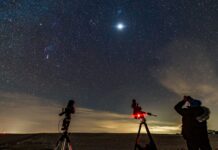
Throughout February, the planet Jupiter has been a prominent fixture in the evening sky within the constellation Gemini, and will remain so well into March. This makes it an easy target for stargazers, even those in brightly lit cities.
Identifying Jupiter’s Position
Gemini is marked by the twin stars Castor and Pollux, easily recognizable as the heads of the twins. Jupiter appears between these two stars, positioned slightly south, and noticeably brighter than both. Its sheer size makes it the most luminous planet visible from Earth, ensuring it stands out even in light-polluted areas.
Why Planets Don’t Twinkle
Unlike stars, Jupiter doesn’t twinkle. This is because it is much closer to Earth, so its light isn’t as distorted by the atmosphere. The steady glow makes it easy to distinguish from surrounding stars, which appear to flicker and dance due to air turbulence.
Tracking Jupiter’s Movement
Jupiter slowly shifts position against the background stars over time, reflecting both its own orbit around the sun and Earth’s orbital motion. Observing this shift night after night provides a visible example of the solar system’s mechanics at play. The planet’s gradual movement confirms its nature as a celestial body in motion, rather than a fixed point of light.
Jupiter’s visibility in February provides an accessible reminder of the vastness and movement within our solar system, offering an easy-to-observe example of planetary motion for anyone looking up at the night sky.