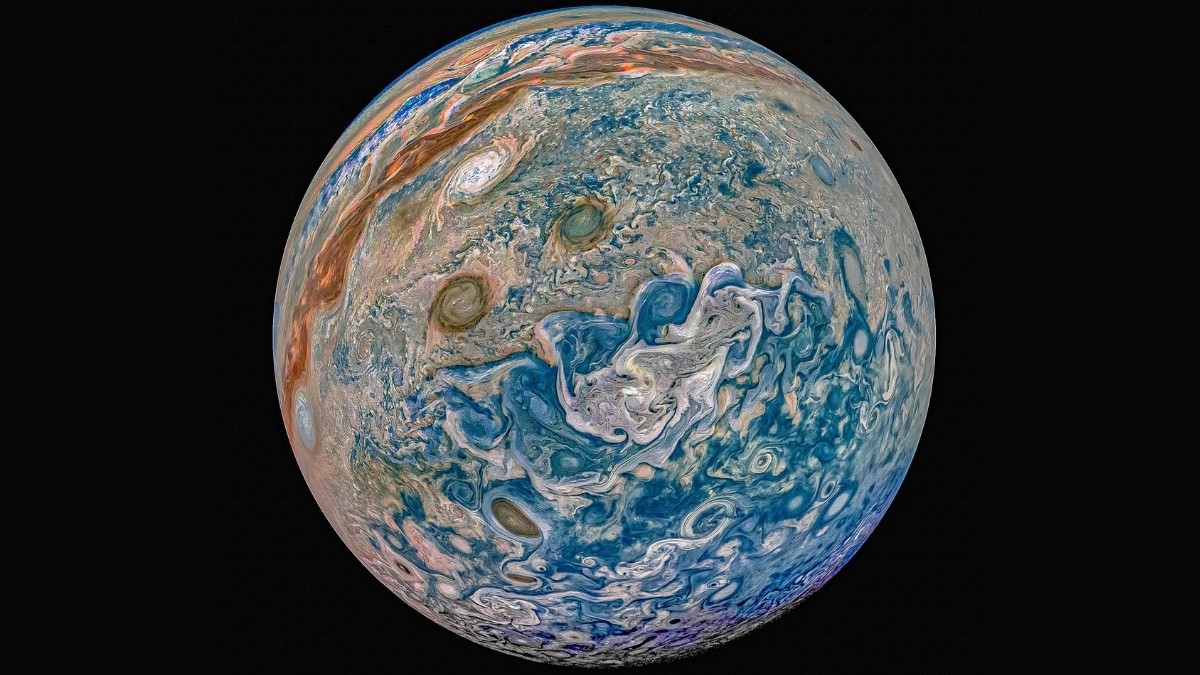
For decades, our understanding of Jupiter’s dimensions relied on data from the 1970s Voyager and Pioneer missions. Now, thanks to NASA’s Juno probe and advanced data processing, scientists have refined our knowledge of the gas giant’s size and shape with unprecedented accuracy.
The Revised Measurements
The latest data indicates that Jupiter’s equatorial radius measures 71,488 kilometers (44,421 miles), while its polar radius reaches 66,842 kilometers. This means Jupiter is approximately 4 kilometers narrower at the equator and 12 kilometers “flatter” at the poles than previously estimated.
While seemingly small, these adjustments are significant for planetary modeling. “These few kilometers matter,” explains Eli Galanti, a planetary scientist at the Weizmann Institute of Science. “Shifting the radius by just a little lets our models of Jupiter’s interior fit both the gravity data and atmospheric measurements much better.”
How the New Data Was Collected
The older estimates came from radio occultation (RO) – measuring how Jupiter’s atmosphere bent radio signals from the Voyager and Pioneer probes. Astronomers had only six RO measurements to work with until NASA repositioned Juno in 2021. This new orbit allowed for regular RO measurements, combined with improved data processing techniques, providing a clearer picture of Jupiter’s size.
Maria Smirnova, another planetary scientist at the Weizmann Institute, notes that tracking how radio signals bend through Jupiter’s atmosphere allowed scientists to create detailed maps of its temperature and density.
The Impact of Atmospheric Winds
Previous size estimates had to ignore the effects of Jupiter’s strong winds. However, recent studies have measured these winds, allowing Galanti and his team to incorporate this data into their calculations. Including wind effects, along with more precise RO measurements, has led to the new, refined dimensions.
Why This Matters
A difference of just a few kilometers might not seem like much, but accurate measurements are crucial for understanding gas giants. These refinements improve our planetary models and provide valuable insights into Jupiter’s interior structure. More broadly, this work advances our ability to study gas giants both within our Solar System and beyond, helping us understand the formation and evolution of planetary systems.
Accurate measurements of gas giants like Jupiter are essential for refining our broader understanding of planetary science. The improved data allows for better modeling of interior structures, which can shed light on the formation and evolution of planetary systems.